
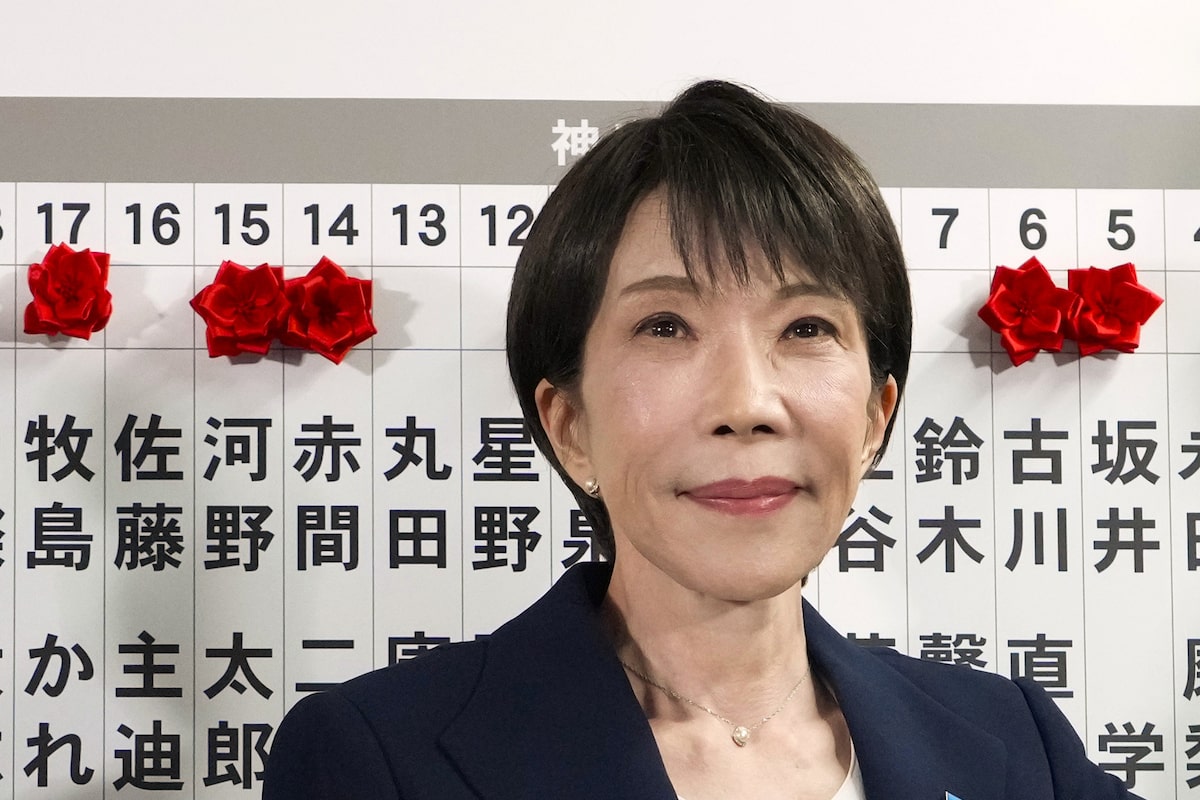
Sanae Takaichi, Japan’s prime minister and president of the ruling Liberal Democratic Party, marks the names of candidates who won elections at party headquarters in Tokyo on Sunday.Keisuke Hosojima/The Associated Press
The Liberal Democratic Party, which dominated Japanese politics for much of the last century but in recent years struggled to reverse a seemingly-terminal decline in support, was on track to win a landslide victory in elections Sunday, exit polls show.
The LDP’s fortunes have been buoyed by the popularity of Sanae Takaichi, who became LDP leader and subsequently Japan’s first female prime minister last year. She assumed control at a time when the once staid Japanese political spectrum was fracturing, and the LDP was bleeding votes to both its left and right after a series of scandals.
With the LDP lacking a majority in either house of the Diet, the conservative Ms. Takaichi seemed fated to be another short-lived premier – Japan has cycled through four since 2020 – and even struggled at one point to get enough votes from lawmakers to be confirmed.
But since assuming the top job, Ms. Takaichi has seen her personal approval ratings skyrocket, as voters responded to her brash charisma and story as a middle class striver who spent decades working her way up through a highly patriarchal organization to break the country’s final glass ceiling.
“Every generation of Japanese woman looks at her and knows the struggles she experienced to get to where she is,” said Tobias Harris, founder of consultancy Japan Foresight. “The fact she’s not a hereditary politician, that she comes from a middle class background, makes her all the more endearing.”
Japanese Prime Minister Sanae Takaichi’s coalition swept to a landslide election win on Sunday, paving the way for her tax cuts that have spooked financial markets and increased military spending aimed at countering China.
Reuters
The LDP should easily secure a majority on its own, and, with its coalition partner the Japan Innovation Party, could control more than 310 seats in the lower house of the Diet, giving the ruling parties a two-thirds majority, according to projections from public broadcaster NHK.
While Ms. Takaichi’s popularity was a massive boon to the LDP, Sunday’s results once again raise questions about the fractured opposition’s inability to effectively challenge the party that has governed Japan almost continuously since the end of the Second World War.
The past six months have seen two major missed opportunities on that front.
After Ms. Takaichi was elected LDP leader, the party’s longtime coalition ally, Komeito, said it could not support her as prime minister, arguing she was too conservative. This left Ms. Takaichi without the votes to be confirmed as premier, and for a brief moment, it seemed the opposition would coalesce around an alternative candidate.
But Ms. Takaichi proved more politically deft than even many of her supporters gave her credit, and after several days of tense backroom negotiations among all parties in the Diet, the centre-right Japan Innovation Party agreed to back the LDP.
With her approval ratings boosted by a strong showing at several consecutive (and fortuitously timed) foreign summits, Ms. Takaichi gambled on calling a snap election last month.
Once again, the opposition attempted to form a united front, announcing a new alliance including Komeito and the Constitutional Democratic Party, an inheritor of the one non-LDP party to form a government in Japan, from 2009 to 2012.
But the Centrist Reform Alliance did not manage to win over enough other parties, leaving it competing in most seats with both the LDP and other candidates on both the right and left. Exit polls suggested the opposition coalition would lose dozens of seats across the country.
Ken Jimbo, a politics professor at Tokyo’s Keio University, said there are many structural issues facing the opposition, which he said has long failed “to consolidate a unified ideological stance against the LDP.”
“There are a lot of small parties that don’t agree,” he said. “And they have often struggled to co-ordinate during elections.”
Most observers expect the LDP will become far more conservative as a result of Sunday’s vote.
As well as sloughing off Komeito, long seen – for better or worse depending on a person’s political stance – as a moderating influence, Ms. Takaichi’s ascendancy has marginalized many centrists within the party.
“This is a decided shift in the balance of power within the party,” said Mr. Harris.
Voter cast their ballots in Tokyo on Feb. 8.Kim Kyung-Hoon/Reuters
While it is unclear how long Ms. Takaichi’s honeymoon with voters will last, her influence will likely shape the party for the foreseeable future, he added.
“She will have a reliable foundation on the back benches, and they will have a lot of influence the next time a leadership election comes round. It’s going to be a more conservative party which is going to favour more conservative candidates.”
In the short term, a strong majority in the Diet will empower Ms. Takaichi to pursue priorities she outlined in the campaign, including cutting sales tax, and increasing defence spending and boosting investment in high-tech.
Her willingness to do so by borrowing has spooked the bond markets, as have comments by some of her advisers which seemed to dismiss concerns about further weakening the yen, which has fallen dramatically in recent years.
Ms. Takaichi will also have to deal with an increasingly uncertain geopolitical environment, including a deeply hostile China – which has limited trade and tourism with Japan after comments by Ms. Takaichi about the self-ruled island of Taiwan – and U.S. President Donald Trump.
Ahead of Sunday’s vote, Mr. Trump offered a hearty endorsement of Ms. Takaichi, and was a close friend of her mentor, the late prime minister Shinzo Abe. But as Canada, Britain and South Korea have learned in recent months, the U.S. president’s favour is easy to lose and hard to get back, and the costs of ending up on his wrong side can be great.