
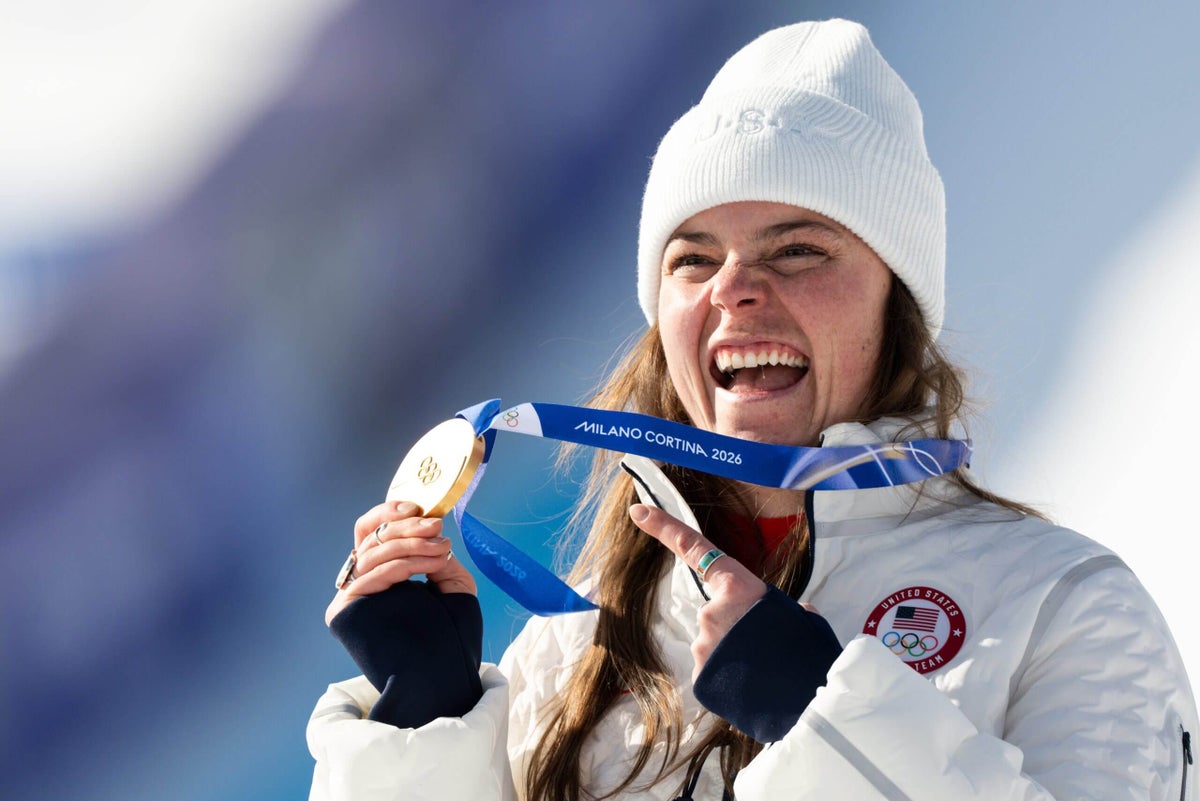
CORTINA D’AMPEZZO, Italy — Breezy Johnson became the first American in 16 years to win the Olympic downhill gold, on a day that will also be remembered for Lindsey Vonn’s crash that ended her hopes of returning to the event’s podium, conquering the famed Olympia delle Tofane slope here on Sunday.
Johnson won in 1 minute, 36.10 seconds, holding off Germany’s Emma Aicher, who was 0.04 seconds back for silver. Italian star Sofia Goggia, who lit the Olympic cauldron in Cortina on Friday, won bronze, 0.59 seconds back.
It also marked the Americans’ first medal of these Games, in any sport.
The 30-year-old Johnson has now won the two biggest downhill races of the past year after topping the podium at the 2025 world championships in Saalbach, Austria. Johnson and Mikaela Shiffrin also teamed up to win the gold in combined at those worlds, with Johnson’s stellar downhill run that day leading the way.
That last American Olympic downhill gold medalist was Vonn, who crashed Sunday, only 13 seconds into her attempt to reclaim her former glory on the ruptured anterior cruciate ligament (ACL) she injured nine days ago in Switzerland. Vonn also won bronze in the downhill at the 2018 Games and in the super-G in 2010.
Breezy Johnson skis to a 1:36.10 finish in the women’s downhill final at the #WinterOlympics! 👏
📺: Peacock & USA pic.twitter.com/XPAceWOSru
— NBC Olympics & Paralympics (@NBCOlympics) February 8, 2026
“Lindsey has accomplished so much and will live in a different echelon than I do,” Johnson said in the press conference after the win, “but I think that to have your name alongside her is really something special.”
Vonn and nearly everyone else in the race were chasing Johnson, who started sixth and put down a run more than a second faster than any of the five previous skiers. Johnson had one slip at the top of the hill and then took off, building her lead in nearly every section of the course. She flew off the jumps, sticking her forehead out toward her tips, got her skis back on the ground in a hurry, and got back to work.
Johnson is one of the sport’s best gliders, and the Olympia delle Tofane’s lower sections are a glider’s dream.
Johnson barely looked at the scoreboard when she finished. She knew she had skied the run of her life, or really the second run of her life after last year’s world championships performance.
“I was telling my mom, you go to your first Olympic Games to have been to the Olympic Games,” Johnson said. “You go to your second Olympic Games to win a medal. And you go to your third Games to win the whole damn thing.”
As Johnson slid into a hockey stop Sunday, she pumped her poles in the air, a big grin spreading across her face.
Johnson, an Idaho native who learned to ski in Jackson Hole, Wyo., skied in her second Olympic Games (she also qualified for a third, in 2022, but was injured). She grew up worshiping Picabo Street, another Idaho native and a gold medalist in super-G at the 1998 Olympics and silver medalist in downhill in 1994. Street has been a mentor to Johnson and a model for combining the big-mountain, back-country free-skiing celebrated in the American West with the discipline and commitment that ski racing requires.
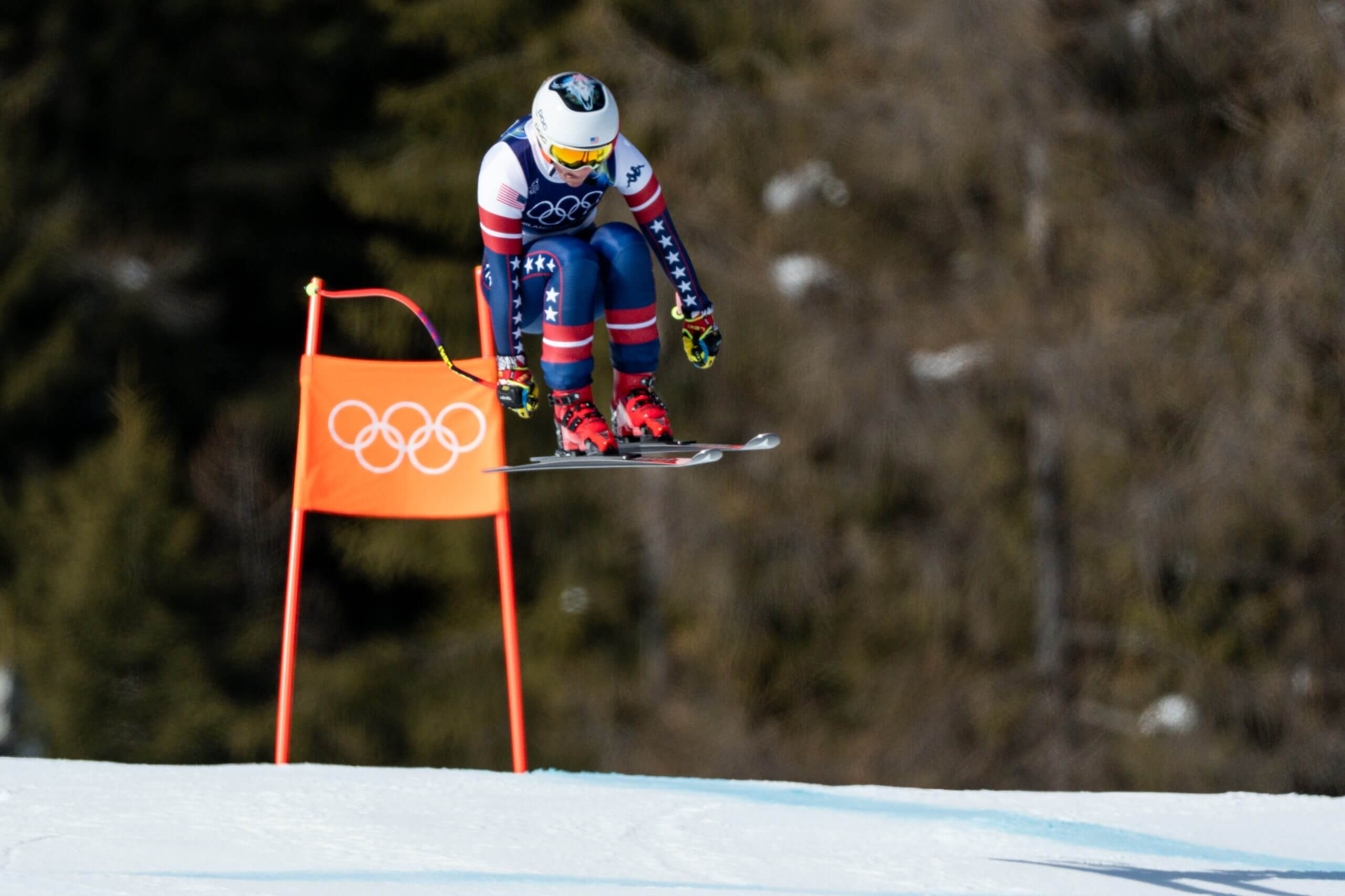
Johnson sails over a jump during Sunday’s gold-medal run. She became the first American since Lindsey Vonn to win Olympic gold in the downhill. (Foto Olimpik / NurPhoto via Getty Images)
Johnson had been in top form ahead of the Beijing Olympics in 2022, skiing as fast as she ever had, but crashed and tore her ACL a month before those Winter Games. Like Vonn and a handful of other skiers have done before, Johnson tried to ski through the injury, but decided to end her season, undergo surgery and defer her Olympic dreams for another four years.
Johnson returned in early 2023 and finished out that season. She was then suspended 14 months, from October 2023 to December 2024, due to whereabouts failures under the sport’s anti-doping regulations.
Aicher, 22, won her second Olympic medal after she earned silver in the team event in 2022. For Goggia, the bronze completed the full set of Olympic downhill medals — she took gold in 2018, silver in 2022. American Jacqueline Wiles had an excellent run too, finishing fourth. But it was Johnson’s day.
“That’s the best I’ve ever seen Breezy ski,” her teammate, Bella Wright, said in the finish area after the race. She and the rest of the team had stayed tight with Johnson through her suspension.
“Everything happens for a reason,” Wright said. “She’s the Olympic downhill gold medalist.”
Johnson’s dad first taught her how to ski on the driveway at their home in southern Idaho, which had a pretty decent pitch. She learned how to race at Snow King Mountain resort, a small mountain by Western standards. It had a solid racing program, though, and it was just what a young Breezy wanted, regardless of how cold it might be on those weeknight training sessions in the frigid darkness of Wyoming.
“I always had the racing bug,” Johnson said in an interview last December.
To Johnson, skiing was always a serious endeavor. Her coaches tried to encourage her to have more fun. For Johnson, there was fun in the seriousness. She said everything changed for her when she met Shiffrin and her mother, Eileen. In Shiffrin, she found a comrade who took the sport just as seriously as she did. Eileen Shiffrin reassured Breezy that there was nothing wrong with putting everything you had into your favorite pursuit and caring about the results.
At the time, Johnson was working through stiffness in her back that had slowed a promising season. As she spoke, she was in near constant motion, stretching on the bed in her hotel.
She was hoping she might find a way to get healthy over the next few weeks and get her confidence back ahead of the Olympics. She and everyone else who has known her have long believed that with a good run of health, anything was possible for her.
As January wore on, Johnson rounded into form. The numbers next to her finishing times grew smaller and smaller. She finished seventh in Zauchensee, Austria, fifth (and third in a super-G) in Crans-Montana, Switzerland, and first in Saturday’s training run.
“This is the healthiest I’ve ever been,” Johnson declared after that run.
Sunday morning dawned bright and crisp and blue, and she backed up her words. As she crossed the line, she felt like she had had a solid run.
“There were definitely some places that weren’t the best, but I hoped that it would be enough,” she said. “I knew it was fast in some of the places where I made mistakes.”
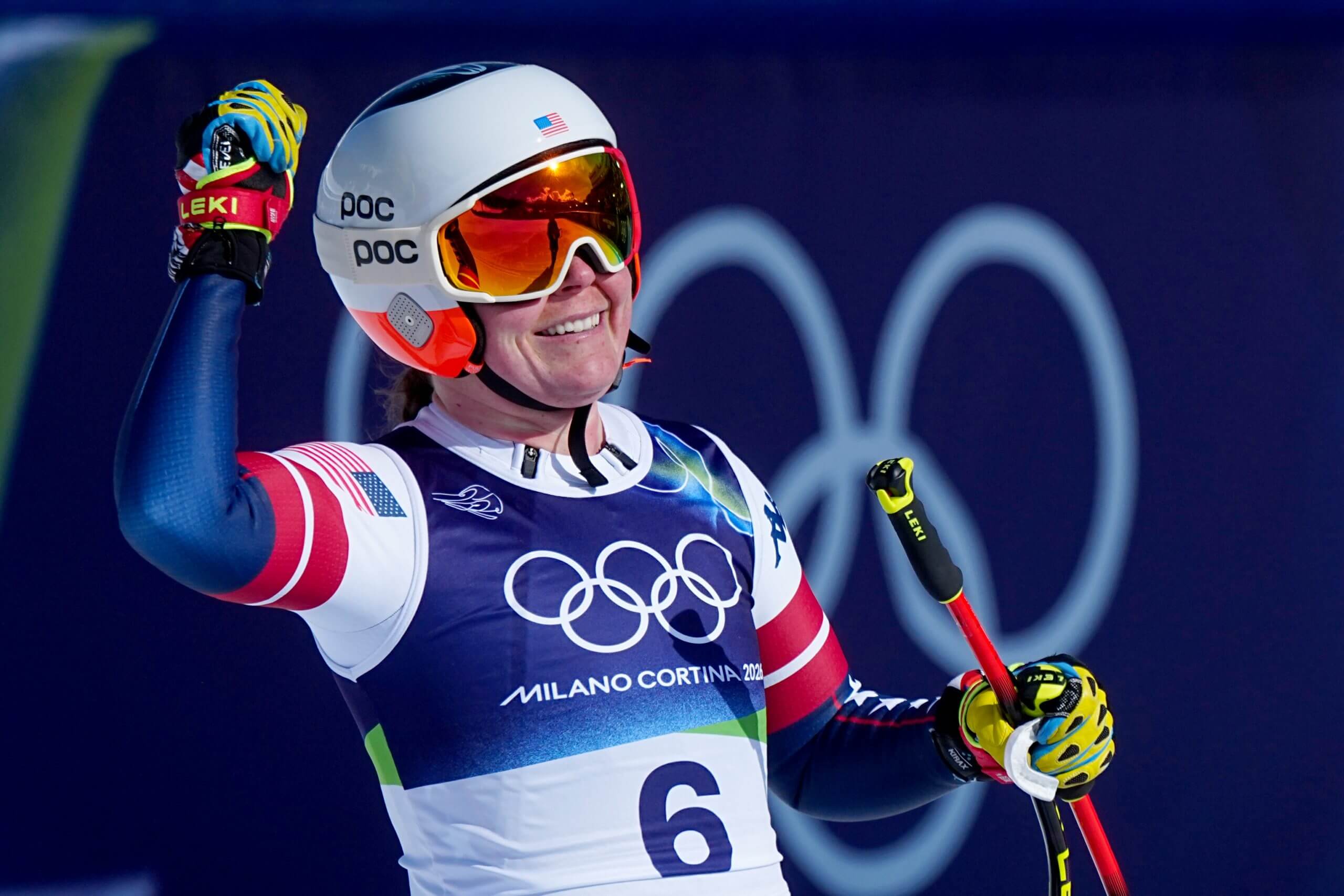
Johnson celebrates after finishing her run. “To have your name alongside (Lindsey Vonn) is really something special,” she said of her U.S. teammate, who won downhill gold in 2010. (Michael Kappeler / picture alliance via Getty Images)
Johnson said she was pretty sure her run was going to be good enough for a medal, but the color still had to be determined. Germany’s Aicher, skiing 10th, came after her with everything she had. Through the top part of the course, Aicher was more than a half-second ahead of Johnson’s pace. But then she started to come back, unable to match Johnson’s ability to glide through the bottom half of the course.
By the third interval, Aicher had slipped to 0.15 seconds ahead of Johnson’s pace. Then her lead fell away. She crossed the finish line .04 behind Johnson, who let out a deep breath of relief.
Still, there were more than 20 skiers at the top of the mountain, including Vonn, who came out hot, but was soon tumbling violently across the snow and ice.
“I don’t claim to know what she’s going through, but I do know what it is to be here, to be fighting for the Olympics, and to have this course burn you,” Johnson said of Vonn.
“I can’t imagine the pain that she’s going through, and it’s not the physical pain. We can deal with physical pain, but the emotional pain is something else.”
After roughly a half-hour, Vonn was in a helicopter, and the race was back on. The wait proved worth it for Johnson. A little after 2 p.m. in Italy, she was jumping for joy on top of the podium. Johnson jumped so hard that her medal fell off its strap.
When she stepped off, she donned the lucky, blue wool headband she knitted Sunday night, which has become a ritual for her.
She is set to race again Tuesday in the combined event, likely with Shiffrin, a full-circle moment if there ever was one.
Before that, she will get back to her knitting, because she knows how the magic of her bespoke headbands wears off quickly.
“I know that even if I did well in one of them, if I bring it back, it’s not lucky anymore.”