
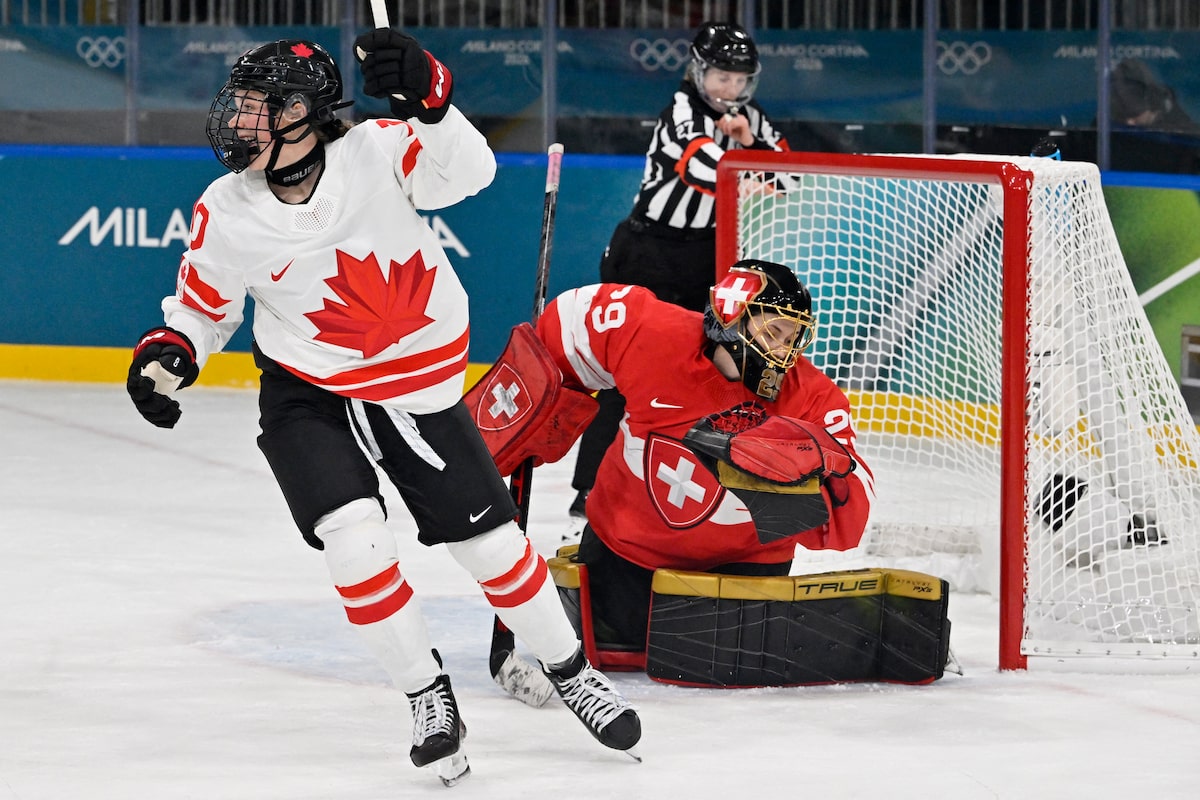
Canada’s Sarah Nurse celebrates a goal against Switzerland’s Saskia Maurer at the Milano Cortina Winter Olympic Games on Saturday.ALEXANDER NEMENOV/AFP/Getty Images
Back in 2018, just before COVID turned everyone into epidemiologists, was when they first tried turning a women’s hockey tournament into a hot zone.
This was the Four Nations Cup in Saskatoon. Flu ripped through the Finnish and Canadian teams. Multiple players were out for every game, and others were throwing up during breaks.
The Finns struggled mightily and called it a win. The Canadians finished second and called it a disaster.
This isn’t Saskatoon and nobody’s staying at the HoJo. The idea that a tournament of this importance would be allowed to implode because someone drank from the wrong water bottle was always a bit fanciful. Instead, this passing tempest may turn out to be the distraction that obscured a bigger problem.
Until Saturday evening, the issue was norovirus. Who had it? Who might get it? Who was doing what to prevent it? The teams’ doctors were doing more press than the players. The players were letting the medics do all the worrying as well.
“I’ve only heard about it from you,” said Canadian goalie Ann-Renée Desbiens early on Saturday, meaning the virus and the media, respectively.
Canadian women’s team shakes off rust to beat Swiss in Olympic opener
Team Canada tries to flip norovirus upheaval into a positive
This brand of Canadian presentation never changes. Same ol’, same ol’; excited to get out there and make memories; ready for anything. It’s not that they’re cocky. It’s that they truly believe they can’t lose. Why would they? They never have.
Nobody ever says, “It’ll be great to warm up for a few days before the final,” but that is implied. We take for granted that this team won’t just be good at this stage of a big event, but that it will be embarrassingly good. Often, so good that it has the unintended effect of putting the sport into disrepute.
Just as the tournament’s hot topic was running cold, that’s when the real issue materialized.
The U.S. hammered Finland 5-0 in Saturday’s late-afternoon slot. You knew it was over after you’d watched both starting line-ups skate the length of the ice once. The U.S. is both bigger and faster than everyone else. It’s the most powerful combo in contact sport.
The only unknown in that game was whether they’d show U.S. Vice-President JD Vance, who was in attendance with his family, on the scoreboard, and whether the crowd would boo him. They didn’t, and so he wasn’t.
Canada played another, more mildly infected team, Switzerland, in the late game. Something funny happened in that one. It was an actual competition.
Canada didn’t score until nearly halfway through the second period. The Swiss couldn’t get a shot on the Canadian net for love nor money, because they were all hanging back to eliminate odd-man breaks. Canada was reduced to plinking away from distance, getting nowhere.
As the game ground on – and that was the right way to describe it – the Canadians weren’t exactly frustrated. They were never in danger of losing. They seemed more confused. As in, why isn’t this thing that has always worked for us working? Should we turn it on and off, or jiggle the plug?
The game ended 4-0. That’s not even close to close by normal hockey standards, but it was tight by Canada standards. If the Swiss hadn’t taken so many bone-headed penalties, there was a possible world in which this game ended scoreless.
The last time Canada faced Switzerland at an Olympics, they beat them 12-1. It was 8-0 after two periods. So either someone’s getting better, someone’s getting worse or it’s both at the same time.
Maybe the long-threatened rise of parity in the women’s game is going to start here, just as every Canadian stops caring how we win, as long as we do.
Canada celebrates their win over Switzerland at the Milan Cortina Winter Olympics on Saturday.DARRYL DYCK/The Canadian Press
The other problem is perspective. When Canada doesn’t annihilate their non-U.S. opposition, people begin wondering about a great fall. People were already thinking about it before this one started. Canada lost to the U.S. in last year’s world championship. They got absolutely run over by them in Rivalry Series two months ago.
Obviously, hockey is different when it’s the Olympics. That’s when Canada’s qualities of northern resilience and historic underdogging come to the fore, eliminating all minor quibbles about goaltending.
That has become a national article of faith, in large part due to the dependability of the women’s team.
But all that is solid melts into air. Marx said that, meaning that all traditions collapse. There is no greater modern Canadian sporting tradition than this team as gold-medal favourites in a Games. We have never considered that the other way around, or even a toss-up. It may be time to start.
“It’s the Olympics,” defender Renata Fast said afterward. “Obviously, to come out and start, you’re going to be gripping your stick a little hard.”
I’m not sure that was ever obvious before.
Perspectives can change quickly. The Canadians play the Czechs on Monday. If Canada scores a first-period touchdown in that one, then everything’s fine.
But if they don’t, a lot of people are going to start to worry, and worry is a contagion you can’t isolate your way out of.