

Follow Winter Olympic SportsPersonalize Your Feed
addShort Track Speed Skating
Chris Jones reports from Milan.
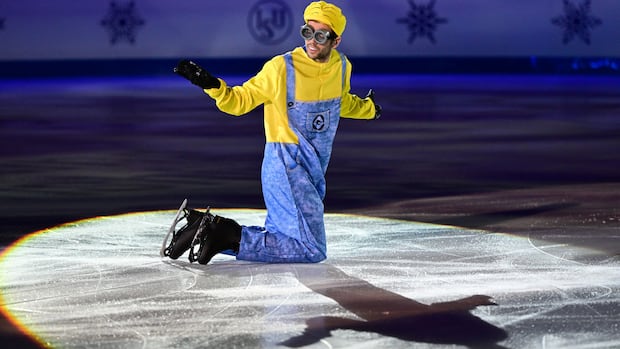
The Minions will have their moment in Milan after all.
The figure skating world has been embroiled in an unusual kind of controversy: Copyright law has suddenly become part of an increasingly complicated artistic equation.
The plight of Tomas-Llorenc Guarino Sabate, a Spanish skater who has performed a popular Minions-themed program to a medley of four “Despicable Me” songs all season, gained widespread attention last week when he went public with his fears that he wouldn’t receive permission to use the music at the Winter Olympics in time.
Perhaps because of mounting pressure from skating and Minions fans around the world, Sabate received his final clearance, for a cut from the Pharrell Williams song “Freedom,” on Friday.
On Saturday, he went through his rescued routine at a practice facility near the Milano Ice Skating Arena. He wasn’t wearing his signature yellow shirt and blue overalls, but as soon as the unmistakable laughter of Minions rang out, Sabate began tearing around the ice, as though set free by his relief.
WATCH | Minions routine:
“It all worked out like we wanted,” he said after. “I’m happy about it. My coach is happy. I guess all the public that fought for it is happy. At the end, everybody’s happy.”
Everybody’s still a little nervous, too.
In October 2014, to modernize the sport and appeal to younger audiences, figure skating authorities began allowing singles and pairs skaters — previously limited to instrumental music that was often ancient and in the public domain — to use songs with lyrics for the first time.
That decision led to a revolution in on-ice performance but also an unintended off-ice consequence: Musicians began objecting to the royalty-free use of their own art, especially when it was widely broadcast during the Olympics.
In February 2022, Heavy Young Heathens sued U.S. skaters Alexa Knierim and Brandon Frazier after the pair performed in Beijing to the band’s cover of “House of the Rising Sun.” The lawsuit included U.S. Figure Skating and NBC and was settled for an undisclosed amount, rumoured to have been $1.4 million US.
That struck understandable fear in network executives and skaters, who overnight needed to become experts in the murky matter of licensing song rights.
It also enraged the sport’s passionate fans, who couldn’t understand how a band that had covered a folk song that had been previously covered by Woody Guthrie, Pete Seeger, Andy Griffith, Joan Baez, Nina Simone, Bob Dylan, Dolly Parton, Five Finger Death Punch, and, most famously, The Animals, could sue for copyright infringement.
Canadian husband-wife team
ClicknClear, a service designed to streamline the process, has proved helpful but far from infallible. A single song might require several permissions — for broadcast, choreography, and editing — from multiple composers, lyricists, and performers. (Hence the claim from Heavy Young Heathens.)
Marie-Jade Lauriault and Romain Le Gac, a Canadian husband-and-wife ice dance team, have had to make a last-minute change to their rhythm dance routine after they couldn’t secure the multilayered rights to Prince’s “Thunder” in time for the Olympics.
WATCH | Lauriault, Le Gac skate to Prince’s ‘Thunder’:
On Saturday, they practised their altered program to a cleared song: “Sex Bomb” by Tom Jones.
If Sabate looked relieved by the end of his saga, Lauriault and Le Gac seemed supercharged by theirs. They watched recordings of their earlier performances while playing several artists behind them — Queen, Britney Spears — before they fired up Tom Jones and looked at each other and nodded.
“Prince has grit and confidence, and that brought us here,” Lauriault said.
“We needed to qualify,” Le Gac said. “Since we are qualified, we’re happy to change. It’s an opportunity to bring a new energy to the program. Tom Jones and Prince —”
“— are not the same vibe!” Lauriault said, finishing her husband’s sentence. “Prince is attacking. This is more of a celebration. It’s a change we needed to make.”
“It’s fitting perfectly,” Le Gac said. He was beaming.
The current chaos has resulted in another unexpected positive, the way discomfort sometimes does: More people will be watching figure skating than otherwise might, with a rooting interest in skaters who now seem like underdogs in more ways than one.
“Everybody wants to perform and wants to be seen,” said Sabate, who finished 20th at last year’s world championships and calls himself “a small skater from a small federation.”
Now he’ll skate for his largest and most invested audience, which on Saturday included Japan’s Kao Miura, who stopped his own practice to watch Sabate’s routine.
“Spain skater is a very fun program,” Miura said in English after.
Sabate smiled at the recognition. “In a sport like this, you want everybody to enjoy it the most possible, and you want to perform the best that you can,” he said. “It all goes together” — like music and lyrics, like song and dance.