
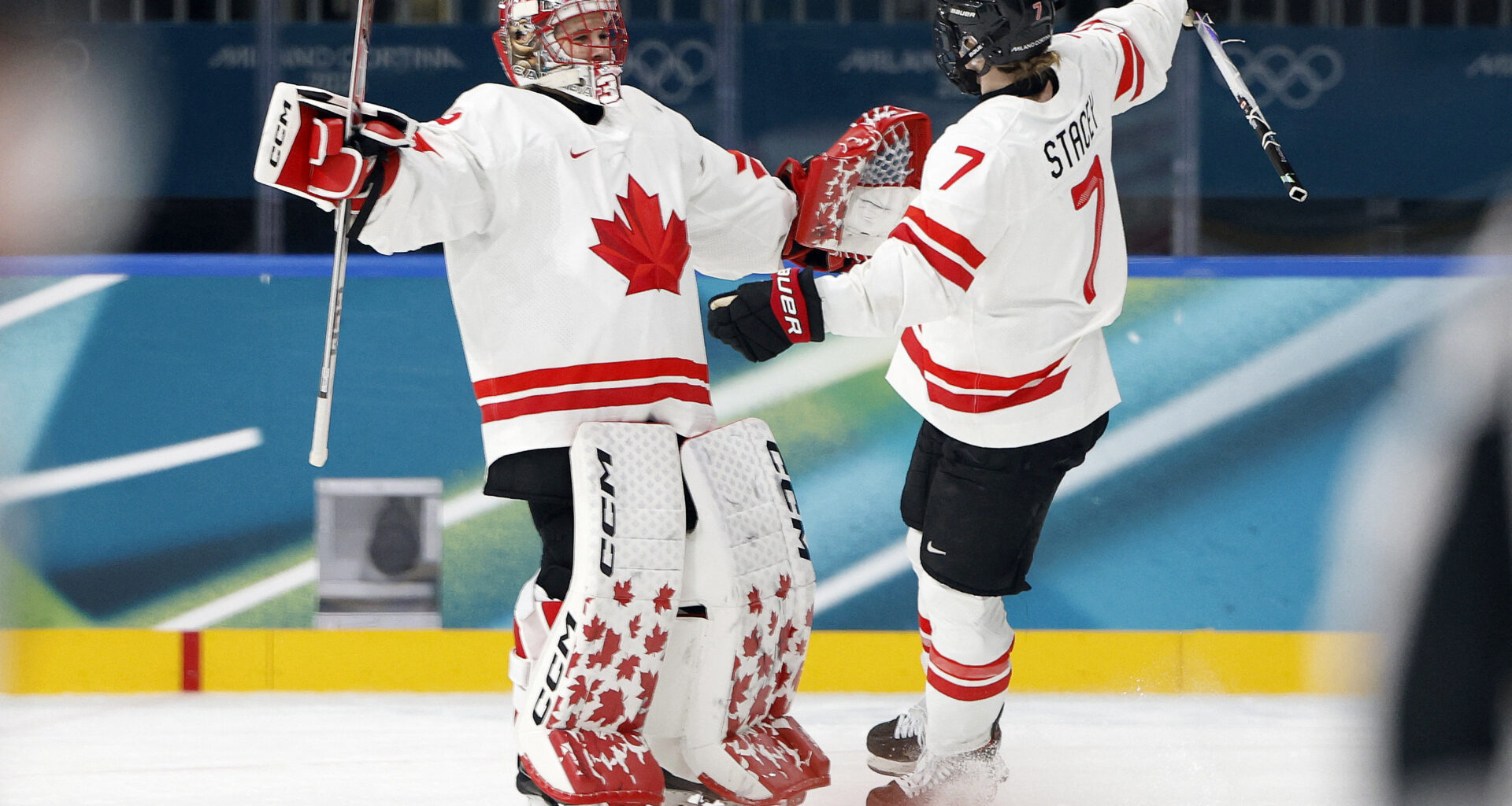
On the third day of women’s hockey action and the first official day of the 2026 Winter Olympics, the two final teams played their first game and we got some clarity in the standings.
Germany 5, Japan 2 (Group B)
In what was a must-win for Germany to keep their quarterfinal hopes alive, they came out strong against Japan. The Germans opened up a 5-0 lead midway through the second period led by four points from Boston Fleet forward Laura Kluge and two goals and an assist from Nicola Hadraschek (née Eisenschmid, and yes her brother was in the Canadiens organization for a bit).
Japan scored two quick goals late in the second period to make it a 5-2 game and opened the third period with a power play, but that was as close as they came.
Victoire goaltender Sandra Abstreiter made 20 saves in the win, her first career Olympic victory. Germany is now tied with Japan and Italy in a battle for the final two playoff berths from Group B.
Sweden 6, Italy 1 (Group B)
In the final tournament with an un-even group format (more on that later), this game was proof that sixth-ranked Sweden is a class above the other teams in their group. This was the hardest game that Italy has had to play as a group in a long time, and Sweden’s pace overwhelmed the Italians as the game wore on.
It was only 1-0 after 20 minutes, and then the teams traded quick goals in the second period. Italy made the score 3-1 less than two minutes after Sweden’s third goal, but Hanna Olsson scored 1:19 after that goal to restore the three-goal lead. They added two more goals in the third period.
Ebba Svensson Traff once again got the start for Sweden ahead of Emma Söderberg, perhaps solidifying herself as the goaltender of choice early on. Montreal’s Lina Ljungblom had an assist in 12:33 of action.
United States 5, Finland 0 (Group A)
After their game on Thursday with Canada was postponed because of a norovirus outbreak in the team, Finland made their 2026 Olympic debut against the United States. They dressed a full lineup, and all players dressed played, but it is fair to assume they weren’t all at full fitness. Having said that, if that wasn’t their best effort, it was a pretty respectable outcome.
The US had a 49-11 shot advantage and were led offensively by Megan Keller’s goal and two assists. Hilary Knight scored to move into a tie for the most Olympic goals by an American woman, a record she will attempt to own by herself in her final Games appearance.
Aerin Frankel got the shutout in her second straight start. Montreal’s Hayley Scamurra was +1 in 10:40 of action.
Canada 4, Switzerland 0 (Group A)
It hasn’t been an ideal start for Canada at these Olympics. Their first game was postponed at no fault of their own, and despite heavily outshooting Switzerland, entered the first intermission in a 0-0 game.
They did eventually get pucks past Saskia Maurer, who made 51 saves in the losing effort. Natalie Spooner opened the scoring with a power play goal in the second period, and Canada added power play goals from Sarah Fillier and Julia Gosling in the third before Daryl Watts added an even strength goal.
“There’s a lot of emotion going on out there and a handful of people are playing in their first Olympics. We had the delay of Game 1; it looked a bit antsy and we looked a bit panicked,” said Canada head coach Troy Ryan. “A lot of times we had point-blank shots, but we were taking that instead of looking off the weak side and seeing if we could upgrade the shot. I think it’s somewhat expected in the first game of the Olympics, but obviously if that continues to happen it’s probably going to be a little bit more nerve-wracking.”
Emerance Maschmeyer became the fourth Canadian woman with two shutouts at the Olympic Games, making six saves, in only her third Olympic start. Marie-Philip Poulin and Erin Ambrose both had assists for Canada. Claire Thompson had two assists, while Watts and Fillier had helpers to go with their goals.
“I think for us, we just have to keep going,” said Poulin. “We have been waiting for this game—it’s been a long 48 hours and we were pretty excited to get on the ice today. We are happy where we’re at, but we still want to improve.”
Kati Tabin played 9:53 in her senior tournament debut for Canada with two shots on goal.
Up Next
As mentioned above, this is the last tournament that has the Groups sorted by the top five teams and the bottom five teams. This means that all five teams in Group A will make the quarterfinals, with the top three from Group B making it. The seeding has A1 facing B3, and A2 facing B2 which basically means that, in all likelihood Canada and the US will be facing either Japan, Germany, or Italy. That means the team that finishes third in Group A will all-but-certainly face Sweden (the Group B winner) while the fourth and fifth place teams in Group A will play a rematch in the quarterfinal.
This ultimately means very low stakes for Group A in round robin play. They can essentially use the preliminary round simply as preparation for the playoffs as there is no real difference, or even advantage, to facing Sweden over Czechia, Switzerland, or Finland.
The good news is that starting with the next World Championships in 2026, the format will be a snake-ranking format similar to what we see with the World Juniors on the men’s side and by 2030, it is all but a certainty that format will make its way to the Olympics as well. While Canada and the United States are still the top of women’s hockey, the middle pack of European countries have become too competitive to warrant a separation and it is wholly unfair to the team that happens to be ranked sixth at any point – and that is even before Russia returns to the world stage.
All that to say, the games on Sunday have pretty simple stakes. Sweden will play France in a game that France needs to win to stay in contention. A Sweden win will guarantee them top spot in Group B.
The other game is Czechia and Finland. Czechia will look to rebound after a tough loss to Switzerland on Friday.