
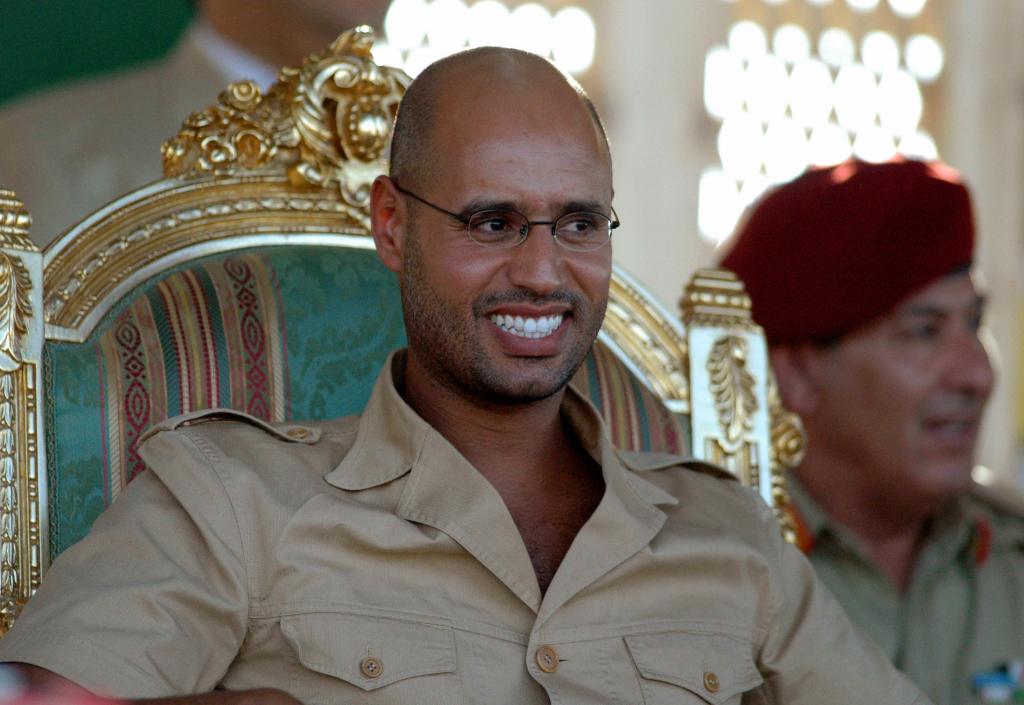
Last Tuesday, there was a death in Libya—a murder, an assassination. The victim was Saif al-Islam Gaddafi, a son of Muammar, who ruled Libya from 1969 until his own death—his murder, his assassination—in 2011. Some dictators die in bed, some do not. The same applies to their children, especially their sons.
Saif was an unusually interesting dictator’s son. He tried to go straight, so to speak: to be a Western-style liberal or at least an Arab reformer. In 2008, he actually left Libya, saying he was fed up with the lack of change in his native country—his father’s realm. He stayed away for three years.
But he returned when his father faced a revolt, and did all he could to defend his father’s regime—the family business, if you will. Subsequently, he was wanted for crimes against humanity by the International Criminal Court.
His father was killed on October 20, 2011. About a month later, Saif tried to escape to Niger, disguised as a Bedouin. He was caught, however, by a rival faction: the Zintan Brigades. They held him captive for six years. Four years after that, in 2021, Saif announced that he would run for president of Libya.
It is not even clear that such a position exists in that segmented country. In any case, Saif never rose to bossdom. And on February 3 he was shot to death in his home by four masked gunmen. He was 53.
I learned quite a bit about Saif when researching my 2015 book Children of Monsters: An Inquiry into the Sons and Daughters of Dictators. I also encountered him personally, in 2005.
That was at the annual meeting of the World Economic Forum in Davos, Switzerland. A group of us sat with him at a “media coffee,” listening to him talk about a range of issues, especially his pet theme of many years, democracy.
At one point, he had a question for us: “Do you know why we Arabs have lost all our wars against Israel?” (I am paraphrasing him.) We were all ears. “Because Israel is democratic, and we are undemocratic,” he continued.
So, “in one of our states, the worst general becomes army chief of staff, because he is no threat to carry out a coup d’état. Loyalty to the strongman is all that matters. Democracy, on the other hand, is a competitive mechanism—and that’s why Israel wins.”
In our group was an Israeli journalist. With a mixture of humor and nervousness, he said, “Please don’t ever have a democracy.”
At the end of our “coffee,” someone asked Saif about the Holocaust and the widespread Arab denial of the same. Answering, Saif started out hesitantly. “I am not a historian. I don’t know all the facts.” Uh-oh.
He then tried a familiar line: Arabs cannot be antisemitic because Arabs are Semites themselves, you see, and Jews and Arabs are cousins.
No dummy, Saif could sense that his answer was not working in this room. So he said the following: “It is incorrect to deny the Holocaust.” And why was that? Because it was the Red Army that liberated Auschwitz. “We learned about it from the Russians, not from the Zionists, not from the New York Times. So, if Arabs deny this, it is incorrect.”
The World Economic Forum official who was overseeing the session said, “On that conciliatory note, we must adjourn.” I suppose you take your conciliatory notes where, and how, you find them.
Saif al-Islam Gaddafi was the second son of Muammar, who had seven sons altogether, and one daughter. In general, the sons were a brutish, gruesome bunch: wife-beaters, swaggerers, thugs. They operated with the impunity typical of dictators’ sons.
Saif was different: refined, thoughtful, civilized (until he wasn’t). He had lots of education. He took a bachelor’s degree in engineering in Tripoli, an MBA in Vienna, and a doctorate at the London School of Economics. His Ph.D. came from the school’s department of philosophy.
This last degree was not without controversy. Had Gaddafi’s son really written his dissertation? (“The Role of Civil Society in the Democratisation of Global Governance Institutions: From ‘Soft Power’ to Collective Decision-Making.”) In any event, Saif made a donation to the LSE of 1.5 million pounds.
He was a man of parts. In addition to engineering, business, and philosophy, he took an interest in architecture and painting. In London, there was an exhibition of his art: The Desert Is Not Silent. Lots of people chortled over this. And Saif had a relatively disarming response: “We have to be realistic: I am the leader’s son, and that gives me an advantage. But you also have to give people evidence of your talent.”
There are not many children of dictators—trust me—who admit to having advantages.
Saif hobnobbed with the great and the good, in such locales as Saint-Tropez and Corfu. Among his companions were at least two princes: Andrew of Britain (now an ex-prince) and Albert of Monaco (now reigning in his principality).
Also, Saif surrounded himself with gurus and retainers, including three eminent political scientists from America: Benjamin Barber, Robert Putnam, and Joseph Nye. The West was taken with this different kind of Gaddafi, understandably. The New York Times called him “the un-Qaddafi.” Newsweek published an article titled “Our Man in Libya?” Esquire listed him as one of “The 75 Most Influential People of the 21st Century.”
Saif talked a very good game about democracy, and he evinced sincerity. At a dinner one night, a congressional aide asked him, “What does Libya most need?” Saif said, “Democracy.” The aide said, “You mean more democracy?” Saif said, “No! ‘More democracy’ would imply that we had some.”
Often, he was asked whether he would succeed his father. Saif chafed at the very suggestion. On one occasion, he answered, “To me, dynastic rule is like going backwards in history, something from the period of the monarchy, when really we need to advance.” One of his standard lines was: “Libya is not a farm to inherit.”
Yet did he? Want to inherit it? Some of his brothers did. One was Mutassim, whom the dictator named “national security adviser.” In this capacity, Mutassim met with two consecutive U.S. secretaries of state: Condoleezza Rice and Hillary Clinton.
When the critical hour came—when the Gaddafi regime was under siege—none of the sons was more staunch in defense of his father than Saif al-Islam. He even changed his appearance. Allow me to quote from my book (Children of Monsters):
No longer was he the smooth-skinned Renaissance man who held art exhibitions in London and clinked glasses with the prince of Monaco. He grew a beard, in the style of fundamentalist Muslims. He gave wild-eyed rants on television. He vowed, “We will fight until the last man, until the last woman, until the last bullet.”
Saif functioned essentially as prime minister to his father. About violence, he had no compunction. The ICC would charge him with “murder” and “persecution.”
You know what the LSE did? They renounced his donation. Bitter, Saif said, “Now that rebels are threatening our country, these cowards are turning on us.” He also said, “I am proud of my work at the LSE, and of being an alumni.” (They had not taught him to say “alumnus.”) “This is the reason I became a benefactor. The way these people are now disowning me is disgusting.”
Saif had a point. Westerners had been pleased to be in his company and take his, or the dictatorship’s, money.
Three of the brothers died in that 2011 conflict—what would become known as the “First Libyan Civil War” or the “Libyan Revolution.” Mutassim was killed along with his father. Their corpses were displayed in the city of Misrata, laid out in a commercial freezer. For four days, Libyans filed by.
About 14 years later, Saif, a survivor of sorts, was gunned down in his home.
“I should be careful about playing psychologist in this book—but perhaps I could put Saif on the couch for just a moment.” I have again quoted from Children of Monsters, and will keep going:
It seems clear that he wanted to be something that, in the end, circumstances would not allow him to be. Or, to be slightly stricter about it: He could not find it within himself to surmount those circumstances, to be what he wished to be.
I believe that he had genuine Western leanings—that he was serious about liberalization and modernization. I don’t believe it was all an act. I think he knew dictatorship was wrong. I think he was embarrassed about it, for some years (while enjoying the wealth the regime generated for him). But when the crunch came, he could not cut his ties to his family and to his father in particular, and became just another despot, or despot’s helper.
In the midst of that civil war, a Western associate of Saif’s sent him a text message: “You’re better than this.” Was he? He tried to be. But the pull of blood, and the pull of power, are very strong, both of them. I don’t say that the world should weep for Saif, but I do say that his case is a tragic one.