
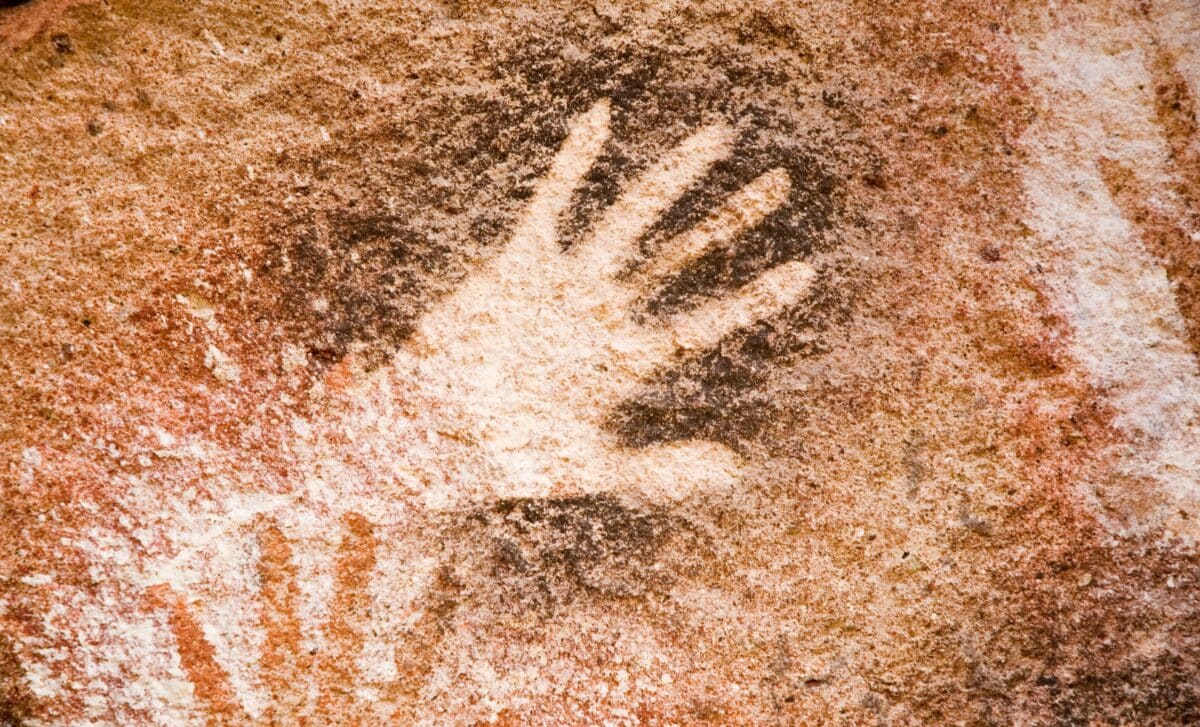
The stencil, a faint hand outline, was uncovered by a team of researchers from Griffith University at Liang Metanduno cave. Hidden beneath newer paintings, it had been overlooked until careful recording techniques brought it back into view.
The use of U-series dating, which measures the decay of uranium in mineral crusts over time, provided the minimum age of the artwork, offering a more precise estimate than previous methods that relied on guesses or style alone. This finding not only rewrites art history but also sheds light on early human cultural practices.
Pushing Back the Timeline of Cave Art
For decades, the oldest known cave art came from Spain, where paintings were dated to over 64,000 years ago. The new Indonesian discovery, however, edges past that minimum age and offers a new understanding of the origins of human artistic expression. Researchers used U-series dating to measure the uranium decay in the mineral crusts that formed over the painting. Since these mineral crusts form after the artwork is made, this method provides a more reliable minimum age for the stencil, even if the exact date of the painting remains unclear.
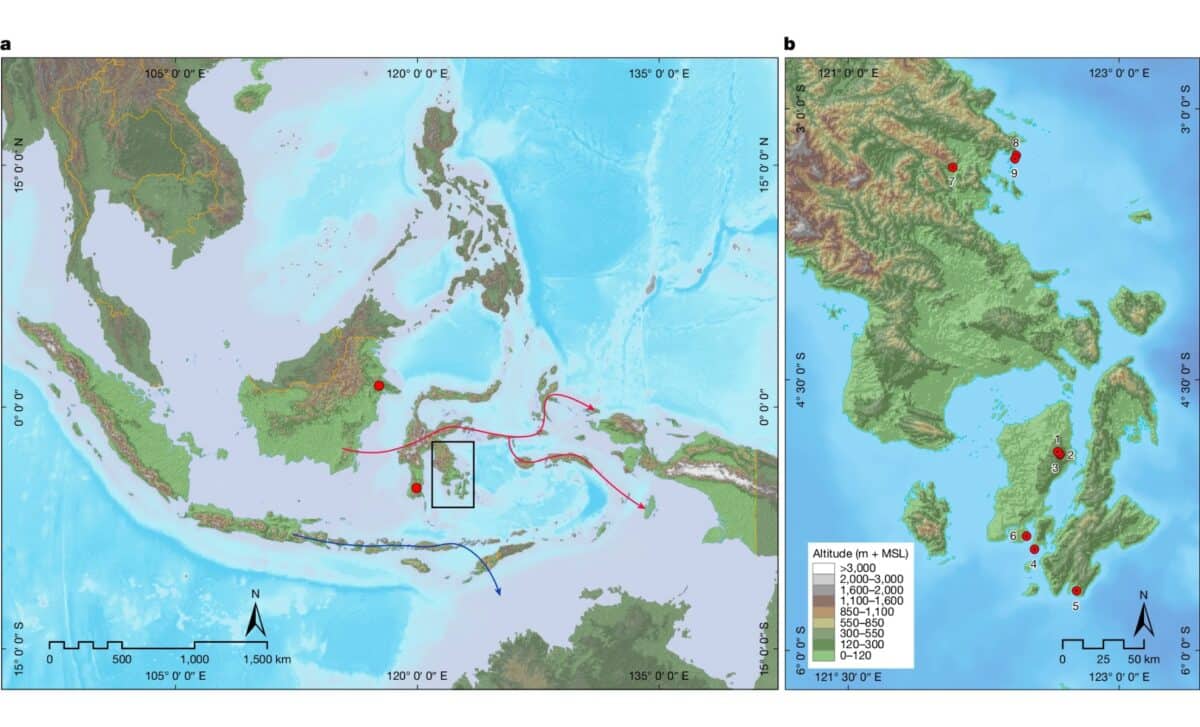 Map of Sulawesi and the wider region – © Nature
This discovery places cave art firmly in the Ice Age, at a time when humans were developing increasingly complex symbolic behaviors. The hand stencil is part of a broader tradition of rock art on Sulawesi, Indonesia, where similar stencils and paintings have been found in other caves. According to Griffith University archaeologist Adam Brumm, this finding suggests that early humans were already using art to communicate and express symbolic ideas much earlier than previously thought.
Symbolic Thinking in Early Humans
The hand stencil is more than just an ancient piece of art; it also provides valuable insight into early human symbolic thinking. Brumm suggests that the design, with its pointed fingertips, may indicate an intentional creation, possibly symbolizing a connection between humans and animals. Other rock art in the region includes depictions of part-human, part-animal beings, suggesting that early humans may have used art to explore their relationships with the natural world.
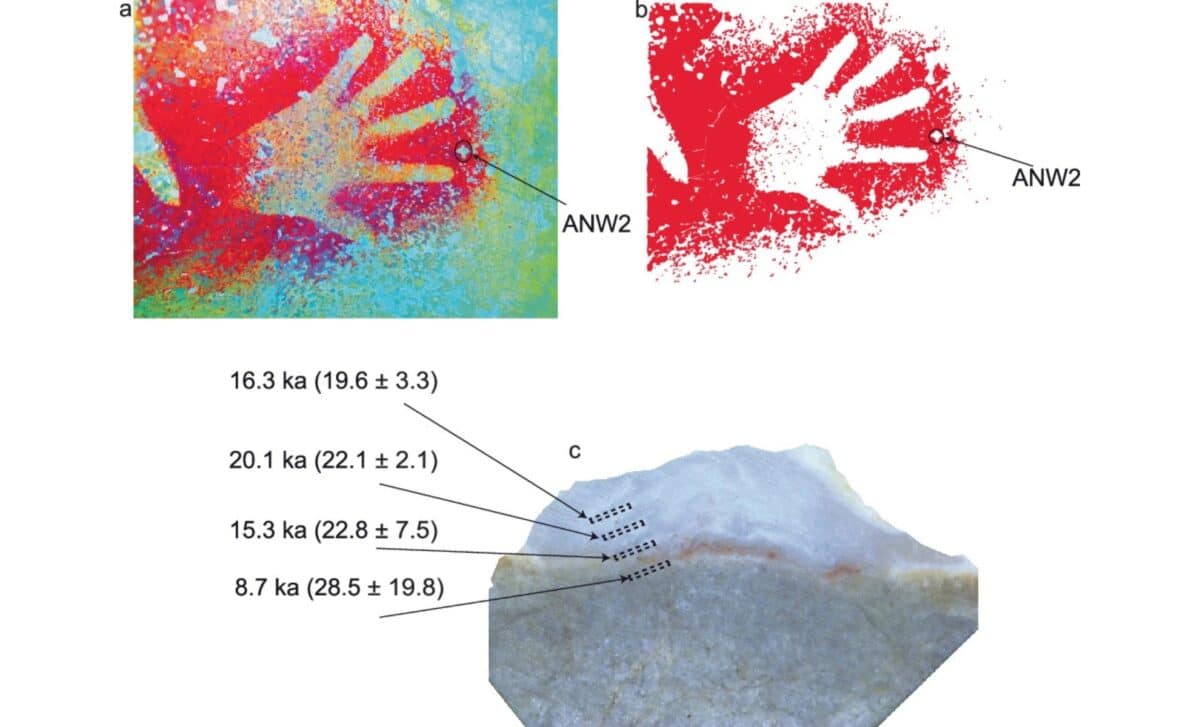 Dated rock art from Gua Anawai. a–b, Sample ANW2, collected from over a red hand stencil measuring 15 ×14 cm (a, photograph of the hand stencil enhanced using DStretch filter_lre; b, digital tracing). c, Sample ANW2 in cross-section, showing the location of the transect of four dated sub-samples on top of the pigment layer. The hand stencil has a minimum age of 20.1 ka (22.1 ka ± 2.1 ka) (ANW2). Individual rasters are 700μm in length. – © Nature
While the exact meaning of the stencil remains open to interpretation, its existence speaks to the complexity of early human thought. Researchers have found evidence of art being used to convey abstract ideas, and this hand stencil could be part of a larger tradition of symbolic culture in early human societies. It highlights the fact that art was not just decorative but possibly tied to spiritual or social meanings.
Art as a Clue to Ancient Human Migration Patterns
In addition to its significance for art history, this discovery has important implications for understanding early human migration. The stencil is located in a region that early humans likely crossed when migrating to Sahul, the ancient landmass connecting Australia and New Guinea. Excavations in northern Australia suggest that humans were living there at least 65,000 years ago. If symbolic art traveled with these groups, this stencil provides further evidence that cultural practices, including art-making, were deeply ingrained in human societies long before humans reached Australia.
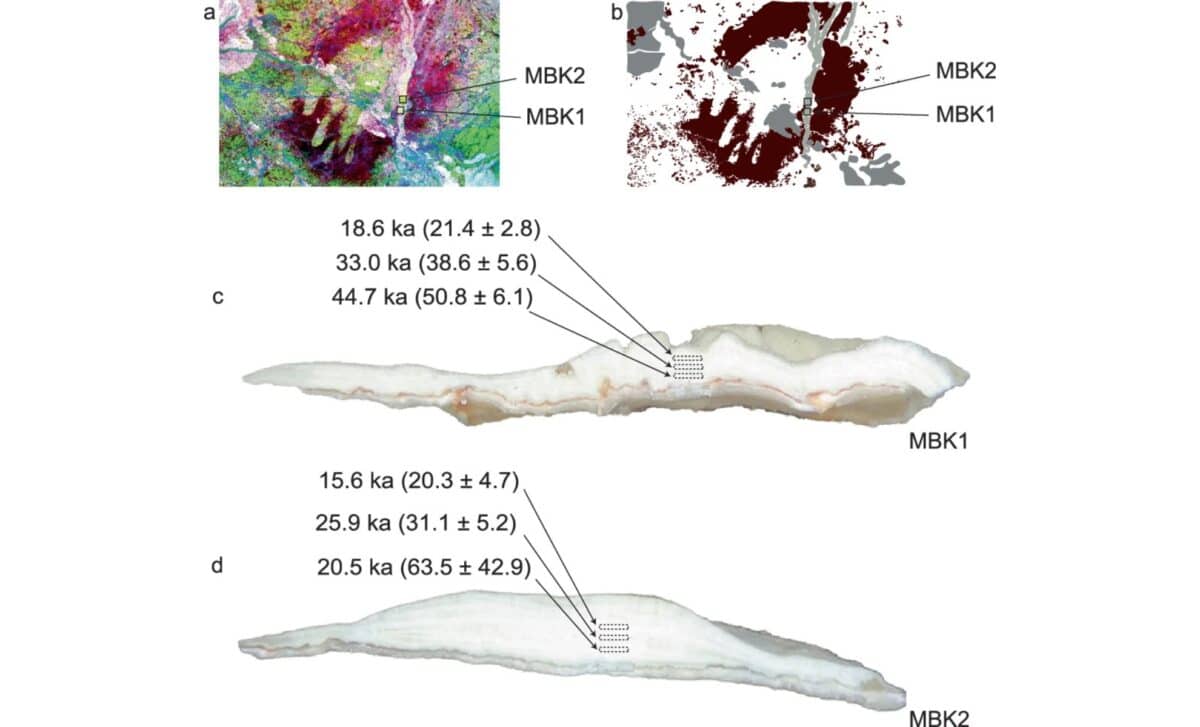 Dated rock art from Gua Mbokita. a–b, Samples MBK1 and MBK2, collected from over a red hand stencil measuring 24 ×17 cm (a, photograph of the hand stencil enhanced using DStretch filter ac_cb_rgb; b, digital tracing). c, Sample MBK1 in cross-section, showing the location of the transect of three dated sub-samples on top of the pigment layer; the oldest minimum ages is 44.7 ka (50.8 ka ± 6.1 ka). d, Sample MBK2 in cross-section, showing the location of the transect of three dated sub-samples on top of the pigment layer; the oldest minimum age is 25.9 ka (31.1 ± 5.2 ka). Individual rasters are 700μm in length. – © Nature
The hand stencil offers a glimpse into the lives of early humans who crossed vast distances, navigating challenging landscapes while carrying cultural traditions with them. The fact that the artwork was created by people who had already developed symbolic practices adds depth to our understanding of human migration, showing that art may have been an important part of the journey itself.
The Future of Rock Art Research
While the hand stencil’s minimum age has been established, further research is needed to refine our understanding of its exact date. The U-series dating method used in this study depends on the stability of mineral crusts over time, and slight variations in the mineral deposits can affect the age estimate. More sampling and analysis at other sites in the region will help provide a clearer picture of the timing and development of rock art.
Moreover, the question of who created the art remains unresolved. Without direct evidence such as bones or genetic traces, it is impossible to identify the exact group responsible for the stencil. However, the deliberate nature of the design suggests that it was created by humans, likely early Homo sapiens.