

Yuli Edelstein, outgoing chair of the Knesset’s Foreign Affairs and Defense Committee, sent fellow panel members on Monday a copy of his proposed ultra-Orthodox military enlistment bill, just hours before the Knesset House Committee was slated to vote on replacing him.
Prime Minister Benjamin Netanyahu faces a coalition crisis over the Haredi draft issue, with the United Torah Judaism and Shas parties demanding that the Knesset pass legislation enabling most ultra-Orthodox men to continue avoiding military conscription or other national service, after the High Court of Justice ruled such exemptions illegal last year.
Edelstein’s bill, which he had held close to his chest amid the protracted conflict over ultra-Orthodox military exemptions, calls for the immediate application of sanctions on draft dodgers, including the revocation of drivers’ licenses and a ban on international travel.
The lawmaker was ousted over his refusal to advance a conscription bill based on a compromise reached with the Haredi parties in June, under which most ultra-Orthodox males would continue to avoid IDF or other national service. Many ultra-Orthodox Jews believe that military service is incompatible with their way of life and fear that those who enlist will be secularized.
Edelstein presented a copy of his proposed revision of the controversial legislation to lawmakers ahead of Monday afternoon’s Knesset House Committee vote on replacing him with fellow Likud MK Boaz Bismuth as chairman of the powerful security panel.
Get The Times of Israel’s Daily Edition
by email and never miss our top stories
By signing up, you agree to the terms
His version of the bill would require all Haredi men to report for registration at an IDF enlistment center and undergo a fitness test before receiving a service deferral. Such deferrals would only be granted to those who study 45 hours a week in a yeshiva or 40 hours in a kollel, a yeshiva for married men.
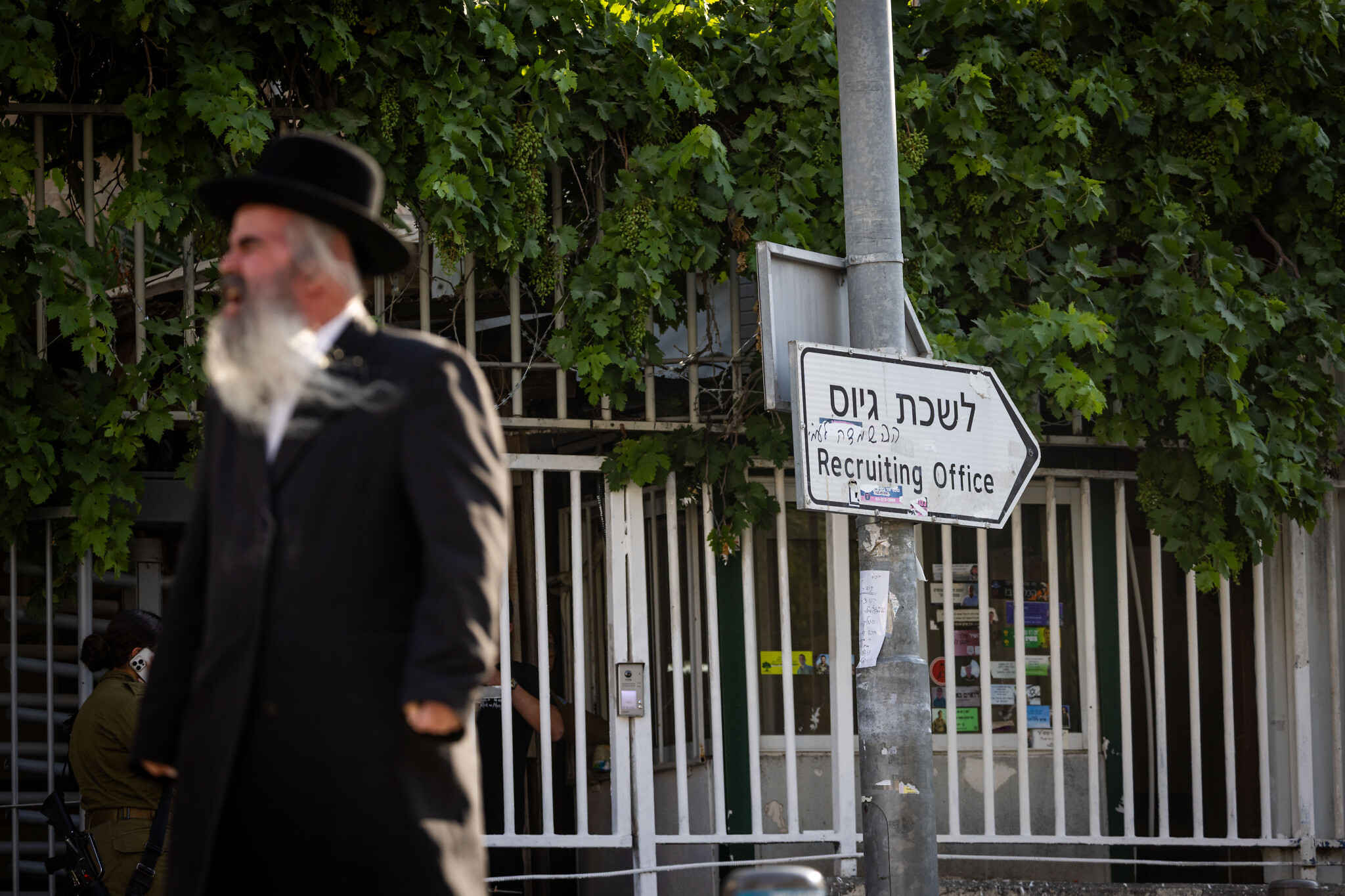
An ultra-Orthodox man near a protest outside an IDF enlistment center in Jerusalem, June 10, 2025. (Chaim Goldberg/Flash90)
If five percent of those designated for the draft at a given yeshiva do not show up when called or the yeshiva dean instructs students not to report, the yeshiva will be removed from the list of institutions whose students are eligible to receive deferrals. Any yeshiva that encourages evasion will lose its status under section 46 of the Income Tax Ordinance, which allows financial supporters to receive tax credits for their donations.
According to Edelstein’s draft, 5,760 Haredim would be required to enlist in the first year following the bill’s passage, rising to 6,840 in the second year, 7,920 in the third, 9,000 in the fourth and 9,500 in the fifth. After the fifth year, the number of conscripts would be determined by the defense minister with the approval of the Foreign Affairs and Defense Committee but would not fall below 9,500.
Evaders would lose drivers’ licenses, right to travel abroad
Draft dodgers would be subject to sanctions including the revocation of drivers’ licenses, a ban on flying abroad, a prohibition on applying for civil service jobs, no government subsidies for purchasing an apartment and cancellations of discounts on public transportation, National Insurance payments and electricity bills. Daycare subsidies for draft dodgers would be cut in half.
If annual conscription targets are not met, all daycare subsidies would be cancelled and state housing benefits and property tax discounts would be revoked, among other penalties. Should the Haredi community fail to meet its quotas for three years in a row, the government would be required to submit a new bill.
The legislation would also impose sanctions on yeshivas that fail to meet recruitment targets, with anything less than 95% of the target triggering a cut in government funding.

Ultra-Orthodox rabbis attend an emergency conference against the draft of yeshiva students, in Bnei Brak, July 31, 2025. (Flash90)
The draft bill was sent to the committee hours before the Knesset was slated to convene Monday afternoon to hold an emergency discussion on the Haredi draft issue, despite having entered a recess of nearly three months on July 27. The body is set to reconvene on October 19 for the winter session.
The special session was called after the opposition last week collected the 25 signatures necessary to hold a discussion on “advancing the evasion law during wartime, bringing back the hostages, and advancing an immediate deal to end the fighting in Gaza.”
MK Gafni: Hard to believe a Jew wrote this bill
MK Moshe Gafni, who chairs the United Torah Judaism party’s Degel Hatorah faction, slammed Edelstein for both the timing and content of the bill, but did not refer to any specific provision in it.
UTJ, unlike the members of Edelstein’s committee, had seen the bill prior to Monday’s reveal, and had argued that it did not “satisfy the demands” of the faction and its spiritual leaders, prompting a coalition crisis, as UTJ and fellow Haredi party Shas threatened to bring down the government.

MK Moshe Gafni leads a Finance Committee meeting, at the Knesset on July 14, 2025 (Yonatan Sindel/Flash90)
“Yuli Edelstein released the law today, three weeks after he refused to release it because he had hopes that he would remain chairman of the committee — and only today he realized that he is being dismissed,” Gafni declared in a statement on Monday.
“It’s hard to believe that a Jewish person wrote something like this,” he said of the proposed bill. “Everything with him is politics, nothing beyond that.”
Degel Hatorah is one of two factions comprising the United Torah Judaism party, representing its Hasidic component.
Poll: Most non-Haredi Jews want sanctions on draft dodgers
Eighty-five percent of non-Haredi Israeli Jews support the imposition of revoking benefits and imposing sanctions on ultra-Orthodox draft dodgers, according to a poll conducted by the Israel Democracy Institute last month.
According to the survey, 98.5% of secular Israelis, 86% of traditional but not Orthodox and 65% of Orthodox Jews support sanctioning Haredim who fail to enlist.
Seventy-two and a half percent of Likud voters, 76.5% of Religious Zionism voters, 94% of Blue and White-National Unity voters, 97% of Labor voters, 99% of Yesh Atid voters and 100% of Meretz and Yisrael Beytenu voters support sanctions, as do 30% of the ultra-Orthodox Shas party’s non-Haredi voters.
Overall, 69% of Israelis support the immediate application of sanctions, including 86% of secular, 71% of traditional non-Orthodox and 41% of Orthodox respondents. Religious respondents are significantly more likely to support delayed sanctions.
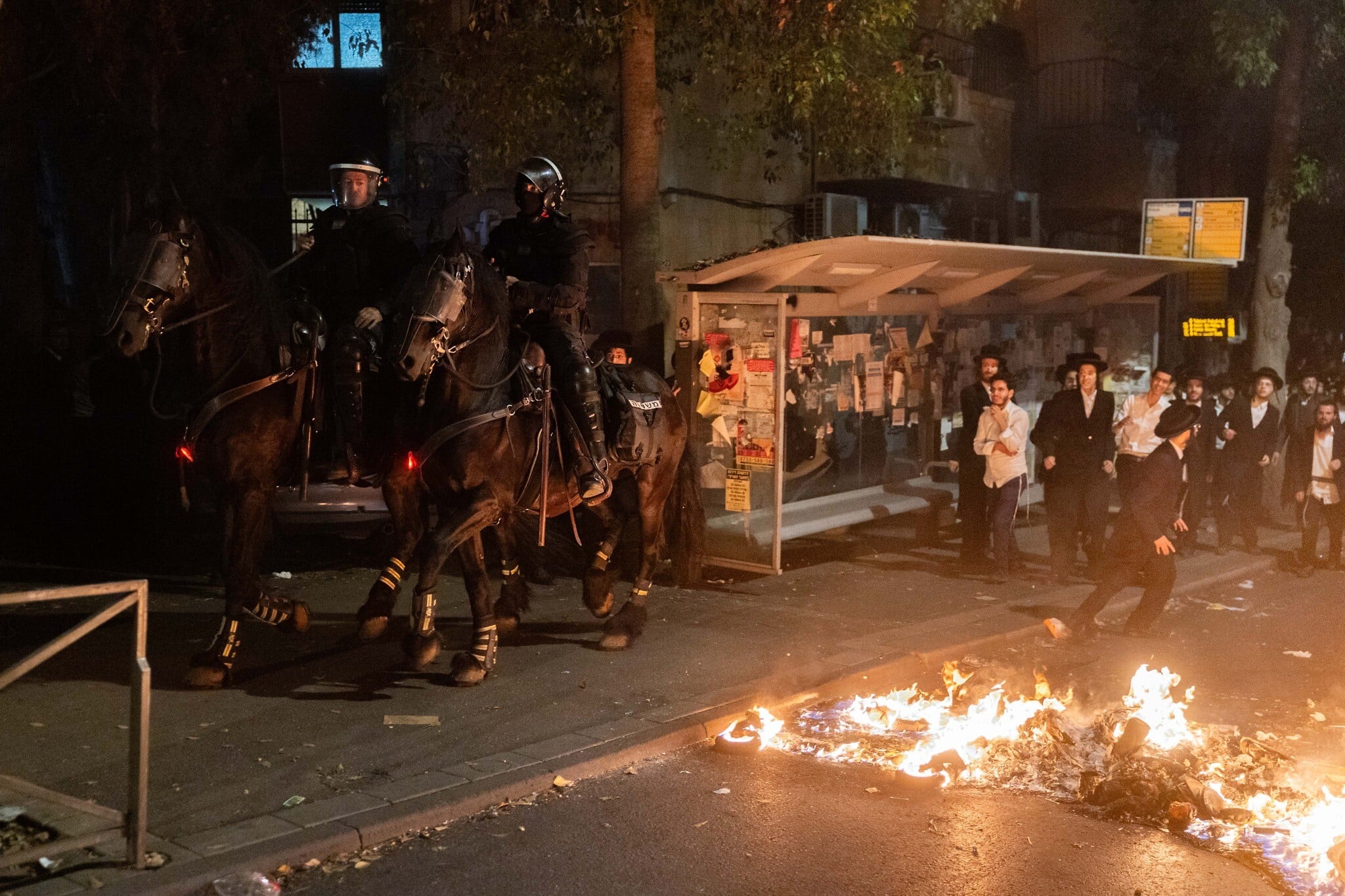
Ultra-Orthodox Jews protest against the recruitment of Haredim to the IDF, in the ultra-Orthodox neighborhood of Mea Shearim in Jerusalem, July 31, 2025. (Chaim Goldberg/Flash90)
Of the possible sanctions that Haredi draft dodgers could face, 61.5% of non-Haredim support denying voting rights to draft dodgers, 65% are in favor of withholding driver’s licenses, 71% endorsed imposing financial penalties and 73% believe in preventing Haredim from traveling abroad.
More than three-quarters of respondents called for canceling daycare discounts for Haredi draft dodgers while 75% said they support fully canceling state funding for yeshivas whose students are evaders.
Eighty-two and a half percent believe evaders should be denied academic scholarships and public sector jobs while 85 and 86%, respectively, believe that Haredi evaders should be denied assistance in purchasing homes through state-sponsored housing auctions and discounts on municipal taxes and transportation costs.
Among Likud voters, 52% support revoking evaders’ right to vote, 51.5% support withholding driver’s licenses, 60% are in favor of financial penalties/fines and preventing them from traveling abroad.
Fifty-five and a half percent of Likud voters are in favor of canceling daycare subsidies and 60.5% believe yeshivas in which such evaders study should not receive taxpayer money. Seventy-three percent believe that Haredim who do not serve should not receive property tax and public transportation discounts and 69% are in favor of denying them assistance in purchasing homes via housing auctions.