
To make sure we keep San Francisco updated and families connected to resources, we have removed our paywall from some of our work related to the teachers strike. If you’d like to support our journalism, click here to become a subscriber.
San Francisco’s public school teachers are on strike for the first time in 47 years.
The San Francisco Unified School District closed all schools Monday, affecting roughly 50,000 students. At campuses across the city, teachers walked the picket lines to pressure the district to accept their contract demands.
SFUSD Superintendent Maria Su (opens in new tab) announced that all schools will remain closed Tuesday.
Who was at the bargaining table?
At about 3 p.m., SFUSD Director of Communications Laura Dudnick led a press conference as parties returned to the negotiating table.
Dudnick addressed allegations by union officials that the district wasn’t at the negotiating table.
Dudnick said the district representatives were in a nearby room in the War Memorial Opera House, where negotiations are taking place, waiting for the union negotiators to say they had reviewed a counterproposal.
When district negotiators were told the union was ready, they went back to the bargaining table.
“We know that every day that students are not in school, it’s a day of missed learning and missed connections with their peers and teachers,” Dudnick said. “We want this strike to end.”
District awaiting counteroffer
As negotiations between SFUSD and the union continued, the superintendent played down potential issues of disagreement.
While noting that SFUSD is operating with a structural deficit and remains under state oversight, Su said the district’s bargaining team is ready to remain at the table “for as long as it takes” to finalize a deal — overnight, if necessary.
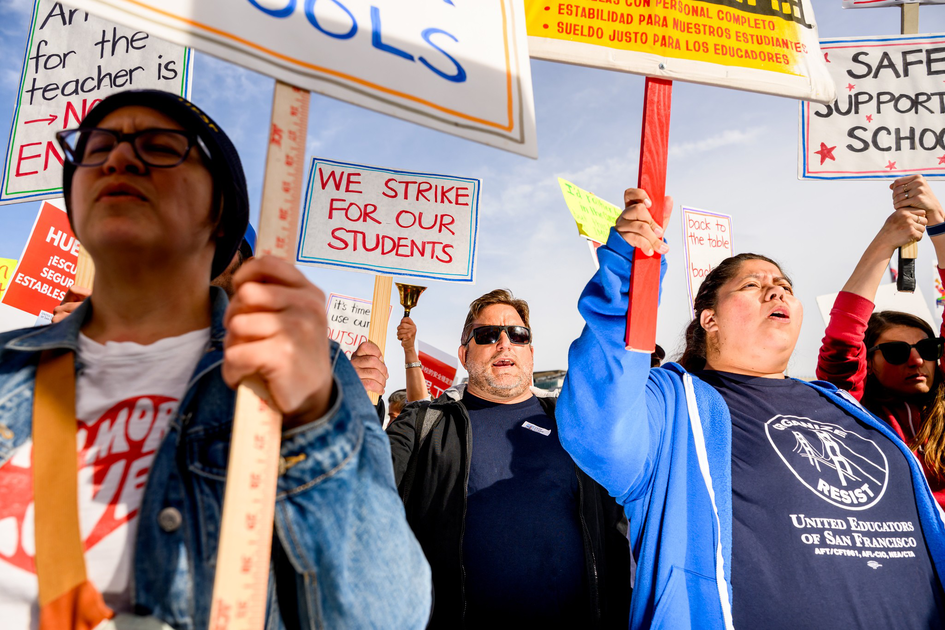
 Educators rally outside Mission High School. | Source: Noah Berger for The Standard
“Every minute counts,” she said. “I do not want a prolonged strike.”
Su said the two parties have been negotiating for nearly 11 months and have reached tentative agreements on most contract articles, including ensuring sanctuary district protections. Pressed by reporters on whether healthcare premiums and wage increases remain the primary sticking points, Su declined to specify, reiterating that negotiations are ongoing.
“We provided our counteroffer on Saturday,” she said. “We’re waiting to hear what their counter to our counter is.”
Rally for the teachers
At a City Hall rally starting at 1 p.m., speakers including union leaders, California Teachers Association President David Goldberg, and District 9 Supervisor Jackie Fielder addressed a crowd of hundreds.
“Some of these people have the chutzpah to ask you to wait three days,” Goldberg said, referring to last-minute efforts by Mayor Daniel Lurie, Rep. Nancy Pelosi, and state Sen. Scott Wiener to delay the strike. “You’ve been waiting 50 years! Decades of disinvestment.”
The speeches went far beyond the strike and contract demands. Goldberg asked why the region’s ultra-wealthy don’t focus on public education, rather than Mars exploration. Fielder spoke against Immigration and Customs Enforcement and called for the protection of students and schools from federal agents. All the while, supporters wearing red (“for ed”) pumped signs and cheered.
Leslie Foster, an art director, and her son Julian, a third grader at Francis Scott Key Elementary, joined the rally to support teachers.
“I hope the teachers can get back so we can go back to school,” Julian said, holding a green bottle of bubbles.
Foster said she’d heard that negotiations didn’t begin in earnest until Saturday.
“I really hope that Maria Su and the district give the teachers everything they want.”
Kate Solimine shepherded her two kids, students at Sutro Elementary, and a group of their friends through the crowd. All the children had blue lips from eating frozen treats. Their reasons for attending varied.
“Support our teachers!” said one.
“Scream at Daniel Lurie!” said another.
Solimine’s analysis identified a broader systemic issue.
“I think everyone who opts out of public education is to blame for the problems in public education,” she said, referencing San Francisco’s high rate of students in private school.
Negotiations stall out
At 8 a.m. Monday, when the campus gates would typically open to students and staff at Lowell High School, nearly 100 educators were chanting and marching, blocking the school’s three entrances. Underscoring the action, a boombox blasted out “Under Pressure (opens in new tab)” by David Bowie and Queen.
Rebecca Johnson was picketing at Lowell. The social studies department chair said she would rather be in her classroom than protesting outside of the school.
“I love my job, and I am very sad that I don’t get to do my job today,” Johnson said.
The United Educators of San Francisco and the school district were unable to reach a contract agreement after nearly a year of contentious negotiations, which escalated after the release of a neutral fact-finding report that gave the union the green light to announce a strike.
Since then, the district and union have come closer on wages and an agreement on increased protections for immigrant students, but little else.
They remain at an impasse over the union’s demands for higher wages, increased capacity for special education professionals, and fully funded family healthcare. The district says its dire budget situation and its appointed state fiscal monitor are limiting its options.
 Teachers picket outside of Lowell High School. | Source: Manuel Orbegozo for The Standard
The strike proceeded despite last-minute appeals from prominent figures, including Rep. Nancy Pelosi and Mayor Daniel Lurie, who on Sunday called for a cooling-off period.
“I’m happy that people are involved,” Johnson said. “But it was a little late for us to adjust.”
Matt Alexander, a school board commissioner and former SFUSF teacher and principal, spoke on the steps outside Mission High School, saying he’d seen “a ton of progress” in negotiations.
“I think this could have been avoided,” he said after hugging UESF President Cassondra Curiel. “It’s been frustrating to me. I don’t really understand it.”
Teachers picketing outside Mission High chanted “Housing is a human right” and “Immigrants are welcome here.” Amid a chorus of trumpets and drums, they yelled that public schools are “under attack.”
Educators rally outside Mission High School.
A protest on the bridge at Webster over Geary.
At a press conference outside Mission High School, Curiel reiterated that teachers would strike until they receive an acceptable contract, with fully funded family healthcare, better wages, and additional support for special-education students.
“It has taken over 10 months of sounding this alarm, asking nicely, and hearing unfulfilled promises to get to this point,” Curiel said. “We will continue to stand together until we win the schools our students deserve and the contracts our members deserve at every single school site — until we close this deal.”
When asked how conversations with Lurie had gone ahead of the strike, Curiel was vague. “They’ve been conversations,” she said, inspiring laughter among educators standing behind her.
 Cassondra Curiel, president of United Educators of San Francisco, speaks Monday. | Source: Noah Berger for The Standard
When pushed for details, Curiel said she had been to Lurie’s office and picks up the phone when he calls.
“He supports our demands,” Curiel said. “He’s working to make sure that the agreement that we get meets the needs of the people of this city.”
Phil Kim, president of the Board of Education, said he has been taking unpaid leave from his staff job at the Human Rights Commission since Thursday so he can spend more time handling the strike situation.
Kim, who’s running for reelection in June, said he respects the union’s right to strike and believes that educators deserve more support and better pay.
“I am focused on supporting the district and UESF in reaching a resolution as soon as possible,” he said. “It’s important that we come together and remain at the negotiating table until we reach an agreement, so that we minimize disruptions as much as possible.”
Daniel Lurie speaks
Lurie made his first public statement since the strike began Monday morning outside the Tenderloin Recreation Center on Ellis Street.
Lurie said he has made the War Memorial Building available for negotiations between the district and the union. He emphasized that he is a facilitator of discussions and is not at the table himself.
“I’m not in the weeds in the negotiations; I don’t think that’s my role,” the mayor said. “What I’ve heard from both sides is that they made productive strides on Saturday, which I think was the first time in months that that happened.”
He said he spoke with UESF leadership Monday morning and has made himself available to both sides.
 Mayor Daniel Lurie said he supports the union and the district sitting down to negotiate an end to the strike. | Source: Amanda Andrade-Rhoades/The Standard
“My role is to make sure that we get to an agreement between these two parties,” Lurie said. “That is what I want for our children. I want that for our parents. I want that for our educators. And I want that for the school district.”
When asked if he supports the union’s demands — as Curiel stated — he demurred.
“What I support is both sides getting to an agreement,” he said, declining to take a position on the union’s requests.
Lurie said he has made himself available over the past weekend and continues working “tirelessly 24/7 to facilitate an agreement that educators can agree to and that the school district can agree to.”
The mayor acknowledged that teachers made progress during negotiations Saturday but expressed frustration with a lack of dialogue Sunday.
“We lost a day yesterday,” he said. “I think they’re not that far apart, but I’ll let the two of them discuss that.”
Affording San Francisco
In the morning chill, about 40 educators and students joined the picket line outside Gordon J. Lau Elementary School, the largest school in Chinatown.
Tina Leung, a speech-language pathologist, held a “We can’t wait” sign while leading chants. She underscored the importance of fully staffed schools and access to special-education services like specialized academic instruction, occupational therapy, psychological services, and counseling.
“We are fighting for safe and stable schools for our students and for our educators,” she said. “In order to do that, we have to retain and attract educators.”
More than 50 teachers and parents picketed outside Cesar Chavez Elementary on Folsom Street Monday morning. Spirits were high as the demonstrators, who arrived before 8 a.m., marched in a circle with union signs to a Latin pop and reggaeton soundtrack.
“It’s definitely historic, but it’s not a good feeling,” said Daniel Alonso, a fifth-grade teacher. Alonso, who has been teaching at Cesar Chavez for seven years, said the confusion among families reminded him of the pandemic.
School staff told parents starting Thursday that they should make child-care plans for this week.
“I’m ready to go back,” Alonso said. “Hopefully this pushes the district to compromise.”
More than 40 educators and supportive families marched at John Muir Elementary School on Webster Street. Ashley Hughes, who is in her ninth year at SFUSD, said pay raises are key to keeping new educators in the district. Out of her training cohort of 20 teachers, only a few are still with SFUSD, she said. Hughes, 36, said she is barely hanging on.
She has lived with roommates most of her life and could afford her own place for the first time last year — in Oakland. If she could afford to live closer to John Muir, she said, it would benefit her students. She said she’s contemplating getting a second job.
 Chad Gaver, an English teacher, at a picket line outside of Lowell High School. | Source: Manuel Orbegozo for The Standard
“To come into work and not stress about, is my money going to go to all these supplies that I have to buy?” she said. “Am I going to be able to afford retirement? Or to fix my car next month?”
Michael Ungar has taught history at Lowell High School for more than a decade, long enough to watch the financial pressures on educators transform from manageable to crushing in one of the nation’s most expensive cities. He’s watched younger colleagues take second jobs, move farther from the city, or leave teaching altogether.
“I’ve got 13 years of experience, and I still have to think twice about basic expenses,” he said. “That’s not how it should be for professionals with advanced degrees who are shaping the next generation.”
Ungar said the union’s demands focus on bread-and-butter issues: salary increases that match inflation, affordable healthcare for dependents, and retirement benefits that allow teachers to leave the profession with dignity.
His planned lesson this week happens to be relevant: “I’m teaching a course in comparative government. We’re really going into the structure of the Mexican government; we are studying democracies and authoritarian systems.”
Gesturing at the picketers along the street, Ungar noted that “this is one of our freedoms, to strike and petition our government or certainly petition our local authorities.”
Healthcare burdens
Lowell social studies teacher Erin Hanlon brought her infant son to the school, trading maternity leave for a few hours of solidarity with colleagues.
“We definitely need dependent healthcare. I can’t afford to have my son on our insurance,” she said.
 Erin Hanlon, a social studies teacher at Lowell, brought her son George Young to the picket line. “I can’t afford him on my insurance,” she said. | Source: Manuel Orbegozo for The Standard
Sarah Carp, 49, an instructional coach at John Muir Elementary School, is charged with training the next generation of teachers. Through her roughly two decades teaching and working in SFUSD, she has paid out of pocket for healthcare for her kids. Now, with premiums on the rise, she and her partner, also an educator at SFUSD, pay $1,500 monthly for their three teenagers. Carp’s take-home pay is about $6,000 a month, she said, forcing them to make choices about where to trim.
“When it was in the hundreds, it felt doable. Now it’s in the thousands,” she said. “When you have children, you want them to be able to join a soccer team, take piano lessons, buy boba with their friends. All of those are things we’re considering cutting to pay for healthcare.”
Carp is hopeful the district backs the union’s demand for better special-education staffing. She sees many of John Muir’s students who have specialized education plans go without support.
Carp said she thought the last-minute demands from politicians for a three-day cool-off period to avert a strike missed the mark.
“This has been a problem for years. It feels frustrating,” Carp said. “We’ve been talking about it for so long.”
Striking in support  Cody Tse, 16, a junior at Washington High School, picketed in support of teachers.
| Source: Han Li/ The Standard
Kids were in attendance on the picket lines at Cesar Chavez, if not in their classrooms. Armed with chalk, they drew colorful messages featuring slogans like “Invest in the schools our students deserve” and “We can’t wait.”
At Lau, a handful of students joined the picket line. Caleb Douville, a fourth grader, stood alongside his mother, an SFUSD educator.
“We’re out here protesting for teachers’ fair rights and fair pay,” he said. “I feel like I can contribute a lot to the protest by being the only kid here.”
Cody Tse, 16, a junior at Washington High School who graduated from Lau, said he planned to visit multiple locations throughout the day to support the strike.
“It’s really a group effort,” Tse said. “A lot of students have been going around telling classmates not to go to school even if schools open, just to support teachers, in spirit. If you go to school, it shows the higher-ups that schools can run without teachers, which they really can’t.”
Members of the United Administrators of San Francisco, which represents principals, assistant principals, program administrators, and supervisors, are striking in solidarity with United Educators of San Francisco, along with SEIU 1021, the union that represents clerks and custodians at the district.
 A message in chalk outside of César Chávez Elementary School. | Source: Max Harrison-Caldwell/ The Standard
Abby Matthews, an administrator at the district, has spent 16 years in education and she said the disparities in compensation have become impossible to ignore.
“I’ve taught at schools where we didn’t have basic supplies, and I’ve taught at schools with every resource imaginable,” said Matthews, who held a sympathy-strike placard as she joined the picket line at Lowell. “But no matter where I’ve been, teachers have been underpaid for the work we do.”
Matthews said her experience across the district has given her a unique perspective on the challenges facing educators. She described watching colleagues leave the profession or move to neighboring districts that offer better pay and benefits, while San Francisco struggles to retain experienced teachers. The current dispute reflects systemic issues that have been building for years.
“We’re not asking for anything unreasonable. We’re asking to be compensated fairly for our expertise and our commitment to these students,” Matthews said. “This isn’t just about one school or one contract. This is about whether San Francisco values public education enough to invest in the people who make it work.”
A statewide movement jj Munos stands by a banner over Geary St. during the first day of a San Francisco Unified School District teacher strike in San Francisco on Monday, Feb. 9, 2026. . | Source: Noah Berger for The Standard
The San Francisco union’s labor action is part of the statewide California Teachers Association “We can’t wait” campaign (opens in new tab).
David Goldberg, president of the California Teachers Association, came up from Los Angeles for the strike.
“I wouldn’t miss this for the world,” he said. “This kind of thing is 50 years in the making — 50 years of pent-up, balancing the budget on the backs of workers.”
Goldberg added that teachers unions are striking across the state, including in West Contra Costa County.
“Frankly, there is no student in this state getting what they deserve, and there is no educator in this state getting what they deserve,” Goldberg said. “They know we’re not going to win statewide unless we have strong locals.”
Cecilia Ortega is a teacher-librarian at Cesar Chavez with a son in fifth grade at Dolores Huerta Elementary School in the Mission.
“As teachers and parents, we are tired of being told every single year by the city of San Francisco and by our district that there is no money for public schools,” she said. “I taught for 15 years, and I know many really good educators who had to leave simply because they couldn’t afford to live here.”
Resources for hungry students
This is a developing story that will be updated.