
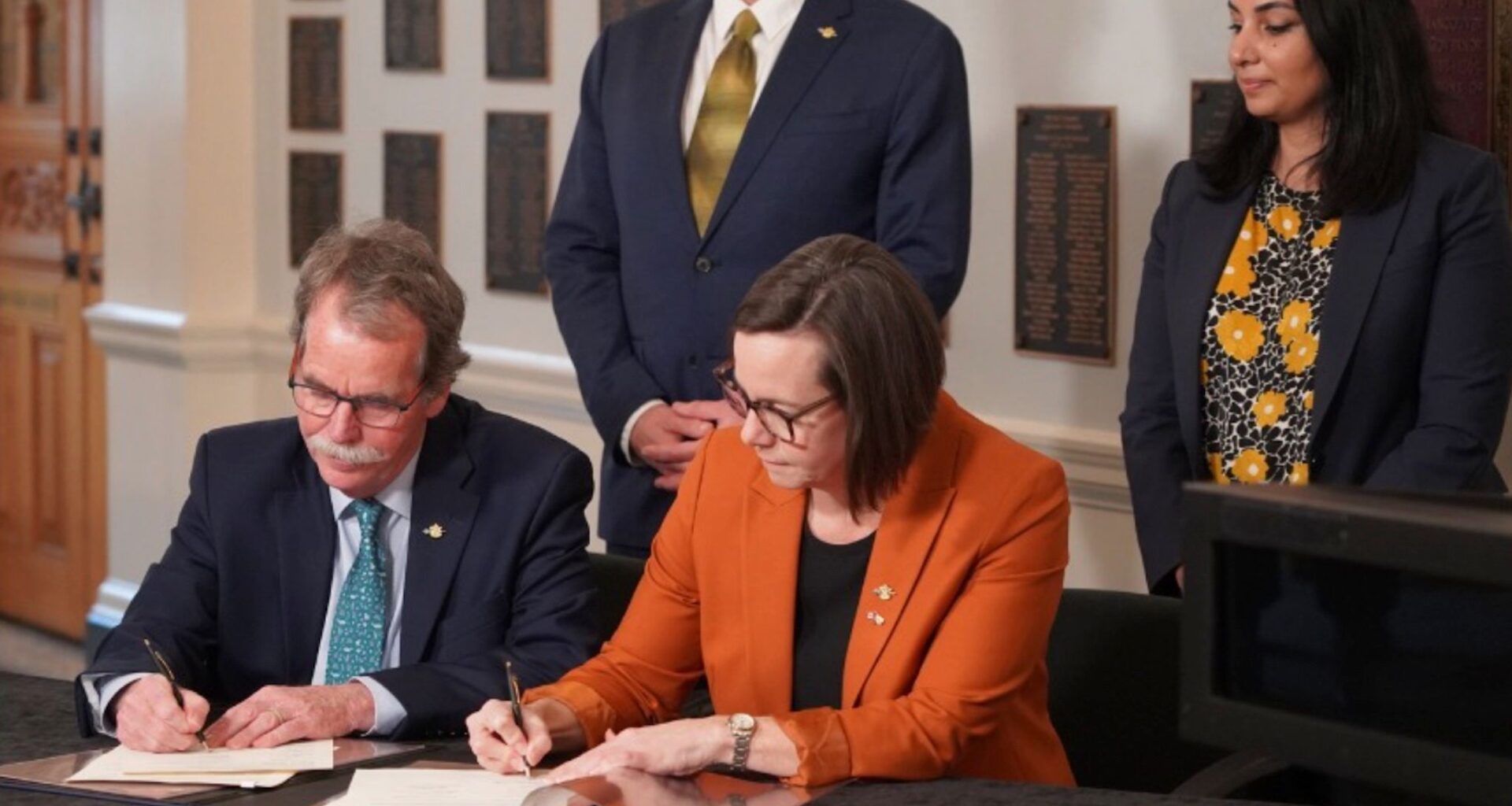
The BC Green Party announced today it will not renew its Cooperation and Responsible Government Accord (CARGA) with the BC NDP, bringing an end to a formal political deal that was meant to keep Premier David Eby’s provincial government stable while both sides worked together on shared priorities.
CARGA is a cooperation agreement where the BC Greens agree to support the BC NDP on key votes to keep the provincial government in power. This particularly relates to key confidence measures such as budgets.
Currently, the BC NDP hold majority government power with a razor thin margin, occupying 47 seats in the legislature, while the Conservative Party of BC has 44 seats and the BC Greens have two seats. The partnership with the BC Greens provided the BC NDP with a buffer, a safer cushion.
In return, the BC NDP agreed to work with the BC Greens on specific policy commitments. The BC Greens are not part of cabinet, but the deal gave them influence over their own priorities and legislation.
The decision not to renew CARGA increases the risk of an early provincial election in 2026. That risk has already been heightened since last summer, amid growing political tensions and signs of strain in the relationship between the two parties, and internal strife within the ranks of the BC NDP.
The BC NDP and BC Greens have had a close relationship since 2017, when they first formed a confidence and supply agreement — similar to CARGA — to enable a BC NDP-led minority provincial government to take the place of Christy Clark’s BC Liberals’ minority government following that year’s provincial election. This should not be confused for a coalition government.
However, Lowan emphasized that given that the BC NDP currently holds majority power, an election call will ultimately be determined by Eby.
“Let’s be clear from the start. The BC NDP has a majority. They can govern, pass budgets, and call an election whenever they choose. If the Premier decides to trigger an election, that is his decision — not ours,” said Lowan.
Rob Botterell, BC Greens MLA for Saanich North and the Islands, added, “The BC Greens entered the CARGA agreement in good faith because British Columbians needed stability and results. But when the BC NDP failed to deliver on clear 2025 commitments — commitments they agreed to complete — it raised serious questions about their ability to execute, and it broke the trust that agreement depended on.”
Jeremy Valeriote, BC Greens MLA for West Vancouver-Sea to Sky, accused the BC NDP of becoming more closed off and less willing to work with their party.
“This government is increasingly centralized, less collaborative, and less willing to work with partners,” said Valeriote. “We’ve seen it in legislation, in labour disputes, in failed consultations and reports not acted upon. In the legislature, this BC NDP has been closed to amendments and compromise.”
“Effective governments work well with others — they don’t sideline them.”
This comes just ahead of the BC NDP’s throne speech on Feb. 12 and the 2026 budget announcement on Feb. 17.
The provincial government is facing sustained historic annual budgets, and staggering increases to provincial debt. The 2026 budget is expected to outline major austerity measures amid significant economic headwinds and structural issues with the provincial government’s finances, with government spending far outpacing the growth in revenues.
However, the BC Greens pushed back against the idea that the provincial government’s financial situation explains why their promises were not kept.
“The NDP’s fiscal situation is not an excuse for broken commitments,” said Botterell. “We brought forward solutions, including serious revenue options. The consequences of this government’s fiscal choices shouldn’t be downloaded onto working British Columbians, and that’s who we negotiated for in our CARGA priorities.”
Valeriote said the distance between the two parties is growing on major issues.
“On climate, Indigenous rights, civil liberties, and other core issues, the gap between our parties is clear and growing. We offered stability and bold action; the BC NDP chose instability and status quo,” he said.
The cooperation agreement was first signed on March 12, 2025. It included a yearly review, giving both parties the option to set new priorities or walk away from the deal, as well as a promise to release quarterly progress reports.
According to the BC Greens, more than half of the 2025 commitments have not been completed. They point to several areas where they say the BC NDP has fallen short, including a lack of progress on launching regional public transit services on the Sea to Sky Corridor linking Vancouver, Squamish, Whistler, and Pemberton, no expansion of public coverage for psychologist appointments, no new support for community health centres, and no review of social assistance and disability assistance rates.
British Columbians last went to the polls for a general provincial election in October 2024.
The BC Conservatives are currently in the early stages of running a party leadership race, following the resignation of John Rustad in late 2025. The party is expected to choose a new leader on May 20, 2026.
On October 17, 2026, British Columbians will be voting in their individual municipal government’s civic elections.