
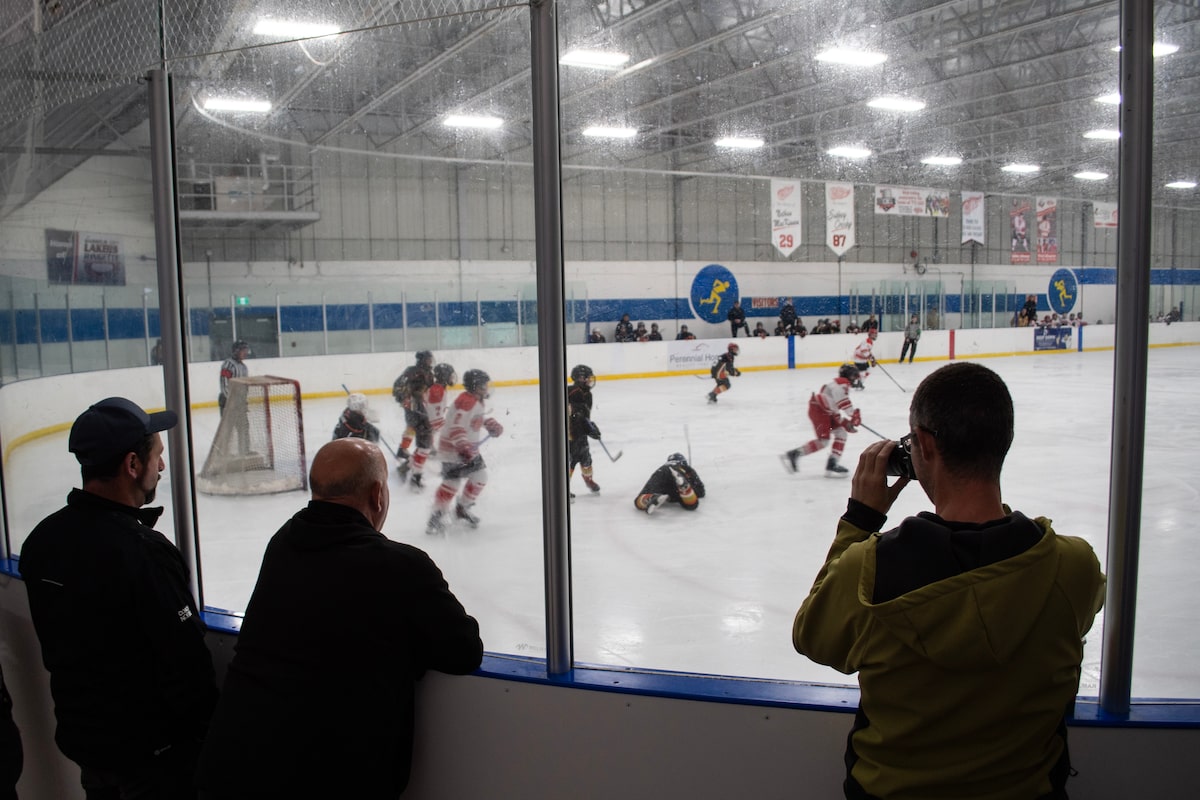
Brad Marchand remembers the first time he set eyes on Sidney Crosby. He was nine years old and Marchand’s dad took him to Cole Harbour Place, an arena 20 minutes east of downtown Halifax, to watch the kid who was fast becoming a local legend.
Marchand, who grew up a few minutes away in Dartmouth, was a year younger, undersized and a below-average skater. But because Crosby’s talent always had him playing among older age groups, Marchand’s dad thought Brad could learn from watching how Crosby managed against much bigger players.
“The way he would kind of spread his legs to shield pucks against a group of guys, that’s what my dad wanted to me to see,” Marchand said, recalling how Crosby’s habits left an imprint.
It was the beginning of one of the most remarkable talent factories Canadian hockey has ever seen. Home to Crosby, Marchand and Nathan MacKinnon, the greater Halifax area has somehow produced three future NHL hall of famers in a single generation, racking up six Stanley Cups between them. It is an outlandish amount of prowess from a relatively compact area. If you drove between all three of their houses growing up, Marchand figures you could do the round trip in under 25 minutes. “It’s not far.”
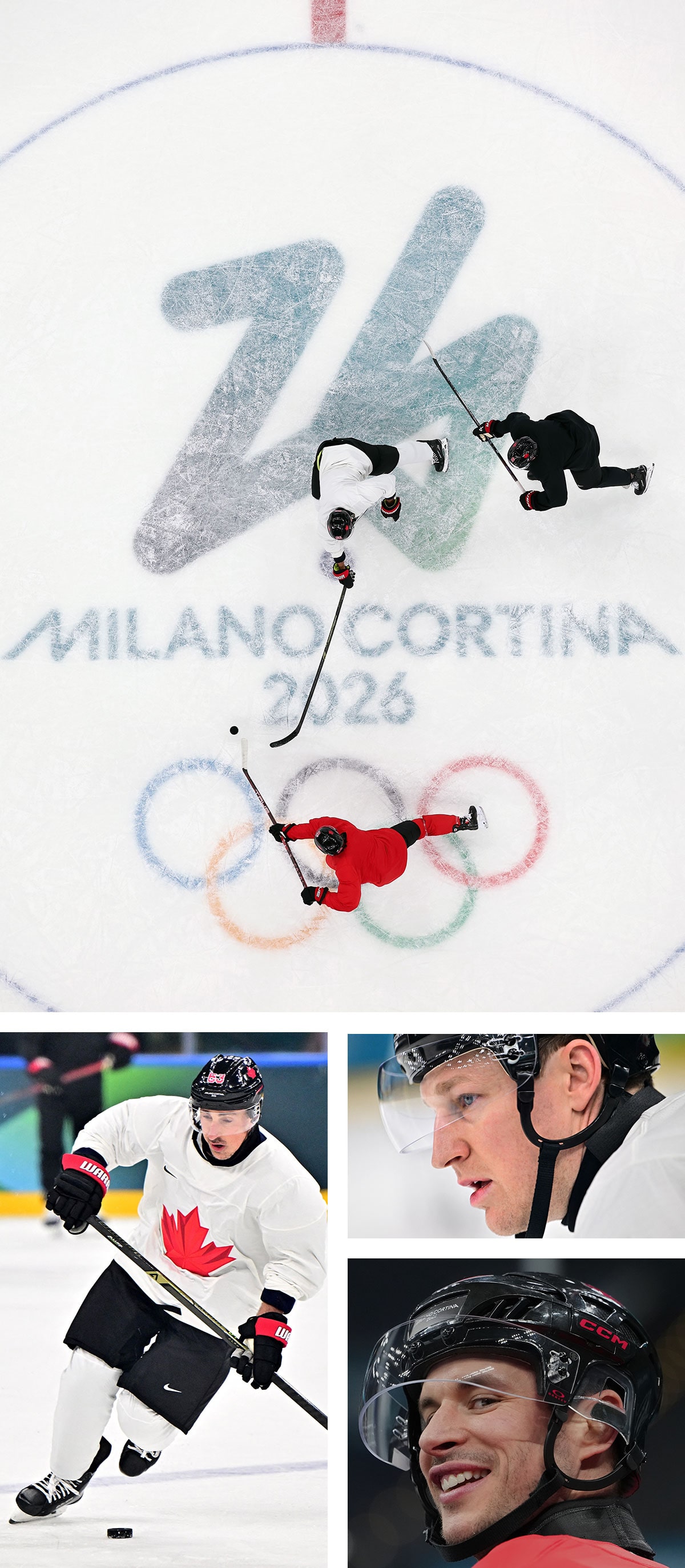
Brad Marchand, Nathan MacKinnon and Sidney Crosby, at Milan’s Santagiulia arena last week, grew up within minutes of each other and gathered in the Halifax area this summer to train for the Olympics.
Gregory Shamus/Getty Images; Marton Monus/Reuters
This offseason, the trio gathered back home to train, something they do most summers. But these workouts came with an added edge as they prepared for the Milan Olympics. What took place on the ice would never be mistaken for a typical summertime game of shinny. It was physical, vocal, aggressive and relentless.
But if Canada is to win gold in Milan – after narrowly defeating the United States in overtime at last year’s 4 Nations Face-Off – the road to victory will, in part, run through Cole Harbour and Dartmouth, drawing on what Marchand said is a work ethic that only comes from growing up there.
“We really take a lot of pride in the fact that we’re gritty in the way that we do things, and kind of muck it up,” Marchand said. “And that never gets lost on us; even just the way we go after each other, chirp each other, and stuff like that. We’re just trying to keep each other humble and grounded and make sure we don’t get ahead of ourselves ever. But it all stems from pride and being where we’re from.”
Crosby and MacKinnon both seemed touched by the hockey gods at an early age, but Marchand was never the best player on any of his teams growing up. What he did have, he said, was an internal fire. As a teenager, if a teammate texted him at the end of the night and said he’d shot 500 pucks that day, Marchand wouldn’t think twice.
“You’re in bed and you’d have to go downstairs and shoot 500 pucks to beat him, so that you weren’t doing less. Everything was a competition, every single day: who was doing the most? Who was getting better?” Marchand said.
Players like Marchand saw the opportunities that developing players in bigger cities had access to – more high-end skills coaches, sophisticated training facilities, elite hockey academies and frequent ice time. “We didn’t have any of that available to us,” he said. “We just kind of grinded it out.”
The question Halifax-area hockey coach Brad Crossley gets asked most is, what’s in the water in Nova Scotia? It’s the thing everybody wants to know.
In a nation that prides itself on hockey, there’s always clusters of talent to be found; Connor McDavid and Sam Bennet, MVP of last year’s Stanley Cup playoffs, grew up 10 minutes apart in Newmarket, Ont., and were nine-year-old linemates. Macklin Celebrini and Connor Bedard – both drafted first overall and destined to be cornerstones of future Olympic teams – came up together at the North Shore Winter Club in Vancouver.
But the greater-Halifax cluster, emerging from an area with a population base of about half a million people, is particularly unique.
“People say it’s in the water, but it’s in their blood,” Crossley said.
“Those guys have three things. Number one, every detail matters. Number two, when they step on the ice, they don’t play nice. And number three, they work harder than everybody else. They want to be known for that.”
“Sid’s a prime example. Everyone says, ‘Geez, you’re just so gifted, you’re so good.’ But nobody really sees the work he puts in.”
Brad Crossley still coaches locally and works with Crosby and MacKinnon when they return home after the NHL season.
Crossley coached the Dartmouth Subways, a local AAA under-18 team, when Crosby played as a 14-year-old underage phenom. “Sid had 217 points in 87 games that year, it was just crazy.” He now runs the summer workouts when all three return home at the end of the season.
The ice times are hard to explain to an outsider, Crossley said. If someone were to walk in off the street, they might be left with the impression that the three harbour some sort of deep grudge against each other. But that friction is the sand in the oyster that ultimately produces the pearl.
“They’re vicious at times,” Crossley said.
“When they step on the ice, at times it’s like they just don’t like each other.”
There’s a story told locally, as though it may one day be enshrined as a Canadian Heritage Minute, about Crosby and MacKinnon training together early in their careers, sprinting up Halifax’s Citadel Hill as part of their workouts.
“They’d be grabbing for each other’s ankles to try to stop the other guy from getting ahead. That’s just the way they train,” Crossley said.
Crosby and Macklin Celebrini, who grew up on opposite Canadian coasts, trained together this summer. They played for Team Canada at last spring’s IIHF World Championship in Stockholm.Anders Wiklund/TT News Agency via AP
In preparation for the Olympics, select other Team Canada hopefuls flew in to train with them, including Celebrini. Fresh off a standout rookie campaign in San Jose, Celebrini was being talked about last summer as a possibility to make Team Canada, but probably a longshot. Crosby and MacKinnon saw it differently.
“I can tell you that some of the players that are included in some of our sessions, it’s almost calculated. And I don’t know whether it’s Sid and Nate putting together rosters, or how it works, but Celebrini came down here for a purpose,” Crossley said.
Asked later if the skates in Halifax were as intense as people say, Celebrini simply responded, “Yeah, they are.”
MacKinnon in particular has set a high bar for himself in Milan, especially after last year’s 4 Nations Face-Off, where Canada needed a McDavid goal in overtime to win. MacKinnon, no-nonsense in interviews, batted aside any suggestion that anything he did on-ice this offseason was special.
“I didn’t work that hard,” MacKinnon said after a recent Colorado Avalanche practice in Toronto, where he was among the last players off the ice. “I think Sid worked a lot harder than I did.”
As the guy who watched both of them, Crossley saw it differently.
“Nate’s probably one of the most vicious, intense people I’ve ever been on the ice with.”
Few people have witnessed the golden era of Halifax-area hockey like Jon Greenwood.
A few years older than Crosby, he remembers Thursday nights at Cole Harbour Place in the 1990s, where the games would start at 6:30 p.m. and go all night. When Crosby was on the ice, it could be tough to find a seat.
“We would all show up early to watch the younger guys play, and the younger guys would stay around after their games to watch us play,” Greenwood remembers.
“Those home nights in Cole Harbor were pretty special. It was a real community feel.”
When Greenwood was done playing, he got into coaching 11- and 12-year-olds. He soon began to hear about the next young phenom coming up – 10-year-old MacKinnon. “He had something like 132 goals the year before, so we were pretty confident he’d make our team,” Greenwood said.
What he didn’t expect was the kind of personality MacKinnon had. The kid was hard on himself. He saw Crosby and wanted to be him.
“It was that uber-competitiveness at a young age,” Greenwood said. “That could boil over from time to time, not necessarily in an undisciplined way or taking penalties, but just Nate getting frustrated because he expected so much from himself.”
Greenwood, who coached MacKinnon, remembers the high expectations the player set for himself, even at a young age.
MacKinnon’s calling card is his ability to charge through the neutral zone at high speed, like an unstoppable freight train. He’s one of the game’s best skaters, but it’s something he had to work at.
“There’s certainly some God-given ability, no question. That natural spring in his legs and the balance of power he had in his skate blades,” Greenwood said. “But I wouldn’t want to ever suggest he was born this skater. He put the time in. He was going to power-skating sessions before school through the week, and he did a lot of extra stuff to work on his skating. Now, that being said, so do a lot of other kids – and they don’t skate like that.”
Outside of Crosby, Greenwood hasn’t seen a player with this much competitive instinct.
“We all have those stories of the kids from our hometown that were uber-talented and could do all this stuff, but maybe didn’t quite have that drive to push them. The drive that he had, even at a young age, was pretty remarkable. That’s an innate ability you can’t teach.”
When the Avalanche won the Stanley Cup in 2022, Greenwood and the other coaches wondered how it would affect MacKinnon. Would he finally breathe a bit, take his foot off the gas and allow himself some satisfaction?
“His first practice out that summer he was going like a madman and pushing himself, and we all kind of looked at each other and said, no, I guess that’s not going to happen.”
MacKinnon and the Colorado Avalanche won 2022’s Stanley Cup, but his former coach says he did not rest on his laurels.Phelan M. Ebenhack/The Associated Press
Greenwood isn’t sure what caused this generation of Halifax hockey to emerge.
“There’s obviously some fluke involved there,” he said.
“I don’t know if it’s in the water. I do think there is that small-town, blue-collar work ethic mentality. I like to think that most athletes from our part of the country have that. And then when you have generational talents, I think that’s when you have this.”
Greenwood brought his 11-year-old son to the summer workouts, to help fill water bottles and drink in the surroundings.
“We were driving home from the practice and I said, ‘Bud, I don’t say this stuff to you very often, but you probably watched the best hockey practice in the world today,” Greenwood said. “That’s the kind of pride that we take in it. There’s no way there’s a better skate in the world than this one. There can’t be.”
The Cole Harbour arena keeps its veterans’ numbers high above the ice where new generations play.
Banners hang from the rafters of Cole Harbour Place, signifying Crosby and MacKinnon’s time playing there.
It’s a point of pride for the tiny enclave – though Marchand, proudly repping Dartmouth, would like to quibble with one small point.
“Nate’s not actually Cole Harbour,” Marchand said, poking the bear.
“He says he’s Cole Harbour, but he’s a Dartmouth boy. He just wants to be like Sid.”
Informed of this, MacKinnon doesn’t flinch. You get the sense Marchand says this a lot.
“Yeah, technically my address is Dartmouth, and I played for Cole Harbor growing up,” MacKinnon said. “It’s all like within a street of each other.”
Greenwood chuckles at the jab. Months after their spirited summer workouts, Marchand, in true Marchand fashion, can’t help getting one more shot in.
“Geographically, Brad’s not incorrect. He’s sort of on the border.”
This is Crosby’s third Olympics. And though he’s proven remarkably adept at holding back the inevitable march of time, at 38, Milan could be his last. It will also mark only the second time these three Halifax-area players have skated together for Canada at a best-on-best tournament, after last year’s 4 Nations Face-Off.
“Just grateful for the chance to still be competing and having the opportunity to do this,” Crosby said at Team Canada’s orientation camp in Calgary this fall. “You never know. It’s a tough sport and it’s competitive.”
Back home, one of his first coaches will be watching. Paul Mason, who coached a 10-year-old Crosby, takes no credit for the player he became.
“I’m lucky to have gotten in the way,” he said. “That’s the way I look at it. You coach a long time, you get a guy come through like that, you’re fortunate, period.”
There are plays Crosby attempted at that age – spinning off a check, putting the puck behind his back, or through his skates – that Mason still marvels at.
“We were always on the bench going, ‘Did he do that on purpose?’ And knowing that he did. He had a mind for the game.”
Today, Crosby’s former coach Paul Mason owns a pro shop at Cole Harbour Place. Marli the dog has accompanied him to work for more than a decade.
One of Mason’s favourite memories is when Crosby used the curvature of the net to creatively bank a pass to another player, who then found himself open for a scoring chance.
“The next practice, as coaches, we went down to the side of the net and just started seeing if we could make that pass off the side of the net, and not under game pressure,” Mason said.
None of them could.
“For his mind to go there in that situation was pretty incredible. I’ve never seen a kid try to do that again.”
He remembers Crosby getting frustrated when teams would send out two or three players just to follow him around the ice.
“So, we’d say why don’t you leave the zone, let them follow you. And sometimes two kids would follow him out of the zone and then he’d come in and beat them to the puck.”
They are fond memories. And Mason, who’s been coaching for 47 years, is just happy to have been part of it.
Still, he’s unsure what lessons the Halifax area can offer the rest of the country. Is there a formula that other cities and towns can duplicate? Or is this all just an incredible coincidence, a wrinkle in the hockey universe? He wishes he knew.
“Personally, I think it’s a freak event.”
Milan Cortina 2026: More from The Globe and MailThe Decibel podcast
Canada may bill itself as a “middle power” these days, but Team Canada will not settle for middling results in Milan. Sports columnist Cathal Kelly spoke with The Decibel how politics could shape the Olympic narrative and where our athletes have good chances of success. Subscribe for more episodes.
Olympic hockey in depth
Coach Jon Cooper’s unlikely journey reaches its moment of truth
At her fifth Olympics, Marie-Philip Poulin keeps the fire burning
Five reasons why the size of the Milan rink probably doesn’t matter