
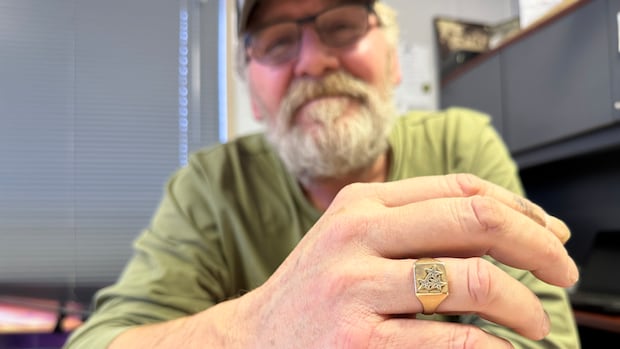
David Hodgson leaned forward across his desk and extended a hand to show off a ring.
“I put that ring on the day Dad died, and basically haven’t took it off,” the 65-year-old contractor and businessman in Norman Wells, N.W.T., explained, before sitting back in his chair.
Hodgson said his father, Edward, received the ring from Imperial Oil to mark his retirement after a lifetime of working for the company. Embossed on its square, golden face are Imperial’s signature three stars, each inlaid with a small diamond.
“Kind of a memento to my father and all the years that he worked for Imperial, and what Imperial meant to him.”
Hodgson’s family history is deeply entwined with the oil industry in Norman Wells, and he’s among many in the community who are wondering what comes next.
Imperial Oil recently announced that after more than 100 years of oil production in the community it will shut down operations this summer.
Hodgson, an owner of HRN Contracting Ltd., said most of his business comes from Imperial Oil.
“We’re losing our anchor and that – that is what it is,” he said on a drive through the community last week, pointing to his various investments in the town: heavy equipment, trucks, trailers, and real estate – including a camp that can accommodate nearly 100 people.
Despite some uncertainty, Hodgson hopes to make the most of the years ahead. Imperial Oil still has a big clean up to do. If the Mackenzie Valley Highway isn’t built, Hodgson said there’s a risk his investments will turn into stranded assets.
It’s something he’s trying to prepare for.
“We’re going to have to work with our client. And as they are making an exit strategy, so will we.”
‘I was thinking of it as a backup plan’
Two teenagers in Norman Wells, on their way back to school after lunch last Wednesday, told CBC News that Imperial’s closure means they’ll have fewer job opportunities in the future.
“I was thinking of it as a backup plan for when I got older,” said Tristen Kakfwi, 15.
“If I were to want to have a better, higher quality job I’d have to move out of town somewhere,” said Easton Goose, 16, who also noted that the town’s economy will suffer when Imperial Oil is no longer flying in workers on rotation.
“I don’t think that’s going to be very good for a lot of people to be leaving,” Goose said.
 Easton Goose, left, Tristen Kakfwi, middle, and John Hoben, right, say Imperial Oil’s closure means different things to them. (Liny Lamberink/CBC)
John Hoben, 15, sees how the closure could be bad for the local economy – but he also sees a potential upside.
“The waters could get more cleared out if they want to take out the islands,” he said, referring to the six artificial islands that Imperial built in the Mackenzie River in the 1980s to serve as oil rig platforms.
“That’s a good thing that could happen for the land.”
Though he wasn’t considering working in the oil industry when he got older, Hoben does see Imperial’s clean up as an opportunity.
“I was thinking I could maybe destroy the place. As in, help them if they need workers, help them take it apart.”
‘A lot of work to do’ for years to come
Chris Chivers has been living in Norman Wells for 21 years and has worked the last six or seven years as superintendent with HRN Contracting.
He isn’t worried about his own future in the community — he expects Norman Wells will continue to be an “oil town” for another 20 years or so, benefiting from Imperial’s closure and clean up.
“That’s a lot of work to do. There’s tons. And even in the short term, things are going to be pretty busy I think, putting the oil field to bed,” he said. “After that, I don’t know what Norman Wells is going to be.”
 Chris Chivers, who has lived in Norman Wells for more than 20 years, isn’t worried about his future in the community — but he does worry for his sons and grandkids. (Liny Lamberink/CBC)
Beyond the next two decades, Chivers worries about what’ll be left in Norman Wells for two of his sons who live in town, and their children.
“It’s time for the town to reinvent itself,” he said. “Maybe capitalize on some tourism a bit.”
Capitalizing on tourism is part of Chivers’ own retirement plan. He’s renovating an eight-by-16-foot trailer on skis into an accommodation for hunters and other tourists who are drawn to the Sahtu.
Hodgson, too, is mulling over what his retirement might look like.
“Will I ever walk away from this? Probably never. I’ll always come home. But will I live here, now, moving forward? Year by year by year? It’s highly unlikely.”
Wherever the future takes Hodgson, his father’s retirement ring will always be on one finger – a symbol of his roots in Norman Wells.
“I’ll probably wear it forever.”