
Stay informed with free updates
Simply sign up to the EU business regulation myFT Digest — delivered directly to your inbox.
The head of the world’s biggest chemical company has hit out at the EU’s “obsolete” emissions trading system, warning that the flagship climate policy was hurting the sector already suffering from high energy costs, aggressively priced Chinese products and myriad environmental rules.
Europe was the “only region in the world” where companies faced punitive fees for polluting, putting the continent’s heavy industry at a “significant competitive disadvantage”, said Markus Kamieth, chief executive of the German multinational BASF, in an interview.
“Most concerning are the energy and carbon costs that we are facing,” added Kamieth, who is also president of the European chemicals industry body Cefic.
The EU’s emissions trading system is a cap-and-trade model that requires companies to buy permits to cover their carbon dioxide emissions, with each business receiving a limited number of free allowances per year to ease the burden.
The ETS has long been considered the cornerstone of the EU’s efforts to reach its goal of net zero emissions by 2050, but a plan to phase out free allowances at the same time as the introduction of a carbon border tax to protect industry has prompted a backlash from executives and politicians who fear that its costs will become prohibitively high.
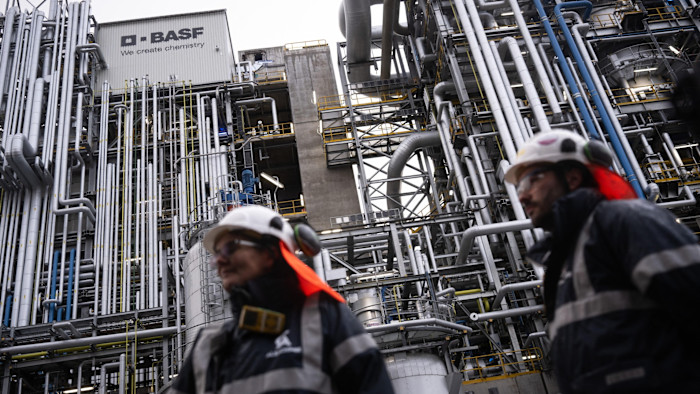
 BASF chief executive Markus Kamieth: ‘Most concerning are the energy and carbon costs that we are facing’ © Ulrich Baumgarten via Getty Images
German Chancellor Friedrich Merz is among those who have called for the phaseout of free allowances to be halted when the ETS is reviewed later this year.
BASF was already paying “triple-digit millions” annually for ETS permits, Kamieth said, “and it’s going to compound over the next year dramatically if there is no change and reform to the ETS”.
ETS costs could be as high as €1bn a year in the 2030s if no revisions were made, according to the company.
He said the “old picture” that Europe forced its industry to decarbonise via the ETS and protected it with a carbon border tax had “become obsolete” amid trade tensions, Chinese overproduction and high energy costs.
Because its products underpin so much other industrial production, the chemicals sector is widely seen as a bellwether for the state of European industry.
Figures from Cefic showed that investment in the sector plunged 80 per cent in 2025 and plant closures doubled.
BASF has suffered sales declines each year since 2022 when energy prices in Europe spiked following Russia’s full-scale invasion of Ukraine and the phaseout of Russian gas from the bloc. It made earnings before interest and tax of €1.6bn in 2025, down from €2bn the year before.
His comments come as Cefic is hosting a summit for energy-intensive industries in the Belgian port of Antwerp on Wednesday to raise industry concerns.
European Commission president Ursula von der Leyen, French President Emmanuel Macron and Merz are scheduled to attend the event, which will be followed by an informal meeting of EU leaders on Thursday to brainstorm ideas to revive the bloc’s flagging economy.
Kamieth said the chemicals industry was facing between 900 and 1,000 pieces of secondary legislation, much of it linked to the EU’s ambitious green rules and that policymakers also needed to focus on streamlining red tape.
French ideas to save the bloc’s industry by introducing local content rules into public tenders, which will be discussed by leaders on Thursday, were not a long-term fix, Kamieth said, warning that Europe should not fall into “a protectionism trap”.
Climate Capital
Where climate change meets business, markets and politics. Explore the FT’s coverage here.
Are you curious about the FT’s environmental sustainability commitments? Find out more about our science-based targets here