
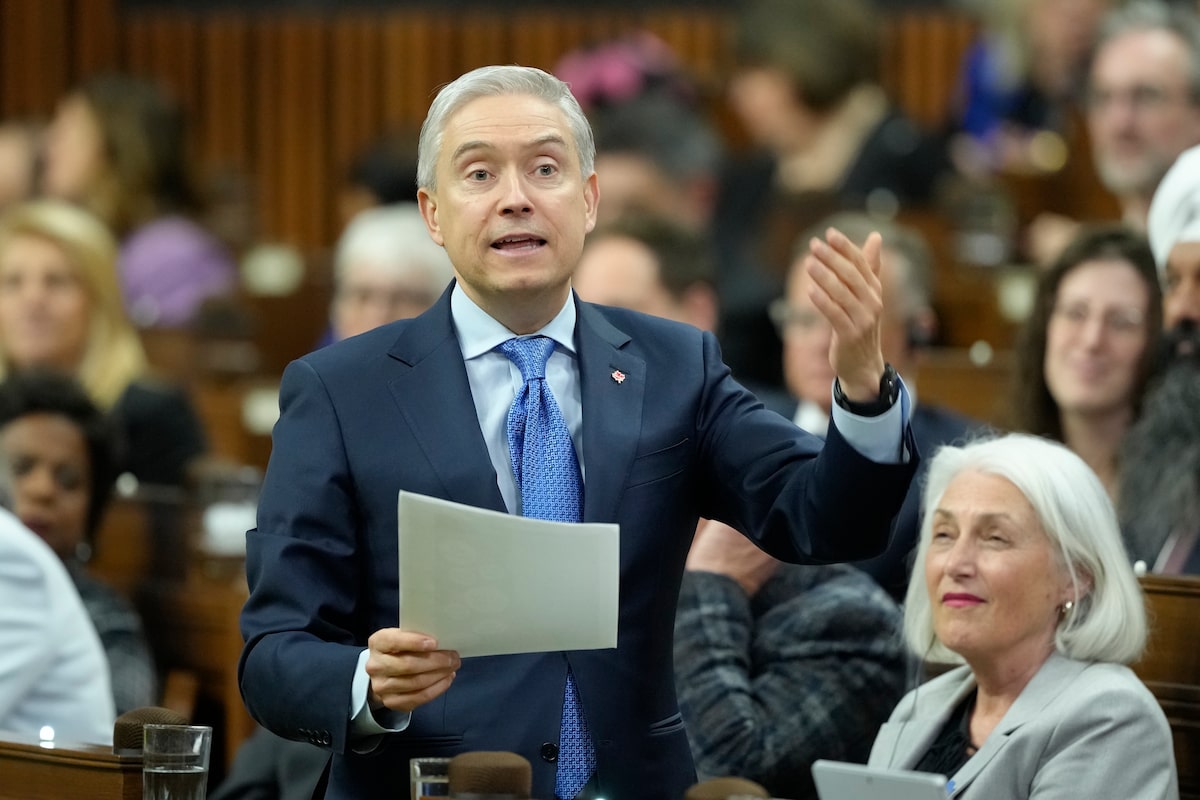
Finance Minister François-Philippe Champagne says the budget provision criticized by the Conservatives is an approach used by other countries.Adrian Wyld/The Canadian Press
The Carney government and Pierre Poilievre’s Conservatives are negotiating amendments to the government’s budget bill, as both parties say they wish to avoid a snap election.
The Conservatives’ acknowledgment Tuesday that they are willing to back the budget bill, which is a confidence motion and would trigger an election if it failed to pass, highlights the rapidly changing dynamic of the minority Parliament as talk of a potential election hangs in the air.
The subject of a potential early vote came up at a meeting late last month between Prime Minister Mark Carney and the premiers, Ontario Premier Doug Ford confirmed Tuesday.
Though Mr. Carney has said he doesn’t want an early election, calling one gives him a chance to secure the majority he came close to winning in last year’s federal election.
His Liberal party has received a bump in opinion polls since he gave a widely noticed speech at the World Economic Forum in Switzerland last month, in which he urged “middle power” nations to band together in opposition to what he called a “rupture” in the world order.
Carney, Ford discussed idea of an early federal election to secure majority, sources say
Conservatives, meanwhile − despite an overwhelming show of support for Mr. Poilievre at their recent convention – are mindful there has been no similar bump in popularity for them.
Conservative House Leader Andrew Scheer said Tuesday that Canadians don’t want an election, and Conservatives are seeking compromises on the budget bill from the Liberals.
He said the provisions his party wants changed are ones that could allow cabinet ministers to exempt companies from federal laws, with the exception of the Criminal Code.
“That’s why we put forward a series of compromises that if the Liberals accept, then we would allow that bill to proceed,” he told reporters ahead of Question Period.
He said the compromises include preventing ministers from being able to circumvent laws without parliamentary oversight or scrutiny.
“It’s in this way that we are respecting what Canadians want. They don’t want half-a-billion-dollar costly election,” he said.
PEI Premier Bloyce Thompson, left, Ontario Premier Doug Ford, Nova Scotia Premier Tim Houston and Manitoba Premier Wab Kinew react as Prime Minister Mark Carney speaks at a news conference after the first ministers meeting in late January.Adrian Wyld/The Canadian Press
Finance Minister François-Philippe Champagne said Tuesday the provisions would spur innovation, as they make it easier for companies to operate.
Similar approaches are used by other Group of Seven countries, he said, but he signalled a willingness to listen to the Conservatives.
“I’m open to looking at guardrails, making sure that we have the proper framework around that, fostering innovation, reducing red tape, and at the same time having accountability,” he told reporters.
Mr. Poilievre has pledged to take a more collaborative approach with the Liberals in recent weeks to find a unified response to the challenges created by the continuing trade dispute with the U.S.
He met with Mr. Carney for about 30 minutes last week in an effort by both sides to find common ground.
Both sides, however, continue to accuse each other of obstruction on legislation related to border security, bail reforms and hate crimes.
Campbell Clark: Beyond self-interest, Poilievre and Carney aren’t interested in co-operation
In 2021, then-prime minister Justin Trudeau justified asking for an early election on the grounds that the minority Parliament at the time had become dysfunctional.
Conservatives have accused Liberals of trying the same tactic now.
“They have used the word ‘obstruction’ in the House this week probably about 150 times, if not more,” MP Costas Menegakis said during debate Tuesday.
“They get very emboldened when the polls change and they start talking about elections.”
Mr. Trudeau was re-elected with another minority, and subsequently signed a supply-and-confidence agreement with the New Democrats. It had the NDP vote with the government on confidence measures in exchange for action on its key priorities, such as labour rights and dental care.
Liberal House Leader Steven MacKinnon answered “no” when asked Tuesday whether there will be a formal arrangement with the Conservatives.
There is no sign the Conservatives are seeking that kind of deal.
Election speculation is common in minority government situations, and was also part of recent premiers’ meetings in Ottawa, Mr. Ford told reporters at Queen’s Park on Tuesday.
“That came up. But that’s going to be up to the Prime Minister. It’s going to be up to the people to decide, if they do decide to call an election,” Mr. Ford said.
Opinion: The overlooked story of Canada’s politics: The luck of the Liberals
Mr. Ford won a third majority government after he called an early election last year, saying he needed a mandate to take on U.S. President Donald Trump.
Three sources told The Globe and Mail this week that Mr. Ford has spoken to Mr. Carney in casual conversations about the importance of a majority mandate to deal with uncertain economic times.
The first source said the two leaders have also discussed their respective poll numbers, including those that show Mr. Carney is much farther ahead in personal popularity than Mr. Poilievre.
The Globe is not naming the sources as they were not authorized to speak publicly about private discussions.
Conservatives are also mindful of the polling, and of Mr. Poilievre’s future. Should he lose a second election to the Liberals, it’s unclear how he could remain as leader.
At a Conservative convention in Calgary late last month, party members voted 87.4 per cent in favour of keeping him on.
Mr. Ford said he congratulated Mr. Poilievre on his strong showing when the two men crossed paths at an unveiling for a portrait of former prime minister Stephen Harper last week.
“But anyways, you don’t win elections at conventions,” Mr. Ford said.
“You win elections across the country. So, let’s see what happens if the Prime Minister decides to call an election.”