
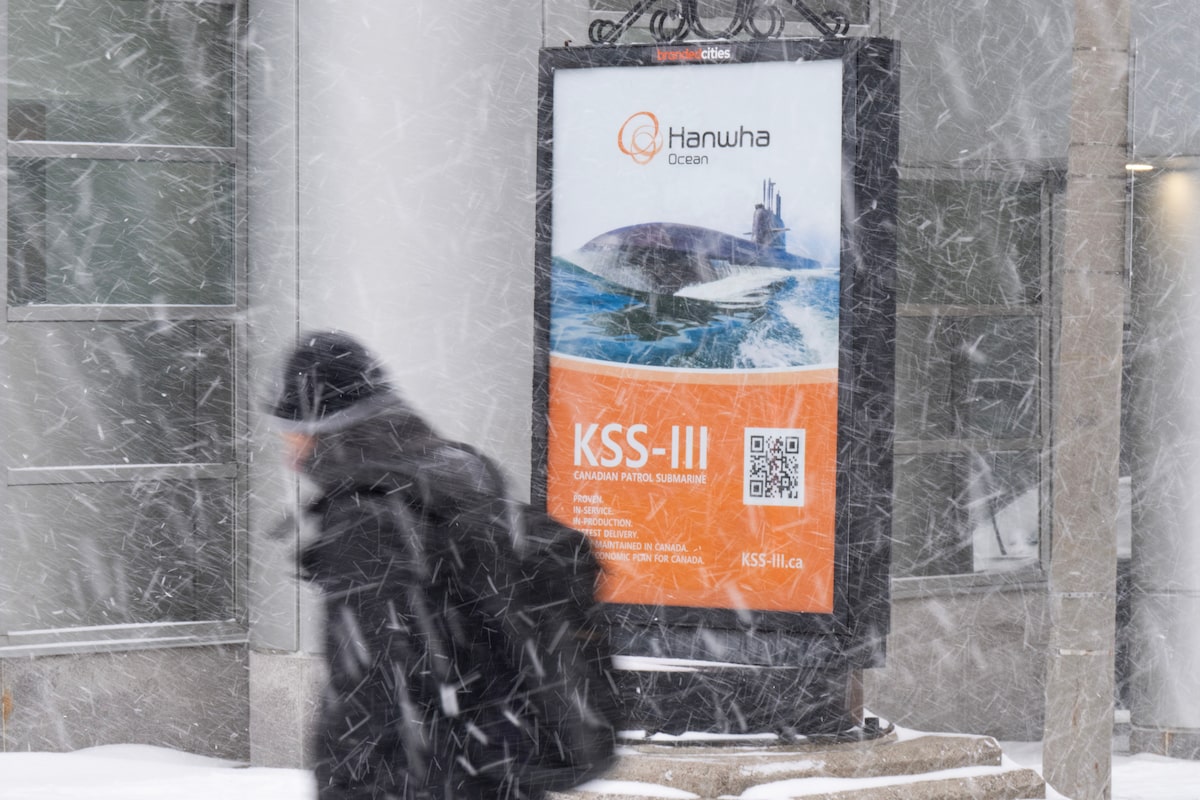
A man walks past an ad for military submarines in the downtown core near Parliament Hill. The South Korean model, the KSS III Batch II, can fire ballistic missiles.Adrian Wyld/The Canadian Press
The new submarines Canada plans to buy will not arrive with all the necessary equipment to operate under Arctic ice, meaning they will require modifications after delivery, the head of the navy says.
Vice-Admiral Angus Topshee said Canada will need to add under-ice gear to the boats after they arrive, such as upward-facing sonar that can detect and map overhead ice and areas of open water.
“Rather than only being worried about the bottom below us, we’re going to be worried about the ice above us, because the ice is actually less predictable,” the naval commander said in an interview.
He also said under-ice operations will not be a significant component of the submarines’ tasks. Instead, their biggest task will be monitoring approaches to the Arctic and other chokepoints.
Canada is seeking up to 12 new submarines and has narrowed the search to two models: one from South Korea and another from a joint German-Norwegian partnership. Ottawa is expected to pick one of these vessels this year.
Germany’s TKMS agrees to work with Seaspan to support future fleet of submarines
This would be the largest submarine purchase in Canadian history. It’s being made at a time of heightened anxiety over the country’s sovereignty in the Arctic, as world powers, including the United States, increasingly look north for resources and shipping lanes. Canada is also under pressure to increase its military expenditures in order to hit a new, higher NATO spending target.
Vice-Adm. Topshee called the needed under-ice operation modifications “relatively simple” to accomplish, but said Canada will proceed carefully on developing its capability in the Arctic environment.
“That’s what we’re going to be targeting: to be able to come up to the surface in basically a crack of open water if we want to,” the commander said. “Part of ability to operate under there is to be able to return safely to the surface when it’s possible.”
Vice-Adm. Topshee said the majority of the effort by the new submarine fleet will be monitoring the chokepoints in the Bering Strait, the Gulf of St. Lawrence and the transit between Nova Scotia and Newfoundland, as well as the Juan de Fuca Strait between British Columbia and Washington State, the entrance to the Puget Sound and the approaches to northern Vancouver Island, Prince Rupert, B.C., and Kitimat, B.C.
He said after taking delivery of the submarines, Canada will “start to work toward going under-ice, up into the Arctic, and then developing an actual under-ice capability.”
South Korean delegation heads to Canada to lobby for submarine project amid competition with Germany
The commander said Canada will also have to verify whether any other modifications are necessary because of the frigid temperatures of Arctic waters.
Canada is drawing lessons on outfitting subs for Arctic operations from Portugal’s navy, which recently modified one vessel to operate under the ice, the naval commander said.
Canada’s submarine purchase will be transformative for this country’s military might. When the subs are delivered, it will be the first time in history that the Royal Canadian Navy will have more than a token presence underwater.
The country hasn’t purchased unused submarines since the 1960s, during the Cold War, and has never ordered anywhere near 12 at once. It currently has four second-hand subs, but only one is normally operational.
The existing Victoria-class subs never journeyed under the ice. Their capability to operate while fully submerged extends only to a handful of days, whereas the new vessels will have underwater endurance measured in weeks, Vice-Adm. Topshee said.
TKMS seeks multibillion-dollar investment package to help win Canadian submarine tender
The Navy commander said part of Canada’s process of acclimating to operating underwater in the Arctic environment will be determining how often submarines need to go under ice.
“When would we go under the ice? And for what purpose? What missions and roles would we be doing?” he said.
Other resources, such as sensors, could play a useful role in monitoring ice-clad waterways instead of submarines, he added, noting that the environment under the ice is extremely noisy.
“You start to lose a whole bunch of capacity and so it becomes more difficult to operate in that environment and you start to ask yourself, ‘Why do I need to go there? Couldn’t I just send a sensor down there?’”
“Under ice is a difficult environment. Submarines really rely on hearing things, using their sonar to detect stuff,” he said.
This means some scenarios aren’t suited to manned craft. “We could do it, because it’s fun and exciting to do,” he said. “But that doesn’t really make a lot of point in some cases.”
The Canadian military has said it needs 12 submarines to properly defend the country, based on the assumption that for high readiness only one of every four vessels would be fit to deploy, with others under maintenance or used for training.
The understated name of Ottawa’s acquisition program – Canadian Patrol Submarine Project – obscures what’s really happening. Canada is buying vessels with a serious offensive capability to launch missile strikes and both options being considered are attack submarines. The South Korean model, the KSS III Batch II, can fire ballistic missiles, for instance.
South Korean bidder Hanwha says if under contract by 2026, it could deliver the first sub by 2032 and four by 2035. Germany’s TKMS has said the company “is positioned to deliver the first submarine well in advance of 2035.”