
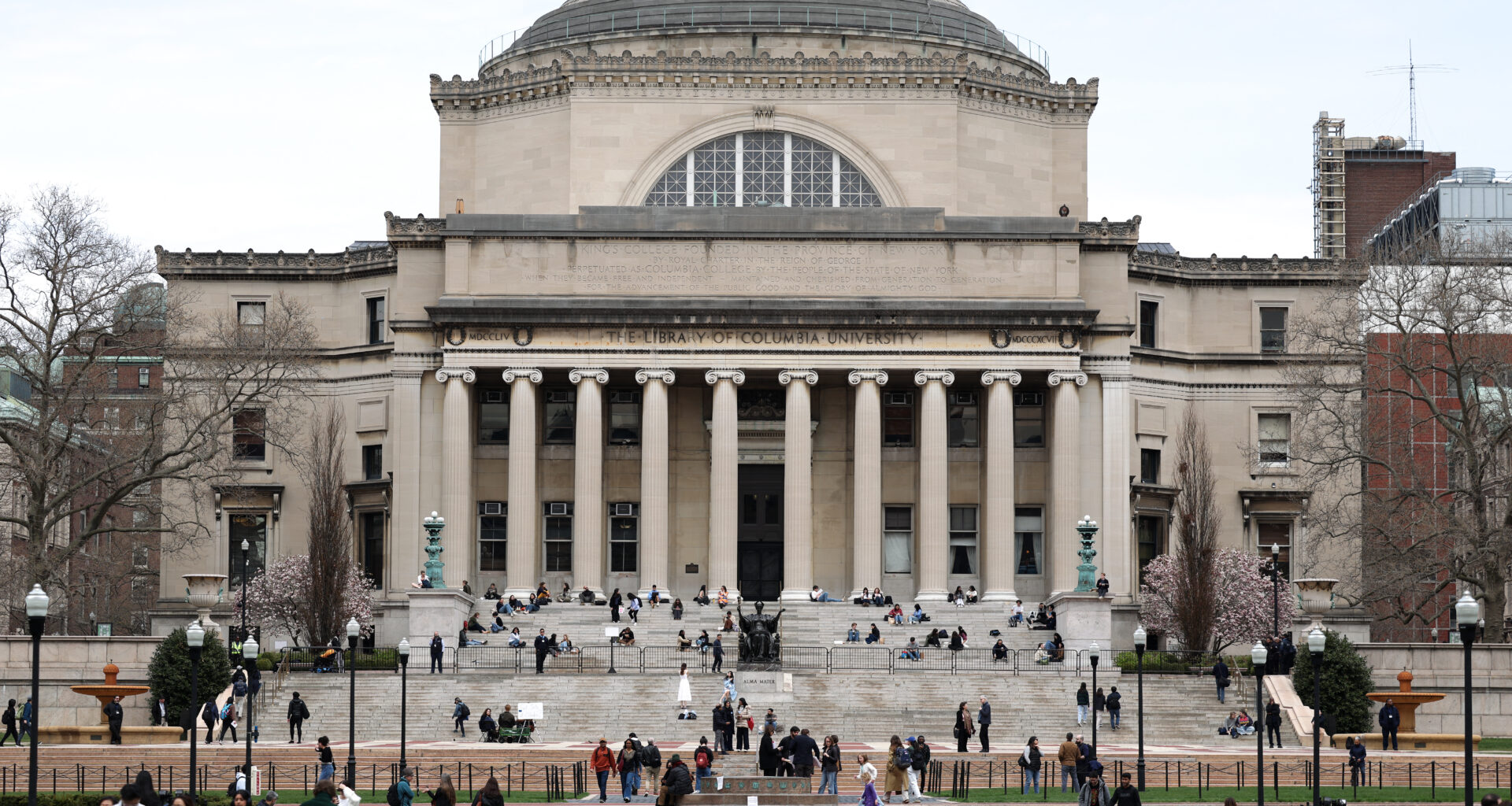
Columbia University is considering expanding and refocusing its Middle Eastern studies department’s instruction on Israel, the provost’s regional review committee announced in a set of recommendations this week, marking a pivot in a field and at a school that have come under immense scrutiny from the federal government and Jewish leaders following the Oct. 7, 2023, Hamas attacks.
Among its recommendations, the review committee urged the department to strengthen its relationship with the school’s Institute for Israel and Jewish Studies through visiting professorships. The IIJS will host a multiyear visiting appointment for a professor to teach about the history of modern Israel beginning this fall, the report said.
Some faculty in Middle Eastern studies departments at Columbia and other elite institutions praised Oct. 7 as “resistance” against the “settler-colonial” Israeli state. Critics of the field have long alleged that it teaches students a one-sided history of the Middle East, describing Israel as the perpetual villain.
A December report by the Columbia University task force overseeing efforts to combat antisemitism on campus spotlighted Columbia’s lack of “full-time tenure line faculty expertise in Middle East history, politics, political economy and policy that is not explicitly anti-Zionist.” The task force found that the absence of ideological diversity had an impact on course offerings — in listening sessions, students said that classes at the university more often than not treat Israel as entirely illegitimate.
The provost’s review committee is headed by Miguel Urquiola, senior vice provost for academic initiatives, whom the university appointed to oversee the department as part of a settlement with the Trump administration after $400 million in federal funding was cut last year over Columbia’s alleged failure to address antisemitism.
Among Trump’s demands for funding to be restored was a mandate to place the Middle Eastern, South Asian, and African Studies (MESAAS) department under academic receivership. While Columbia did not commit to academic receivership, it appointed Urquiola and created the review committee in September, selecting the Middle East as the first region to be reviewed.
The committee’s report additionally states that the School of International and Public Affairs is “finalizing” arrangements for a visiting professor to teach about economic and other policy issues in Israel, scheduled to begin this fall. SIPA partnered with the IIJS to appoint a visiting professor to teach courses on the Jewish world and Middle East policy for a three-year term. The two schools are searching for a joint professor of Israel and Jewish studies, which the review committee notes “may be on the tenure- or practice-track.” The review committee also suggested offering a new undergraduate major or minor in Middle East social sciences and policy, which would fall under SIPA’s undergraduate offerings.
The report further states that the school’s political science department is “actively considering” launching a search for a permanent faculty member to be appointed together with IIJS.
“Columbia’s MESAAS department is notoriously lacking viewpoint diversity, particularly as it relates to Israel,” Lishi Baker, a senior studying Middle East history, told Jewish Insider. “I am grateful that Columbia is finding other ways to increase its course offerings about Israel so that students interested in the region are not stuck with the MESAAS propaganda.”
The recommendations also noted that the search to fill the Edward Said professorship in modern Arab studies and literature is ongoing. The role has been open since Rashid Khalidi retired in August after two decades at Columbia, stating that the university’s adoption of the International Holocaust Remembrance Alliance working definition of antisemitism — which he said conflated criticism of the state of Israel with antisemitism — made it “impossible for me to teach modern Middle East history.”
Two professors under consideration for the position have faced disciplinary action from their universities for participating in antisemitic and anti-Israel activity, The Washington Free Beacon reported this week.
Rosie Bsheer, an associate professor of history at Harvard and formerly the associate director of the university’s Center for Middle Eastern Studies was removed from her role at the Center for Middle Eastern Studies after events she hosted “very likely” violated the IHRA definition of antisemitism, according to former Harvard President Lawrence Summers.
Max Weiss, a Princeton University professor of history and an advocate of an academic boycott of Israel, was put on probation for holding class inside an anti-Israel encampment.