
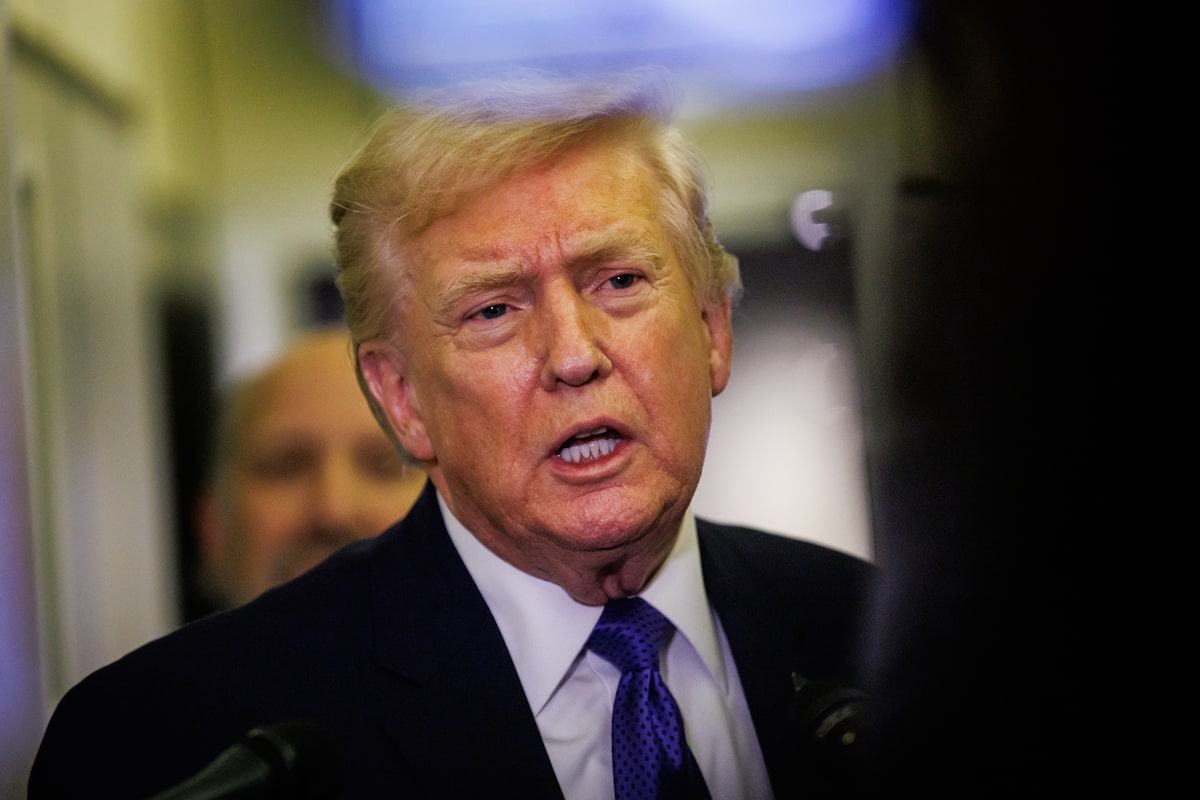
U.S. President Donald Trump speaks with reporters while aboard Air Force One en route to Palm Beach, Florida.Samuel Corum/Getty Images
It’s like watching a reboot of a bad sitcom.
U.S. President Donald Trump is calling the United States-Mexico-Canada Agreement “irrelevant” and making noises about striking bilateral deals with Mexico and Canada instead of revising the three-way pact after this year’s mandatory review.
Don’t touch that dial. History teaches us that Mr. Trump’s jibber-jabber will soon devolve into a full-blown threat of the U.S. going it alone with Mexico on a two-way trade deal and cutting out Canada completely – unless, of course, Ottawa agrees to his laundry list of unreasonable demands.
I am not making a bold prediction. Mr. Trump uses the same tired moves repeatedly to bully Canada on trade because, well, he is an unimaginative man who thinks he can.
During his first term as president, Mr. Trump used that exact strategy after calling the North American free-trade agreement, or NAFTA, the worst trade deal in history. On Aug. 27, 2018, he announced the U.S. had reached a bilateral deal with Mexico, warning that Canada would be excluded and slapped with auto tariffs if it failed to “negotiate fairly.”
Opinion: Trump’s bridge threat heralds pain and turmoil for USMCA talks
“They used to call it NAFTA,” Mr. Trump said at the time. “We’re going to call it the United States-Mexico Trade Agreement.”
Days later, he took to Twitter, as it was known back then, to blame Canada and browbeat Congress to butt out.
“There is no political necessity to keep Canada in the new NAFTA deal. If we don’t make a fair deal for the U.S. after decades of abuse, Canada will be out,” Mr. Trump posted on Sept. 1, 2018. “Congress should not interfere w/ these negotiations or I will simply terminate NAFTA entirely & we will be far better off…”
Mr. Trump’s 2018 threat of a U.S.-Mexico trade deal was a pivotal moment for Canada.
“This diminished Canada’s bargaining position as it was now in danger of being left out of the trade deal,” states an article published in the Vanderbilt Journal of Transnational Law in 2020. “Ultimately, Canada did sign the USMCA on November 30, 2018,” it later added.
Make no mistake, we are witnessing a 2018 redux.
In December, U.S. Trade Representative Jamieson Greer told Politico that Mr. Trump could decide to withdraw from USMCA in 2026: “The President’s view is he only wants deals that are a good deal.”
Like any good American imperialist, Mr. Greer also sought to divide and conquer Canada and Mexico by stressing the U.S. has “totally different” relationships with each country.
This is Mr. Trump’s same old schtick.
There are also signs that Mexico is preparing to hang Canada out to dry – again.
Late last month, the U.S. and Mexico agreed to formally start discussions about possible changes to USMCA. Those could include “possible structural and strategic reforms” such as “stronger rules of origin for key industrial goods, enhanced collaboration on critical minerals, and increased external trade policy alignment,” according to Mr. Greer.
Opinion: Why there’s an opportunity for Canada to help build new free-trade relationships
Mexico and Canada are plotting diverging paths when it comes to negotiating with the U.S., observed Ian Bremmer, president and founder of Eurasia Group, a political risk consultancy, earlier this week.
“president claudia sheinbaum has decided mexico has no options but the united states and so is leaning fully into ensuring the bilateral relationship is as stable and engaged as possible,” Mr. Bremmer wrote in his Monday missive. (He has a thing about writing in lower-case letters.)
“it’s dramatically different than canada’s approach—short of mexico’s red line on the united states unilaterally breaching mexican sovereignty with military operations, the mexican government has attempted to satisfy every american demand, despite domestic backlash.”
As the proverb goes: Fool me once, shame on you. Fool me twice, shame on me.
Back in 2018, then Conservative Party deputy leader Lisa Raitt was blunt about Canada’s predicament: “The Mexicans simply outhustled us.”
This time around, however, Canada does have a measure of protection if it finds itself sidelined by the U.S. and Mexico.
Canada and Mexico are both signatories to the Comprehensive and Progressive Agreement for Trans-Pacific Partnership, a multilateral trade treaty that entered into force at the end of 2018.
The U.S. is not a party to the CPTPP. It withdrew from the CPTPP’s predecessor agreement, Trans-Pacific Partnership, in 2017 thanks to Mr. Trump.
Indian investors watching USMCA talks as they weigh buying stakes in Canada
To his credit, Prime Minister Mark Carney is proving too canny to take the bait from the U.S. Nor does he seem distracted by Ms. Sheinbaum’s genuflection to Mr. Trump.
Mr. Carney has rightly refused to negotiate in public regarding a possible harmonization of trade policy with the U.S. because he is familiar with this plot twist in the story.
As Mr. Trump dusts off his old playbook on trade, Canadians should expect more threats targeting autos, dairy, metals, digital services and even textiles. Past precedent also portends a tantrum or two to weaken the dispute-settlement process under USMCA.
Unfortunately, the Trump show is turning into a mini-series starring an over-exposed reality TV star.
Mr. Trump jumped the shark years ago. That is precisely why we cannot afford to tune him out.