
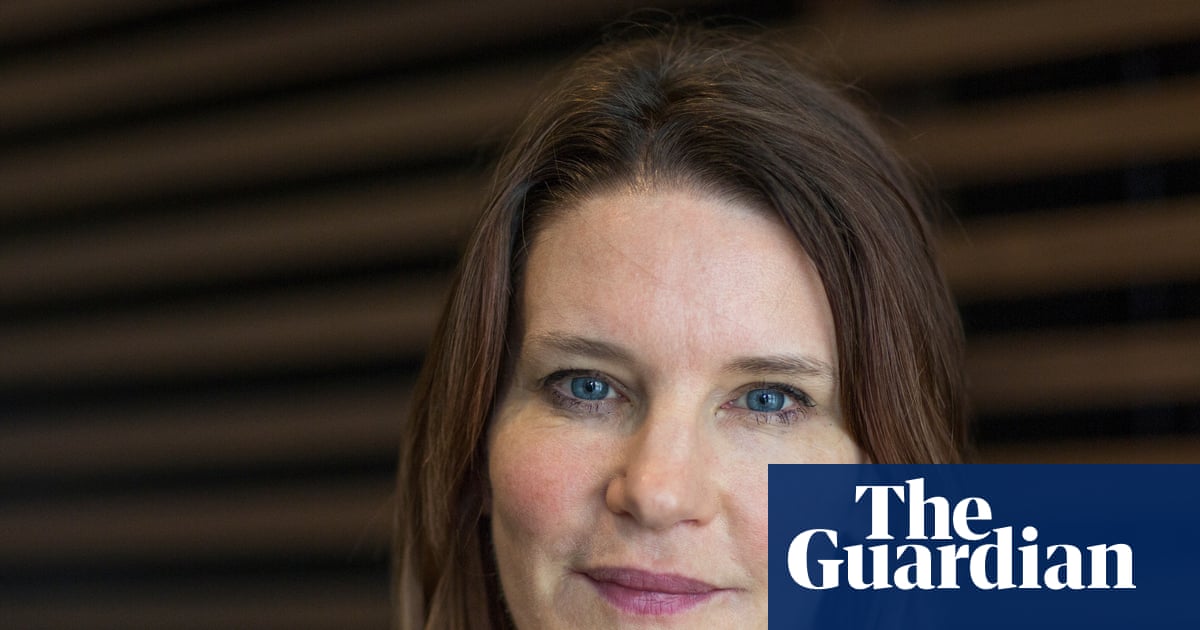
Children’s vocabulary is shrinking as reading loses out to screen time, according to the lexicographer Susie Dent, who is urging families to read, talk and play word games to boost language development.
The Countdown star’s warning comes as the government prepares to issue its first advice to parents on how to manage screen use in under-fives, amid concerns that excessive screen time is damaging children’s language development.
“So many children are now falling behind,” Dent said. “The vocabulary gap is getting bigger and there is a real perception that vocabulary development is suffering and that impacts on learning.”
Citing a 2023 Oxford University Press report that found that two in five pupils had fallen behind in vocabulary development, she said: “There is a huge perception that screen time is having a negative impact on vocabulary, and I think that’s because it is taking away from reading time. The digital lives of our children are taking a greater and greater role and reading certainly is in decline.
“I’m not saying no to screens altogether,” Dent said. “I think technology has a huge role to play in enhancing children’s vocabulary, if it’s used in the right way. But I think reading is really suffering.”
Dent, who has two daughters (one, she said, more in thrall to screens than the other), said English-language speakers had always been afraid of new technology.
“The Victorians were scared of the postcard because they thought it would hamper eloquence because people were going to have to cram sentences into a very small space. And the same happened with the telegram – there was great fear over that. And then we saw that magnified with the advent of the internet.
“There are many ways in which the internet is actually helping. Rather than reducing language or English to some sort of bland monolith, it’s actually encouraged variety. But there is a sweet spot between over-immersion and just using it in ways that can be beneficial.”
Dent, who co-presents Channel 4’s Secret Genius with Alan Carr, is fronting a new campaign – working with an unexpected partner, Soreen malt loaf – aimed at boosting children’s vocabulary at snack time.
A limited edition of Soreen lunchbox loaves will include fun words such as kerfuffle and hullabaloo, with definition and origins, as a way of sparking children’s curiosity.
“This is really close to my heart because I spend my life trying to encourage people, especially children, to enjoy the dictionary because I think it has more drama and magic and adventure than almost any other book I can imagine, and you will also find out the most wonderful stories,” Dent said.
“I think we have lost a bit of that magic. Every age has thought that the golden age of language was in the past … and that somehow everything was perfect in the past. But I do think we are facing a huge challenge at the moment.
“Obviously our children are learning from our habits and many of us get our work emails on our phone, so actually we are working on our phone, but what children are seeing is the constant absorption by something that’s not them.
“We’ve all seen – and I think we’re all guilty of this – parents in cafes literally just looking at their phone while their children are just sitting looking as well. And that in some ways is a great sadness because conversation is everything.
“For me the biggest worry is the widening gap between children who do read and who do have good vocabulary acquisition and those who don’t. It’s quite a well-known effect that children who read will then accelerate their vocabulary acquisition much more quickly and it’s at a much higher rate.”
Is it a crisis? “When we use hyperbole for everything, it makes everything a crisis and it doesn’t particularly help,” Dent said. “But I think there is a huge concern around reading and vocabulary expansion.
“I would just say that there are ways that we can address it. So it is not a foregone conclusion that this is going to continue exponentially and we are about to fall off a cliff. There are definitely things that can be done.
“Dialogue or conversation integrated into daily life is really important, also word-based games. This is another way in which actually going online can help, because there are so many brilliant word games out there.”
Dent also believes that learning a foreign language can play a critical role in developing a love and understanding of English. “If there’s one thing I could change, it would be to really promote the learning of foreign languages at school, because it’s just huge. It’s immeasurable the advantage it can give you.”
Asked if it should be compulsory in schools, she said: “I would love it to be. It might seem like a chore, but I don’t think anyone ever regrets having learned a foreign language.”