

Listen to this article
Estimated 5 minutes
The audio version of this article is generated by AI-based technology. Mispronunciations can occur. We are working with our partners to continually review and improve the results.
The powerful U.S. agriculture industry is throwing its weight behind the Canada-U.S.-Mexico trade agreement, urging the Trump administration to consider the deal’s economic benefits to rural America before making any moves to rip it up.
Some 40 organizations representing farmers, ranchers, food producers and processors have launched what they call the Agricultural Coalition for USMCA, the American acronym for the three-way trade deal known in Canada as CUSMA.
Their campaign, which includes advertising, research and lobbying, puts a heavy emphasis on how the agreement has boosted jobs and revenue in the U.S. agriculture industry. Their targets include members of Congress, senior White House officials and U.S. President Donald Trump.
“Collectively, our point is to make sure that our message resonates with the president. We know that he has an ear to the rural communities and farmers and agriculture,” said Nancy Martinez, a spokesperson for the coalition and a director of the National Corn Growers Association, in an interview Wednesday with CBC News.
This push by the agriculture industry comes amid deep uncertainty about the future of CUSMA, a trade deal that Trump signed in his first term but has repeatedly disparaged over the past year.
The agreement insulates a significant portion of Canadian and Mexican exports from some of the tariffs that Trump has imposed since his return to the White House. But the deal is at a crossroads in 2026: the three countries must decide whether to renew it, renegotiate its terms or let it expire.
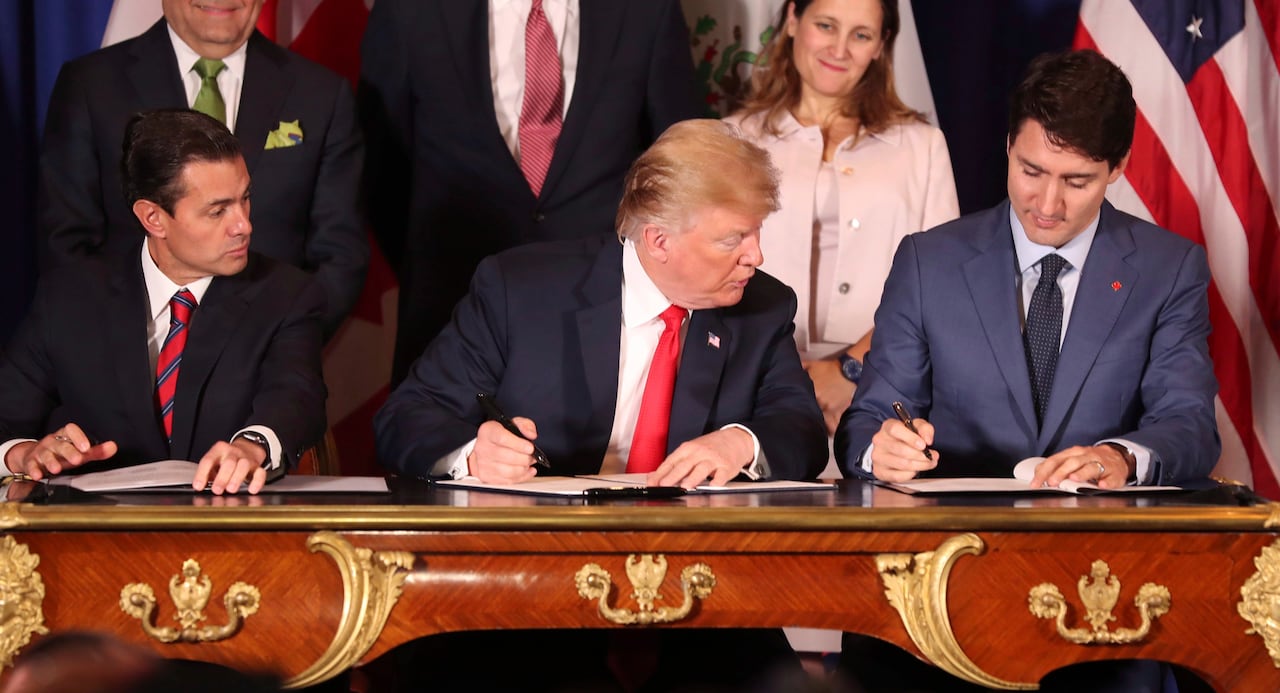 U.S. President Donald Trump, centre, signed the three-way trade deal with Canada and Mexico on Nov. 30, 2018, along with then-prime minister Justin Trudeau and Mexico’s then-president Enrique Pena Nieto. (Martin Mejia/The Associated Press)
As the July 1 renewal deadline approaches, Trump and his officials have already floated everything from negotiating better terms, breaking it into separate deals with Canada and Mexico or abandoning it altogether.
Trump has spoken to aides about the possibility of withdrawing, Bloomberg News reported Wednesday.
Any country can withdraw from the agreement with six months’ notice. Trump used threats of withdrawal as a pressure tactic in the talks that led up to the deal’s signing in 2018.
Campaign includes ads on Trump’s Truth Social
Martinez says trade with Canada and Mexico has benefited the U.S. agricultural industry tremendously.
“U.S. agriculture has a great and positive story to tell on the benefits of USMCA, and we do not feel that the message has been put out there as much as some of the negative messages have been,” she said.
The coalition is trying to get that message to officials in Washington through targeted advertising around the capital, including digital ads on such platforms as Trump’s Truth Social.
“The goal of our campaign is to make sure that everybody in the policy world and the executive branch understands what we’re really talking about here,” Martinez said.
WATCH | What U.S. industry groups really think about CUSMA trade deal:
Business leaders warn abandoning CUSMA could be ‘economic catastrophe’
On the second day of high-stakes consultation hearings in Washington, several U.S. business leaders spoke in defence of CUSMA as President Donald Trump threatens to exit the trade deal early.
The coalition released an economic analysis this week showing what it describes as USMCA’s contributions to farmers and rural America.
Among the report’s key findings:
Canada and Mexico account for roughly one-third of the value of U.S. agricultural exports worldwide.Agricultural and seafood exports to Canada and Mexico generated $149 billion US in domestic economic activity in 2024, including $36 billion US in wages. The value of U.S. agricultural exports to Canada and Mexico has increased 47 per cent since the agreement took effect in 2020, a notably sharper growth rate than the 18 per cent increase in the value of exports to the rest of the world over the same period.
“The economic benefits of USMCA drive investment, strengthen the competitiveness of U.S. producers in global markets, and keep family farms, small businesses and employers in operation,” says the analysis.
Alexis Taylor, chief global policy officer of the International Fresh Produce Association, another member of the agriculture coalition, says the market access provided by CUSMA brings economic benefits to more than just farmers.
“Local grocery stores feel it, banks benefit from it and those small businesses and rural communities feel it,” Taylor told a news conference this week.
WATCH | The Canada-U.S.-Mexico trade agreement is up for review. Will it survive?:
CUSMA: It’s gonna be forever or it’s gonna go down in flames
An upcoming review of the Canada-United States-Mexico Agreement (CUSMA) could lead to major changes to North American trade. For The National, CBC’s Lyndsay Duncombe breaks down how it could play out and how businesses are preparing for the potential shift.
The coalition’s members say they are united in wanting CUSMA’s overall framework to remain, but some agricultural sectors want changes, most notably the U.S. dairy industry.
“USMCA is an extremely strong agreement, but it’s not perfect,” said Shawna Morris, executive vice president of trade policy for the National Milk Producers Federation.
“The USMCA review offers an unmissable opportunity to make some targeted enhancements so the agreement can live up to its full intended potential,” Morris told the coalition’s news conference.
The agricultural sector’s pro-CUSMA campaign follows hearings in Washington in December in which a wide range of U.S. industries including manufacturers, retailers and construction urged the Trump administration to maintain the trade deal.