
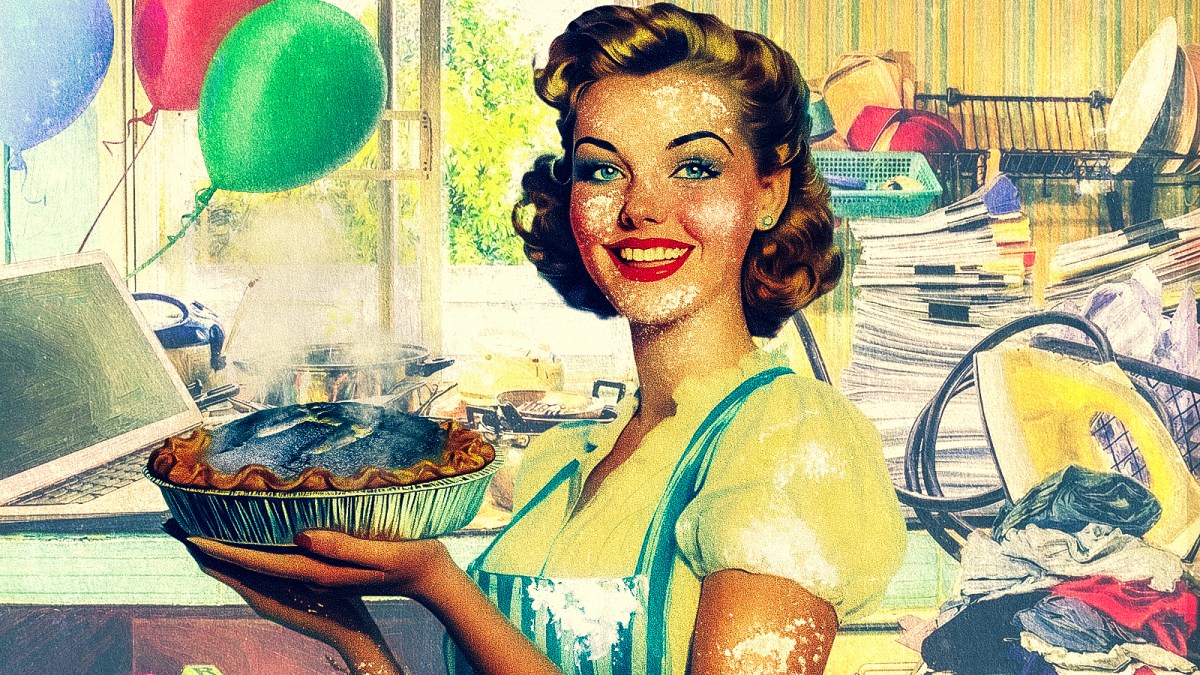
We like to tell the story of modern women as a clean arc of liberation. Girls outperformed boys at school, surged into university and the workplace, and forced men, companies and policy to catch up. Much of that is true. But there is a less triumphant truth. Women didn’t just gain freedom — families came to depend on their income.
Not so long ago, “dual income” meant security. The second salary paid for the extras — the foreign holiday, the savings buffer, home improvements. Today, for most families with children, two incomes don’t buy more. They buy the same life, at manic speed, requiring D-Day levels of organisation.
This didn’t happen because we all became more materialistic or because women became more ambitious. It happened because the costs that anchor adult stability (housing, childcare, education) rose faster than wages. Family budgets have adjusted around two salaries while workplaces and schools, arguably, have not.
• How Gen Alpha became the domestic powerbrokers
Dual income, double stress
Most millennial couples are dual earners, working harder to be less wealthy than their one-income parents. The lifestyle once sustained by a single decent wage now requires two. What looks like cultural progress has also been financial realignment.
And it was not sudden. Women have always worked. In 1975 roughly one in two mothers worked and half of all families were dual earning. The shift wasn’t women entering the workforce, it was women’s wages ceasing to be optional. Today, three-quarters of couples are dual income (usually out of necessity), juggling lives that their parents often find unrecognisable.
But “dual income” masks reality. For roughly a third of families, it means a 1.5-earner household — one full-time wage topped up by part-time work shaped by childcare calculations. This is the under-discussed compromise of modern family life: mothers working less, sometimes by preference, but often because the maths of childcare makes full-time work amount to simply being able to pay someone else to look after your child.

• Our five-point plan to make Britain better off
Lower down the income scale, a different compromise exists. Means-tested benefits taper as earnings rise, meaning a second income can function as a trap rather than a ladder.
Full-time dual earning is therefore concentrated higher up the income ladder, among those with stable jobs, predictable hours and flexible work — the people already ahead. Dual income has become a class advantage.
But if my household is anything to go by, the professional dual-income model has become its own cautionary tale. These families are not poor, but they are time-poor: overworked, overspent and overstressed. Two salaries may pay the mortgage and for childcare, but not the thing everyone actually wants — time with children, time to rest, time to live. The whole system depends on parents behaving as if they don’t have children.
Still needing the Bank of Mum and Dad
This is where the hidden third income appears: the Bank of Mum and Dad. Grandparents provide childcare, emergency buffers and the flexibility that makes “work-life balance” possible. It’s not just an advantage, it’s also awkward. Few things puncture the myth of independent adulthood faster than needing parental help to afford your own children.
And here’s the twist that exposes the lie: the one-earner household has not disappeared entirely. It still exists among the 0.5 per cent, where the old model survives. This is not because they’re more traditional or the women are uneducated, but because they can afford it.
For the richest families, a second salary isn’t necessary, while a full-time partner at home maximises comfort and flexibility. Feminists, look away — female domesticity has become a luxury and an aspiration. Is it any wonder that overworked mums scroll trad-wife content in their lunch break? The “outdated” model still exists, but only for those rich enough to opt out of the modern one.
At the other end of the spectrum are single-parent households, where one income is a necessity rather than a choice. Even here the story has shifted. Single parenthood has slowed in recent years, possibly due to declining divorce rates. The bigger story is that most lone parents now work (67 per cent), but often in low-paid, insecure jobs. They carry the dual-income pressure without the dual-income support. Unsurprisingly, they are more likely to rely on multigenerational living.
• One in four workers would run out of money in a month if they lost their job
The regional picture tells the same story from a different angle. Take the rise of female breadwinners. It is often framed as a story of female success, imagined through the lens of high-flying corporate women in the City. In reality it’s more likely to be a social worker in Sunderland. Female breadwinners are rising fastest in places like the North East of England, with weakening male employment and more public sector jobs. Working-class women are absorbing the long-term fallout of deindustrialisation.
Women bearing the burden
We also know that even if we have come to rely on dual incomes, we still can’t rely on dual domestic responsibilities. Even in households where women are the main earners, they remain the chief carers and household managers. And, in my case at least, because of our own controlling tendencies rather than male unwillingness.
We normalised the two-income household without building the structures to support it. Even in the hybrid era, the ideal worker is still imagined as unencumbered and treating family life as a private inconvenience. Because care is still feminised, it is predominantly women who adjust their hours, take the career-hit or absorb the penalty for having a life outside work. I know I’m not the only one the school calls first when something is awry.
If women’s full entry into paid work were treated as an economic shift, it would rank among the biggest growth stories of the past half-century, on a par with the digital revolution. Yet we rarely talk about it that way. Instead we’ve reduced gender division to a culture war, businesses dismiss care responsibilities as “work-life balance” stuff, and politicians ignore the economic and logistical weight under which families now operate. This isn’t a feminist issue. It’s economics. It shapes growth, insecurity, social fragmentation, and is probably a major cause of the political volatility of the past decade.
The middle classes used to be defined by stability. Now they face pressures that have long defined working-class life: fragility, dependence on two wages, exposure to shocks — especially without parental help.
Two incomes on the surface looks like security. For most families, it’s a tightrope. And the most revealing thing of all is that the only people who can still afford the old model are the ones wealthy enough to escape the new one.
Eliza Filby is the author of Inheritocracy: It’s Time to Talk About the Bank of Mum and Dad