
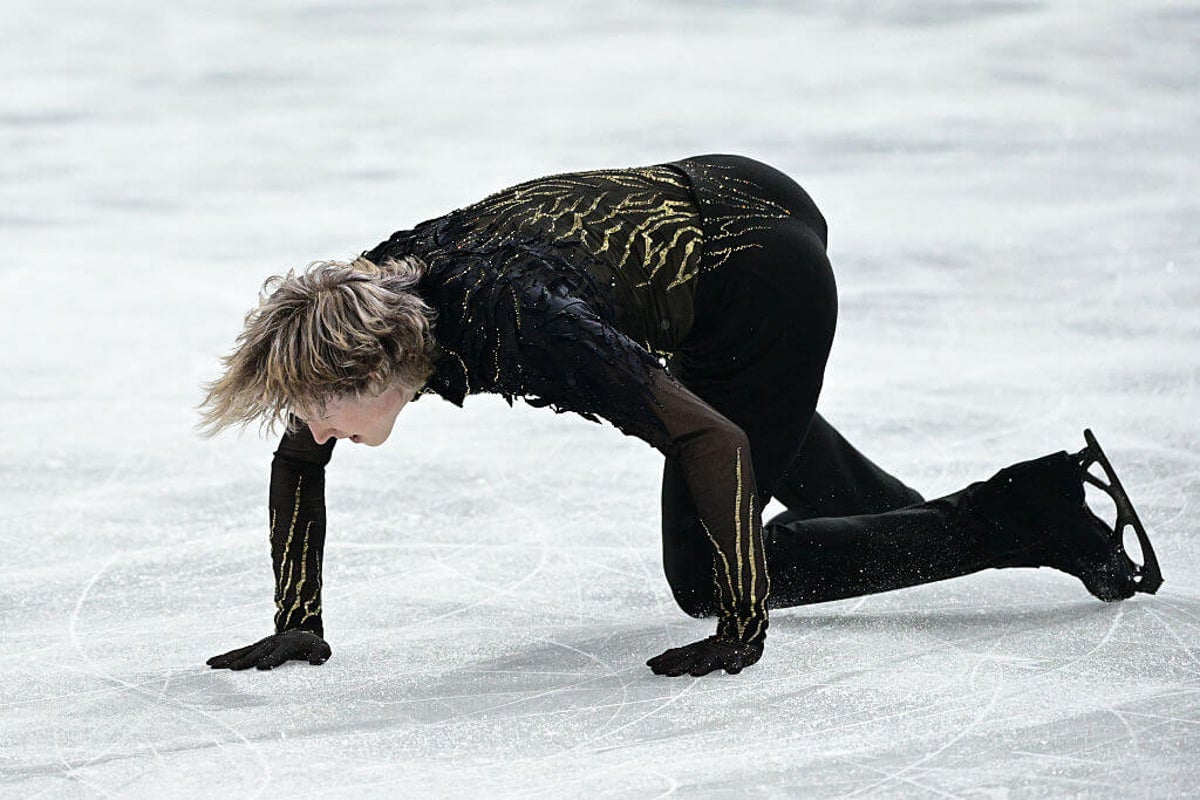
MILAN — When it was over, Ilia Malinin put his face in his hands. With disappointment painted on his face, he knew it. He squandered the gold medal.
And the silver. And the bronze.
On the biggest stage of his life, needing only a solid performance, Malinin’s form and composure fell apart. The world-record holder in free skate scoring with a 238.24 only needed a 183.43 to win the gold medal. He’d scored 200.03 in the free skate during the team event, which was low for him.
In a stunning upset Friday at the Milano Ice Skating Arena, Malinin managed just a 156.35. He only executed three of his seven planned quadruple jumps. It began when he couldn’t do the quad axel, his signature move, popping out of it for a single axel. It was downhill from there, including two rare falls.
The Quad God finished eighth, punctuating a rocky Olympic debut with a stunning downfall.
“Honestly, I still haven’t been able to process what just happened,” he said before a throng of reporters.
He spoke calmly, having found his composure. But the confusion remained like the sweat on his forehead. He felt good coming in, really solid. And he knows he’s better than the field. He knew all he had to do is what he does in every competition.
“But, of course, it’s not like any other competition,” he said. “It’s the Olympics. And I think people only realize the pressure and the nerves that actually happen from the inside. So it was really just something that overwhelmed me. And I just felt like I had no control.”
Kazakhstan’s Mikhail Shaidorov, ranked No. 3 in the world, had the skate of his life and it wound up being worthy of gold. Japan’s Yuma Kagiyama, who’s been sublime at the Milan Cortina Games, also tumbled and it cost him a lead before Malinin took the ice. He still finished with a silver. Kagiyama’s countryman Shun Sato won bronze.
“It definitely felt like not only nerves, but maybe the ice was also not the best condition for what I would like to have,” Malinin said. “And that’s something I cannot complain about because we’re all put in that situation where we have to skate no matter what happens.”
The invincible Malinin became beatable in Milan. His vulnerability a product of his struggles to put together clean skates. He looked tired and frazzled, the mark of inexperience on this massive Olympic stage.
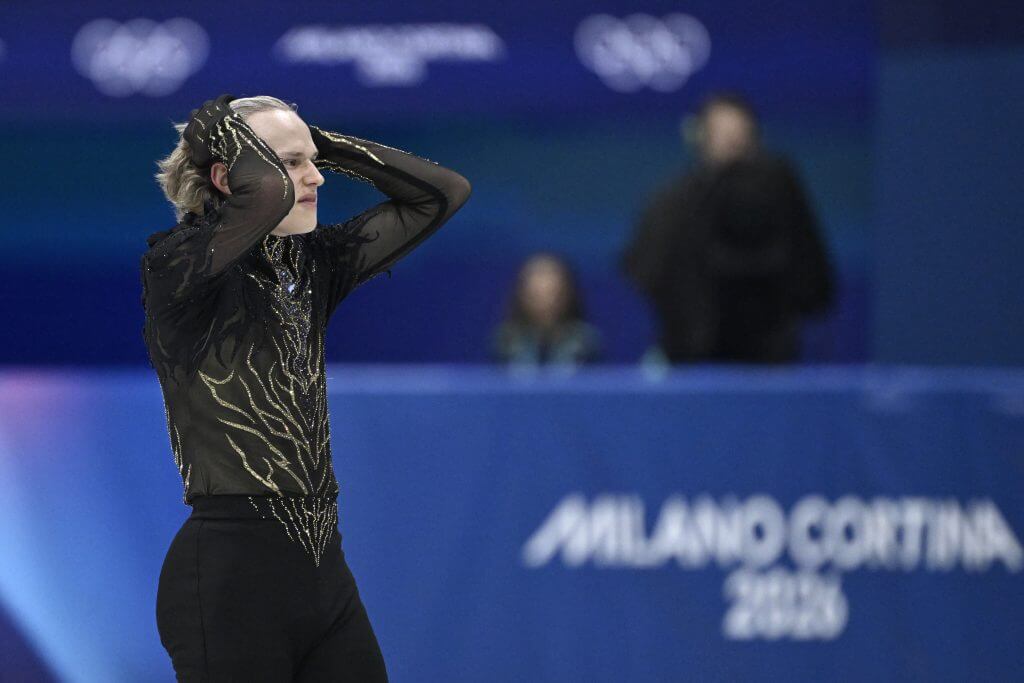
Malinin was heavily favored to win individual gold.(Photo by Wang Zhao / AFP via Getty Images)
Four years ago, Malinin skated the performance of this then 17-year-old life at the U.S. Championships. He came almost out of nowhere to snag silver, behind the gold medalist Nathan Chen, and signaled his promise as a future star.
But U.S. Figure Skating knows as much as anyone the different monster of Olympic competition. So it chose experience over potential. Vincent Zhou and Jason Brown over Malinin.
Malinin previously said he wouldn’t have made these Olympics if not for that disappointment in 2022. Being passed over gave him the drive to find a new level. But having arrived, the trait he seemed to miss most was experience. On this stage, composure matters. Consistency gains value. Cleanliness is next to goldenness. Such elements are easier to muster for those who have already felt the Olympics, which can overwhelm the psyche and swallow up athletes with its hype and magnitude.
The irony, from the vantage of hindsight, is that Malinin’s inexperience cost him a spot in the 2022 Beijing Games and also an individual gold in 2026.
He said as much in the kiss and cry zone as he awaited his score. “(If they had) sent me to Beijing, I wouldn’t have skated like that,” he said.
Later, he clarified while speaking with reporters.
“I think if I went to ’22, then I would have had more experience and know how to handle this Olympic environment, but also I don’t know what the next stages of my life would look like if I went there,” Malinin said. “So now all I can do is just regroup from this and really just take in the information that happened and just figure out how to manage in the future.”
Malinin — the four-time world champ, three-time Grand Prix champ, five-time U.S. champ — does leave Milan with a gold from the team competition. And his free skate there, the same planned routine he performed Friday night, secured that victory for the United States.
But the Quad God came to these Olympics to confirm the supremacy he’s established over the last four years. This was to be a culmination of his stardom. He’s brought a new audience. He gives it the best chance to expand beyond its niche corner of sports into the mainstream — as did Dorothy Hamill, Kristi Yamaguchi, Michelle Kwan, Boitano and Hamilton. And perhaps in this age of pop culture, with Malinin raised in social media culture, he could maybe take figure skating to places it has never been.
Yet athletes with such potential are expected to win gold on the biggest stage. Malinin’s talent demands as much. Friday’s performance belied that potential. And he’ll have to wait four years because the big stage took a toll from which he couldn’t recover.
“Being the Olympic gold hopeful is really just a lot to deal with, especially for my age,” he said.
The troubles began for Malinin in the short program of the team event. The world No. 1 went last, following Kagiyama, who masterfully executed his short program. Malinin did not, his routine suffering from a nervous energy and noticeable discombobulation.
He landed in second place. A jarring experience for a skater who hasn’t lost a competition since November 2023. It set off a chain of events that eventually worked against him.
The rough outing prompted Malinin to also do the free skate in the team event. Not only to get himself a feel-good performance before the men’s individual competition, but also because the Americans needed to win the free skate to secure the gold medal.
He did just that. It wasn’t his prettiest performance, but it was improved compared with his short program. He felt better about himself after the free skate. He said he figured some things out, solved the problem.
“I didn’t really understand the impact of the Olympic environment,” he said Sunday night. “I think I was kind of more in shock of really being at the Olympics for the first time.”
He later added, “Going out there the first time, hitting that Olympic ice and feeling the atmosphere. I didn’t expect it to be so much.”
The decision to free skate left Malinin with just one off day before having to take the ice again. Friday was his fourth skate in seven days.
That’s a daunting load for any skater. But when you add in the sheer physicality of Malinin’s performances — especially his free skate — it’s a serious energy drain. Malinin puts seven quadruple jumps in his program, including the quad axel. He hasn’t done it in competition since the Grand Prix final in December, when he set a world record with a free skate score of 238.24.
Malinin had talked about pacing himself since the U.S. Championships, when he didn’t go all out in winning his fifth consecutive national title. He also held back during the team event. After the U.S. took gold with his high-pressure free skate, the skaters remained at the arena late because of a gold medal ceremony and numerous interviews. There was some concern about the Quad God being deprived of rest with the men’s competition some 44 hours later.
It seemed that Malinin had overcome that hurdle. His next skate, the men’s singles short program, was his best of the three. He found his game. His control, his execution, it seemed to return.
Malinin had two days off following his short program. One good skate and he would win men’s gold.
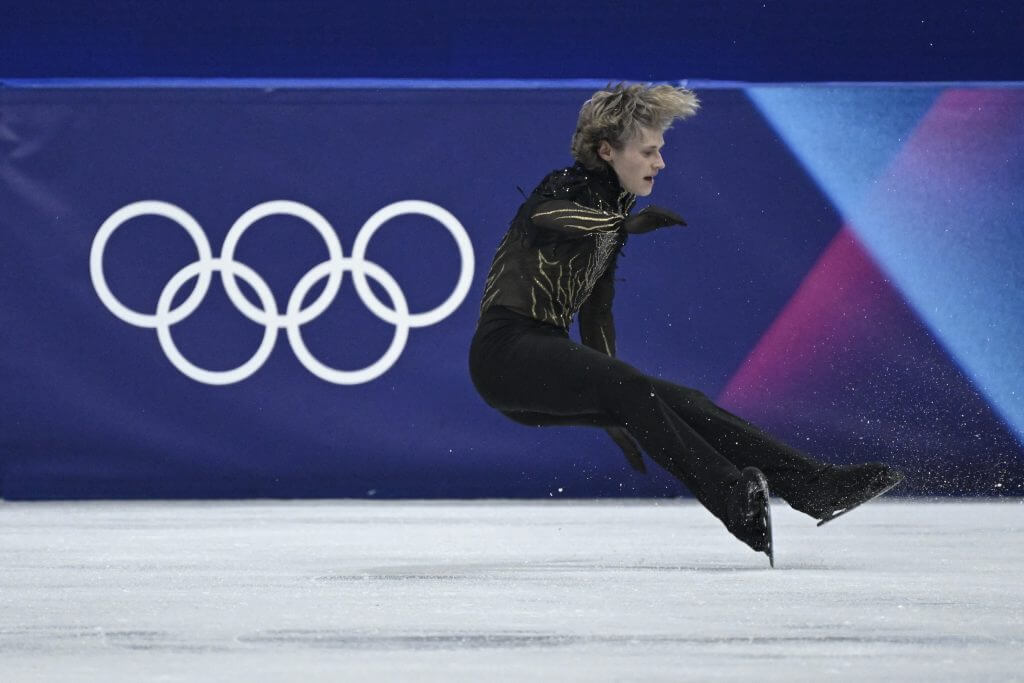
(Wang Zhao / AFP via Getty Images)
Whether the pressure, whether the fatigue, whether the whispers of injury were true, whether the moment was just too big for the biggest name in figure skating, Malinin couldn’t do it. He couldn’t land his quads cleanly. Couldn’t find the best of his edges. Leaving all those points on the table left the door open for the others.
The knock on Malinin has been that he’s all jumps, a cheat code in a sport with an essence based in technique and precision. But he became dominant because he honed his total package. He improved his skating, cleaned up his edges, infused more personality into his routines. He’s unbeatable when his other elements are on the level. They just aren’t always there.
Friday, in the new biggest skate of his life, it wasn’t there.
One can only wonder what happens if he doesn’t disappoint in his free skate. Or if he simply decides to leave the team free skate to Andrew Torgashev or Maxim Naumov, even if it costs the United States a team gold.
Or, if four years ago, the youngster still attending George C. Marshall High School in Falls Church, Va., got his Olympic experience at 17 instead of 21. Maybe he’s more prepared for the pressure this time.
He’ll be 25 in four years when the Winter Olympics take over Nice, France. He’ll have experience with the Olympic monster and still enough youth to potentially conquer it.