
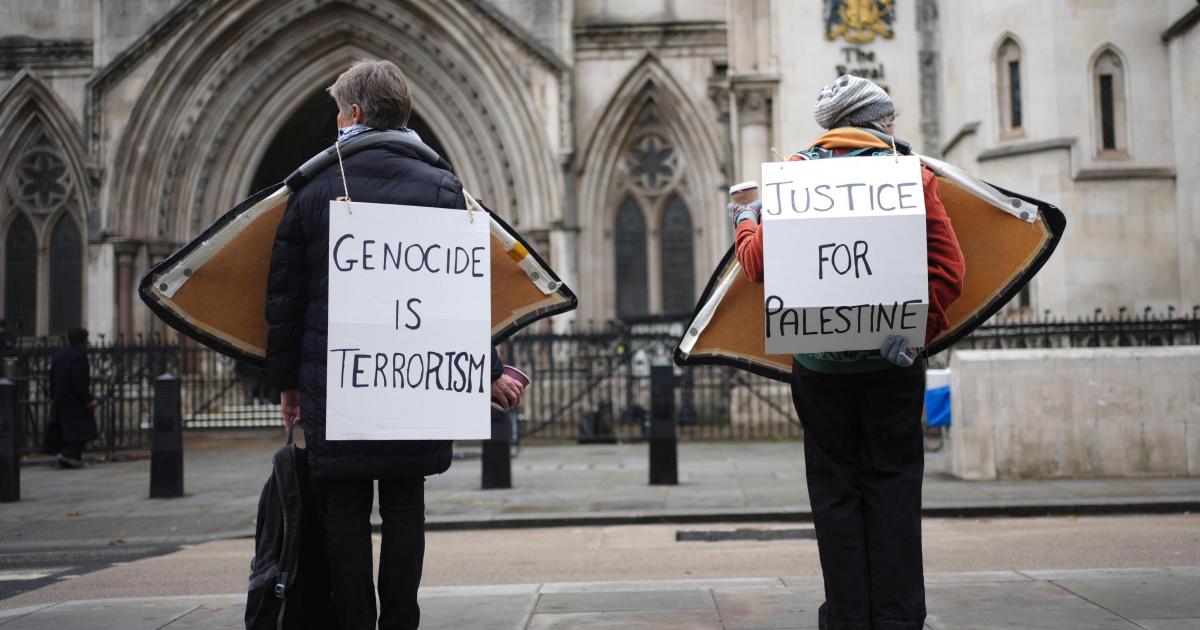
Justice Victoria Sharp said the court found that the ban on Palestine Action was “disproportionate” though it would remain in place to allow the Home Office a chance to appeal.
She said: “The court considered that the proscription of Palestine Action was disproportionate.
“A very small number of Palestine Action’s activities amounted to acts of terrorism within the definition of section 1 of the 2000 [Terrorism] Act.
“For these, and for Palestine Action’s other criminal activities, the general criminal law remains available.
“The nature and scale of Palestine Action’s activities falling within the definition of terrorism had not yet reached the level, scale and persistence to warrant proscription.”
The ban resulted in one of the largest campaigns of civil disobedience in the UK in recent years and the biggest prison hunger strike since the Irish republican hunger strike of 1981.
Pro-Palestine protesters
Sharp said that Palestine Action’s methods were “inconsistent with the hallmarks of civil disobedience” and said the group promoted its “political cause through criminality and the encouragement of criminality”.
This has included raids on commercial properties linked with the Israeli military and the damage of property, most notably vandalising planes at RAF Brize Norton.
But Sharp said this did not mean that the group fell within the definition of terrorism.
READ MORE: The eight court charges against Peter Murrell including ‘£460k embezzlement from SNP’
She argued that the Home Office had failed to prove that it was correct to restrict the freedom of speech and assembly “under the Palestine Action banner”.
Huda Ammori, who helped found the direct action group and took the UK Government to court over the ban, hailed the news, claiming that the group had “won”.
She added: “The High Court ruled the Palestine Action ban is unlawful as it is disproportionate to free speech and the Home Secretary breached her own policy.”
Home Secretary Shabana Mahmood
Home Secretary Shabana Mahmood said she was “disappointed” by the court’s decision and the UK Government would take the matter to the Court of Appeal.
She said: “The court has acknowledged that Palestine Action has carried out acts of terrorism, celebrated those who have taken part in those acts and promoted the use of violence.
“It has also concluded that Palestine Action is not an ordinary protest or civil disobedience group, and that its actions are not consistent with democratic values and the rule of law.
“For those reasons, I am disappointed by the court’s decision and disagree with the notion that banning this terrorist organisation is disproportionate.
READ MORE: UK urged to speak out as Donald Trump ‘attempts forced starvation of innocent people’
“The proscription of Palestine Action followed a rigorous and evidence-based decision-making process, endorsed by Parliament. The proscription does not prevent peaceful protest in support of the Palestinian cause, another point on which the court agrees.
“As a former lord chancellor, I have the deepest respect for our judiciary. Home Secretaries must however retain the ability to take action to protect our national security and keep the public safe. I intend to fight this judgment in the Court of Appeal.”
People who gathered outside the court to await the judges’ decision broke into cheers and chants of “free Palestine” after the ruling was announced. A number were carrying signs which read: “I oppose genocide, I support Palestine Action.”
Because of the ban, carrying posters or wearing clothes with that slogan can result in a terrorism conviction.
A police officer observes pro-Palestine Action protesters gathered outside the High Court
The ban, which began on July 5 last year, was widely seen as an unprecedented crackdown on freedom of speech and the right to protest, with thousands of people arrested for expressing support for the group.
Lawyers for Ammori last year told the High Court that the decision to ban the group was unlawful and said Palestine Action was the “direct-action civil disobedience organisation that does not advocate for violence” to be proscribed as a terrorist group.
The UK Government previously lost an attempt in the Court of Appeal to prevent the High Court hearing the successful legal challenge against the ban.
Among those who had been criminalised for expressing support for Palestine Action were “priests, teachers, pensioners, retired British Army officers” and an “81-year-old former magistrate”, the High Court heard in October.
Best-selling author Sally Rooney also became involved in the legal case, when she announced she would donate the profits from BBC adaptations of her work to Palestine Action.
In written evidence to the court, the Irish writer behind hits such as Normal People and Conversations with Friends, said it was “unclear” whether any UK company can make payments to her under anti-terror laws and that if she was prevented from profiting from her work, her income would be “enormously restricted”.
The Irish writer also said it is “almost certain” she cannot publish or produce new work in the UK while the ban remains in force.