
Stay informed with free updates
Simply sign up to the Life & Arts myFT Digest — delivered directly to your inbox.
Will thaa’ be gwan t’picture hoose, yon weekend? T’see yan’ Emerald Fennell’s version of t’book aboot mad wumman running wild on t’moors?
Apologies, I am no dialect expert. But in West Yorkshire do we set our scene. In preparation for the new screen adaptation of “Wuthering Heights” (please note the quote marks) I have been immersed in Emily Brontë lore.
Wuthering Heights was the only novel written by the complicated fifth Brontë sibling who grew up at Haworth Parsonage on the edge of the Yorkshire Moors. She published the book under a pseudonym in 1847, and died one year later of a fever for which she refused medical intervention. No one really knows much about her: she must be extrapolated from her disturbing prose. Writing in the preface, in 1850, her sister Charlotte described the writer as reclusive: “except to go to church or take a walk on the hills, she rarely crossed the threshold of home.”
Brontë’s romantic gothic novel is now considered to be one of the Best Books Ever Written. Her doomed romance between Catherine Earnshaw and her childhood friend (and possibly half-sibling) Heathcliff has since become a set text for adolescents, the subject of myriad adaptations, the spur behind a thriving tourist market in Yorkshire and a bastion of pop culture thanks to Kate Bush, whose own contribution to the discourse, the 1978 single “Wuthering Heights”, is celebrated globally by thousands of people re-enacting her iconic dance.
Suffice to say, the book is robust enough to withstand wild interpretation. But, like a good student, I felt obliged to reacquaint myself with Brontë’s OG version before heading to the multiplex. I dusted off a copy (a GCSE paperback, RRP £2.25) found tucked into the bookshelf and now gently yellowed over time. I could feel the call of my younger spirit stirring as I opened its pages, the words “vivid as spectres” swarmed alive. The cold clutch of my own sad adolescence tapped me etc . . . etc . . . OK, you get the point.
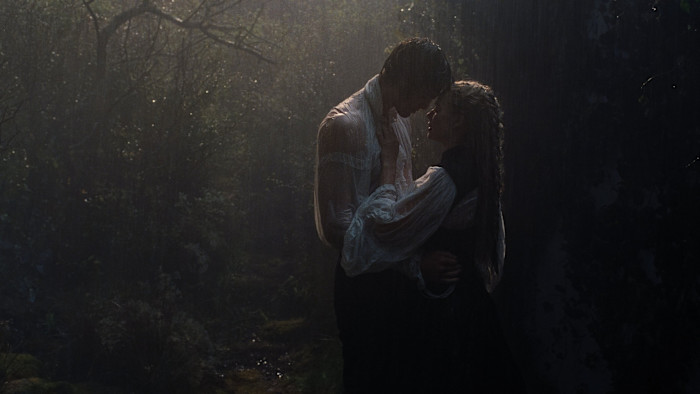
 Robbie stars as Catherine Earnshaw . . .
  . . . and Elordi plays Heathcliff
Mainly I reread Wuthering Heights so that I could gorge on the spectacle of Jacob Elordi and Margot Robbie getting mucky while keeping my integrity intact. I wanted to wallow in lusty admiration for Elordi’s epic hugeness (hey, it’s February) while wearing an intellectual sneer. Fennell, a filmmaker who has evolved a successful franchise of soft-core erotic thrillers (see Saltburn), well understood the job. Her slimy, albumen-obsessed adaptation is ripe with innuendo, violence, pseudo-masochistic teasing. There’s also lots of sex.
The plot, meanwhile, only glances at the shallowest features of the novel, derived mainly from the short romantic denouement of the couple’s love. Elordi’s Heathcliff is hot and broody, but neutered of any menace. And Margot Robbie’s “Cath” has been transformed from the dark, tormented victim of “perverted passion” (as Charlotte wrote in the preface), and reincarnated as a simpering blonde whose feral instincts now recall a Fulham Sloane post “sups” at Annabel’s.
Fennell’s Wuthering Heights is a maddeningly slight, pink turd of an adaptation. Nevertheless I am eternally grateful to her for reacquainting me with Brontë’s book. The wonderful side-note in all the hype building to this “god-tier new classic” (as one breathless X post called the adaptation) is that the 178-year-old novel is trending once again. UK sales of Wuthering Heights have more than doubled since the trailer was released last autumn, says Penguin Classics, with sales having risen by 469 per cent since last year. Likewise, in the US, sales have doubled to 180,000 print copies compared with the previous year.
Moreover, the adaption has spurred new conversation. We’re all eng-lit scholars now. Vogue launched its new book club with a study of the novel, and thousands of others are, like me, combing through a book not touched since high school in order to get up to speed. In desecrating one of the world’s favourite stories, Fennell has arguably reasserted its genius on a wider stage. Arriving hot into my WhatsApp chat group: Sexual Personae: Art and Decadence from Nefertiti to Emily Dickinson, Camille Paglia’s book of essays from 1990. I spent the weekend considering her theory in “Romantic Shadows” that “Emily Brontë’s sexual metathesis into Heathcliff is inseparable from the incestuous-twin theme.” Gor blimey. And of Brontë’s casual disregard for Christian taboos. I was especially taken also with Paglia’s appreciation for the “delicate lesbian eroticism” in which the book abounds.
Many have tutted about the lusty licentiousness with which Fennell has approached the text. She has called it an extreme story for extreme times. If only her interpretation was as demented as Brontë intended: this version is limp and curiously boring, a series of jump fucks designed for TikTok memes. The casting decisions have been tested — Heathcliff is supposed to be “a dark-skinned gypsy”. Cathy’s ghost has been exorcised. No! But the great sadness of this adaptation is in its refusal to embrace the madness at its centre. Wuthering Heights is a dark, deranged story about incest, appalling violence, sexual abuse and torture. It should be utterly unhinged.
Find out about our latest stories first — follow FT Weekend on Instagram, Bluesky and X, and sign up to receive the FT Weekend newsletter every Saturday morning