
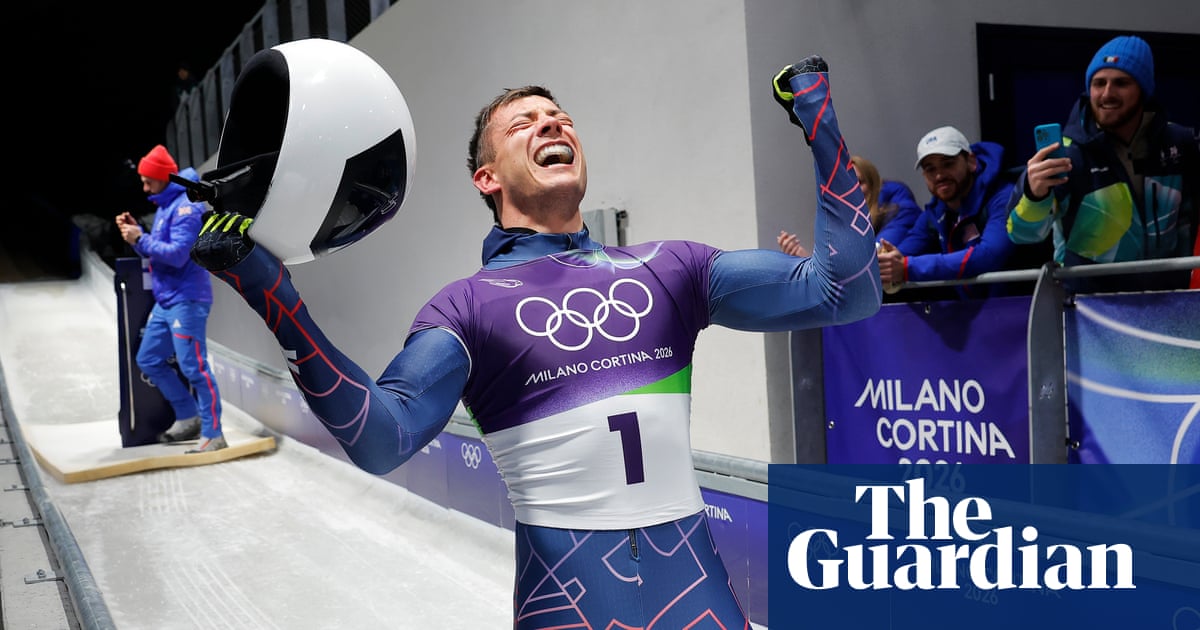
And on the seventh day, Great Britain finally won their first medal of these Olympics. At nine o’clock on Friday night Matt Weston, the man his teammates call “Captain 110%”, became the first British man ever to win the gold in the men’s skeleton, after four faultless races across the two days of competition.
The 28-year-old broke the track record at the Cortina Sliding Centre four times in succession, and won in a combined time of 3min 43.33sec, which was almost a full second ahead of the runner-up, Germany’s Axel Jungk. “I’ve been fortunate enough to win world championships, and European championships and other things, and this blows them all out the water,” Weston said. “I almost feel numb. I keep touching this medal to make sure it is real.”
He is getting married in July, “but for the next few months at least I can say yes, this is the happiest day of my life, then I will have to change my answer”.
Weston’s medal means Great Britain is now the most successful Olympic nation in this curious sport, which was invented by Englishmen looking for something new to do on their holidays in St Moritz in the 1920s. The country has now won four gold, one silver and five bronze medals altogether. Eight of those have come this century, after the UK started pumping in money in the early 2000s, when they built the beginnings of a practice track at the University of Bath.
Weston, and his teammate Marcus Wyatt, who finished ninth, have had the benefit of the best coaching and technical support in the sport. It shows, even if it’s hard to see on TV. “If it looks like I am lying there doing nothing it means I am doing everything right,” Weston said before coming out to these Olympics. During them, the clock told you everything you needed to know.
Matt Weston’s mum, Alison, his fiancee, Alex, and his dad, Tom, watch at the skeleton track in Cortina d’Ampezzo. Photograph: Tom Jenkins/The Guardian
His body may be moving at 80mph, but his mind’s working in slow motion as he shifts his weight to make the minuscule adjustments he needs to stay on the right line around every bend. He is moving so fast that a lot of this is done subconsciously. He has a map of the track in his mind, but he relies on his proprioception, the body’s innate ability to sense its own position and movement, to feel his way down around it.
Weston, Britain’s first male individual gold medallist in the Winter Games since Robin Cousins in 1980, says it is a skill he first learned competing in martial arts. When he was a kid, Weston was ranked second in the world in taekwondo. He won a silver at the Under-17 World Cup in 2012. If you’d asked him then, he would have told you he saw himself competing in taekwondo at the Grand Palais during the Summer Olympics in Paris two years ago. But he had to give up the sport when he fractured his back in a training accident. He played county level rugby for a few years on the wing, too. He is, you guess, one of those people who was always going to be an athlete of one sort or another.
But it was only when he discovered skeleton racing through a talent ID programme that he found his calling. “I distinctly remember the first time I tried it,” Weston said, “and for the first 10 metres I was thinking, ‘I’ve got no brakes so I’m going to the bottom whether I like it or not’. It was terrifying but as soon as I finished I wanted to go back and do it over again. I had the bug.”
Marcus Wyatt of Britain finished in ninth after his four runs. Photograph: Annegret Hilse/Reuters
Weston has spent a decade chasing after the perfect race. “It’s so hard to describe,” he said, “we work on such fine margins that it is so hard to be perfect, it’s like floating, it’s so smooth it’s almost calming, everything fits, everything clicks, like doing a jigsaw puzzle and picking up the right piece every single time.” It’s hard to believe he will ever come closer to it than he did here in Cortina. “I’m still hunting,” he says, “but at the moment this feels as close as it can get.”
Weston will race again in the mixed team event on Sunday, in which he will be paired with the fastest of the three British athletes competing in the final races of the women’s event on Saturday. That looks likely to be Tabby Stoecker, who was in fifth place after the first two heats of the competition.
She had been third after the first run, but made a bad mistake coming into the second half of the course. It left her half a second behind the leader. “I think I just need a good meal, a good sleep, some analysing with my coaches, and then to come back tomorrow,” said Stoecker, “because it’s definitely not over.”