
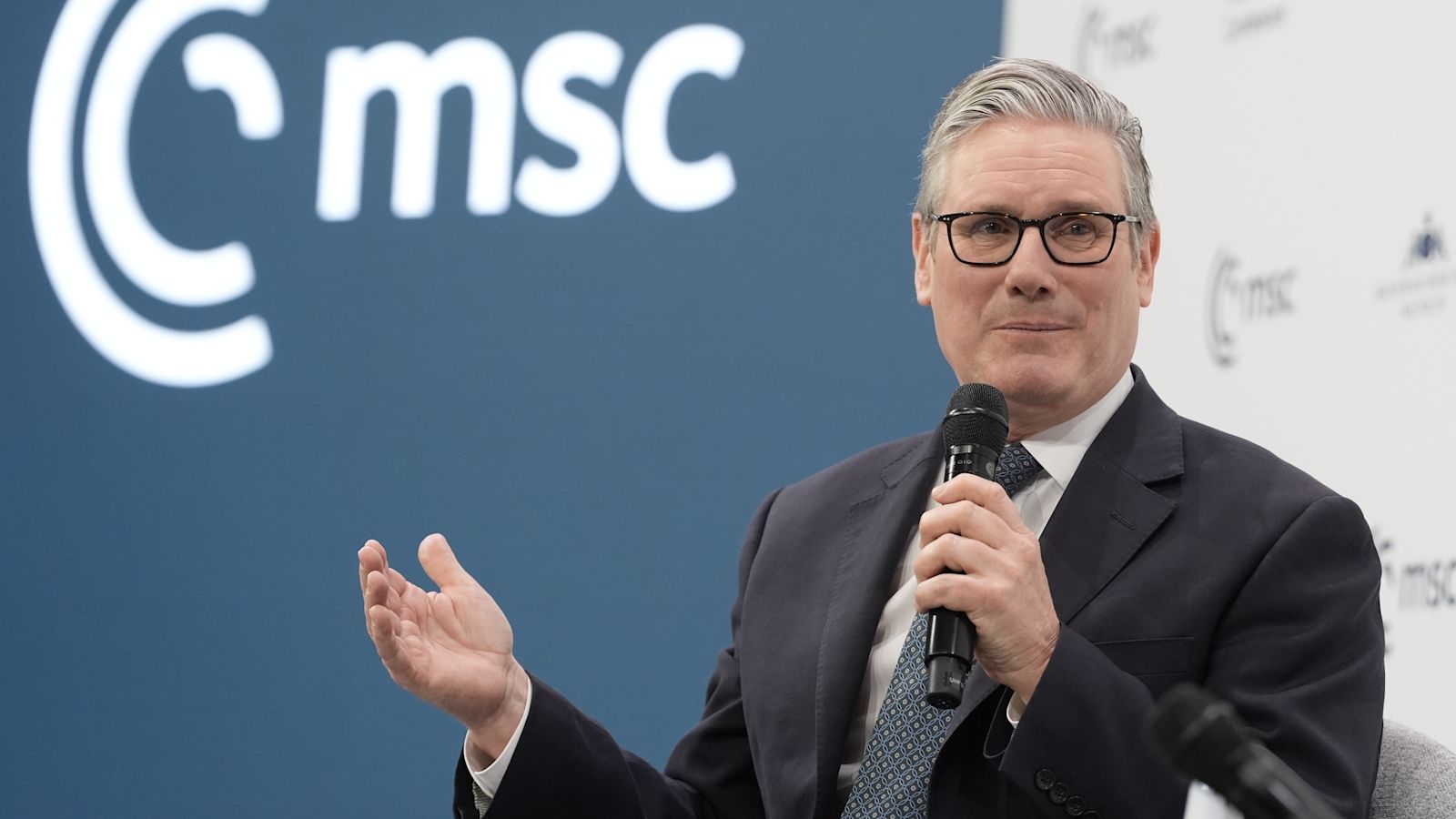
Europe must be ready to fight as it faces a growing threat from Russia, Prime Minister Sir Keir Starmer told the Munich Security Conference.
The UK will also be deploying its carrier strike group of warships to the Arctic this year – a deployment that follows US President Donald Trump’s assertion this year that he wants to take over Greenland.
Sir Keir also announced Britain will seek “deeper economic integration” with the European Union and to “move closer to the single market” in more sectors during his speech.
He insisted the EU-UK “status quo is not fit for purpose”, but he acknowledged there would be “trade-offs” as a result of the move.
ITV News Global Security Editor Rohit Kachroo is in Munich and breaks down the key talking points from the Security Conference
In his speech, the Prime Minister told the conference hall: “Now we feel the solidity of peace, the very ground that we stand on softening under our feet.
“It’s the job of leaders to be ahead of these seismic shapes, yet that is against the grain of history.”
He said leaders must not dither as “Russia has proved its appetite for aggression”.
He continued that after a peace deal for Ukraine, “Russia’s rearmament would only accelerate” and “we must answer this threat in full”.
“To break the convention of a thousand speeches, we are not at a crossroads. The road ahead is straight and it is clear. We must build our hard power, because that is the currency of the age.
“We must be able to deter aggression, and, yes, if necessary, we must be ready to fight.”
Around 50 world leaders are attending the defence summit in Germany to discuss European defence and the future of the transatlantic relationship.
US Secretary of State Marco Rubio speaks at Munich Security Conference. Credit: AP
US Secretary of State Marco Rubio urged European nations to change direction on their economic and defence policy as he addressed them at the Munich Security Conference. He also stated that the US and Europe “will always be intertwined”.
Rubio said: “We want allies who can defend themselves, so that no adversary will ever be tempted to test our collective strength. This is why we do not want our allies to be shackled by guilt and shame.
“We want allies who are proud of their culture and of their heritage, who understand that we are heirs to the same great and noble civilisation, and who together with us are willing and able to defend it.”
The speech comes as Donald Trump’s attitude to the rest of the world becomes increasingly isolationist, with the President seeking last month to take control of Greenland and threatening tariffs on European allies if they didn’t support him.
Starmer has made resetting UK relations with the EU a key aim as prime minister, agreeing a major new deal with the bloc in May last year.
The PM has always insisted he does not need to choose between the US and the EU, but in his speech said, “We are not the Britain of the Brexit years anymore.”
The Prime Minister added: “Because we know that in a dangerous world, we would not take control by turning inward, we would surrender it, and I won’t let that happen.
“That’s why I devote time as Prime Minister to Britain’s leadership on the world stage, and that’s why I’m here today, because I am clear there is no British security without Europe and no European security without Britain.
“That is the lesson of history, and is today’s reality as well.”
Subscribe free to our weekly newsletter for exclusive and original coverage from ITV News. Direct to your inbox every Friday morning.
Nato Secretary General Mark Rutte told the conference on Friday that Nato should be more “European-led”, with countries in Europe “taking more responsibility for their own defence.”
Starmer argued the prosperity and security of the UK rests on closer defence and security ties with Europe.
It comes after talks on Britain joining the EU’s new 150 billion euro (£130 billion) Security Action for Europe (Safe) rearmament fund were reported to have broken down at the end of last year, as the price for entry was thought to be too high.
He said: “My message today is the United Kingdom is ready. We see the imperative. We see the urgency. We want to work together to lead a generational shift in defence industrial co-operation. Now this includes looking again at closer economic alignment.
“We are already aligned with the single market in some areas to drive down the prices of food and energy. We are trusted partners, and as the Chancellor of the Exchequer (Rachel Reeves) said this week, deeper economic integration is in all of our interests.
“So we must look at where we could move closer to the single market in other sectors as well, where that would work for both sides.
“The prize here is greater security, stronger growth for the United Kingdom and the EU, which will fuel increased defence spending, and the chance to place the UK at the centre of a wave of European industrial renewal.
“I understand the politics very well. It will mean trade-offs. But the status quo is not fit for purpose, and to me there’s no question where the national interest lies, and I will always fight for what’s best for my country.”
Starmer’s trip to Germany comes after a tumultuous few weeks domestically with his premiership rocked by controversy surrounding the appointment of Lord Peter Mandelson despite his ties to paedophile Jeffrey Epstein.
Asked whether his domestic challenges left him vulnerable, the Prime Minister said: “No, I reject that.
“I ended the week much stronger than I started it. And that’s a very good place to be, and my party and my Government is completely united on the question of Ukraine and defence and security and the need for stronger relations with Europe on defence, on security and on economy as well.
“And so I think that there is real strength in the position I’ve now set out.”
From Westminster to Washington DC – our political experts are across all the latest key talking points. Listen to the latest episode below..