
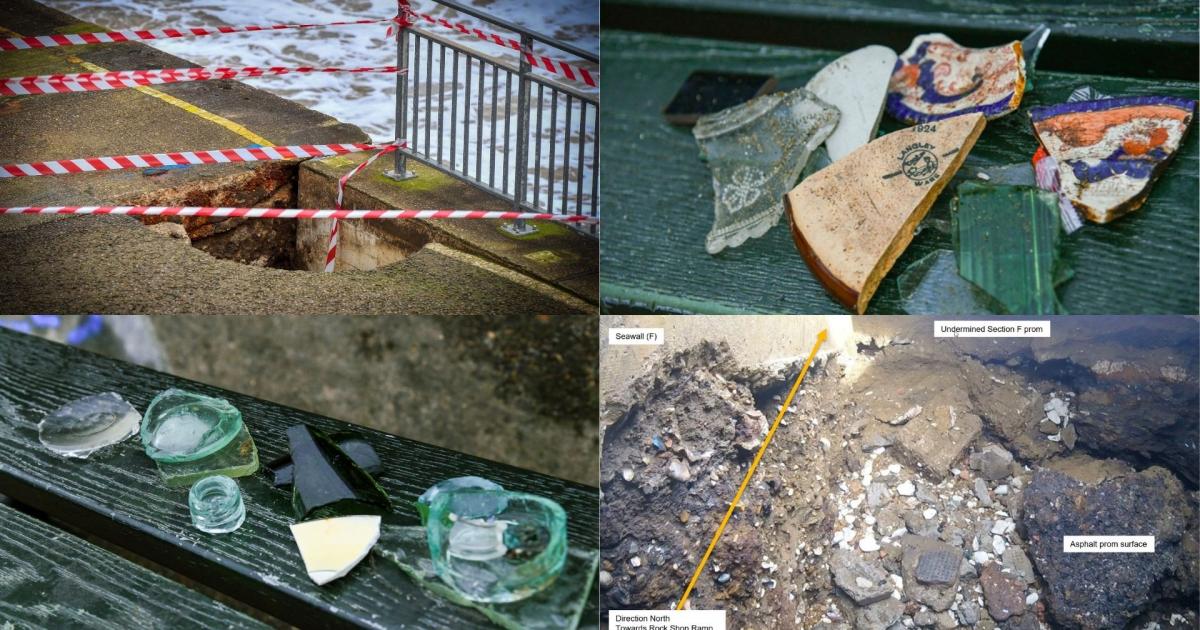
But now fragments of crockery and glass have washed ashore after a sinkhole appeared, revealing relics of bygone times.
Pieces of pottery and bottles are among the material which has been washed out from the sea defences at Hunstanton, leaving a void the size of a single-decker bus.
Fragments of pottery which have been washed out after the sinkhole appeared (Image: West Norfolk council)
They include shards of Langley Ware, which was fired at Langley Mill on the Nottinghamshire – Derbyshire border from the late 19th century.
One fragment carries the date of 1924, which is around the time that the sea defences were first erected at the behest of the then New Hunstanton Urban District Council.
Pieces of glass found on the beach near the sinkhole at Hunstanton (Image: West Norfolk council)
Bits of glass are believed to date back to the same time, possibly indicating that rubble and rubbish was among material used to backfill the original defences, which were resurfaced by laying concrete slabs over their original tarmac top after the 1953 floods.
The stretch where the void has appeared is near the Waterside Bar, which was once the waiting room for Hunstanton’s long-defunct railway station, while a grand hotel also stood nearby at the time.
An architect’s drawing showing the proposed sea defences at Hunstanton before they were built in the 1920s (Image: West Norfolk council)
A 140m stretch of the prom was closed off after the sinkhole appeared last week.
West Norfolk Council is set to deploy a ground-penetrating radar next week to map the precise extend of the void, believed to be 14m long, 4m wide and 3m deep.
The sinkhole which has appeared in the seafront at Hunstanton (Image: Chris Bishop)
Dave Robson, its environmental health manager, said it would then decide the best way to plug the gap before making a start on the work.
Core samples are set to be taken along the seafront later this year, as design work begins on a major revamp of the defences, whose concrete pads are deteriorating after 70 years of being buffeted by the weather and tides.
A view of part of the void beneath the sea defences at Hunstanton (Image: West Norfolk council)
The council says areas of the prom’s foundations are at risk of being undermined, after changing offshore currents washed sand and shingle away from the base of the revetment exposing it to the tides.
It said if nothing was done swathes of the seafront could be at risk of flooding by 2060 as sea levels rise and storm surges become more frequent.
The size of the void shown in red on a picture of the prom at Hunstanton (Image: West Norfolk council)
Drawing up plans for the revamp could take as long as two years, while the cost will not be known until a detailed design has been agreed.
The council hopes central government will pick up the bill for the work, which is expected to run into millions.
A 140m stretch of the prom was been fenced off after the sinkhole appeared (Image: Chris Bishop)