
Laurent Dubreuil celebrates winning the bronze medal on the podium of the men’s 500 metres speed skating race.Luca Bruno/The Associated Press
On Saturday, Laurent Dubreuil won an Olympic bronze medal to pair with the silver he won in Beijing.
His Games is over, but instead of going home he’ll stay in Europe. That way he doesn’t have to pay out of pocket to fly back for the world championships in Heerenveen, Netherlands in about a week’s time.
Once at that event, he’ll stay with friends.
“It’s cheaper than a hotel,” Debreuil said.
He was just minutes off the podium when he had this remarkable conversation.
You have to pay for everything on this trip?
“Yes.”
Would a Dutch speed skater ever find themselves in such a position?
“Nope.”
In the spring of 2024, Canadian Olympic Committee president David Shoemaker tried firing up the old klaxons about sports funding.
“We’re on the brink of a crisis,” Shoemaker & Co. said in a release. COC representatives have said this sort of thing so often over the years that most people have stopped listening.
Three months after that warning, Canada had one of its best summer Olympics ever in Paris. Crisis averted. Except that Shoemaker hadn’t said anything about 2024.
Medals or not, at this Olympics it’s good to be Canadian, say athletes
What he’d said, to the Globe’s Simon Houpt, was that while the Paris Games would be fine, “there are certainly some winter sports that are in financial dire straits, and two years from now, unless something were to change, they’ve got real problems.” It’s now two years from then and guess what? Canada has some problems.
These problems aren’t “real” until this Olympics is over. If Canada beats the U.S.A. for two hockey golds on the final weekend, the resultant national glee will paper over setbacks elsewhere. But it’s clear that if Canada’s Olympic program isn’t yet in the terminal decline Shoemaker warned about, it’s trending in that direction.
At the completion of Saturday’s events, Canada stands on eight medals. That’s five fewer than we had at this point in Beijing.
None of those eight is gold. By the IOC’s official tally, Canada sits 18th on the medal table. We were meant to be gunning for top five. In a perfect world, top three. It is now difficult, verging on impossible, to see how that would happen.
Italy’s all-over-the-map Olympics went too far
Luck plays some role in this. It seems vaguely ridiculous that Mikaël Kingsbury tied for the top score in his best event and somehow came second. That said, when disappointment becomes a pattern, it’s not luck. It’s you.
If you do what most people do during an Olympics – choose to highlight the best moments – things can feel fine.
Dubreuil surprised some with that bronze, including, one suspects, himself. By his own telling, he was left in the dust by the 21-year-old American and 22-year-old Dutchman who finished ahead of him.
Three days earlier, he finished 8th in the 1,000-metre event. He’d been second in Beijing.
That means Dubreuil, who is 33 and rounding out his career, is actually down one aggregate step on the podium from Beijing to Milan. No younger Canadian has convincingly shown here that they are about to take over his medal-contending duties.
Canada’s William Dandjinou competes in the men’s 1500m short-track speed skating final on Saturday.Nathan Denette/The Canadian Press
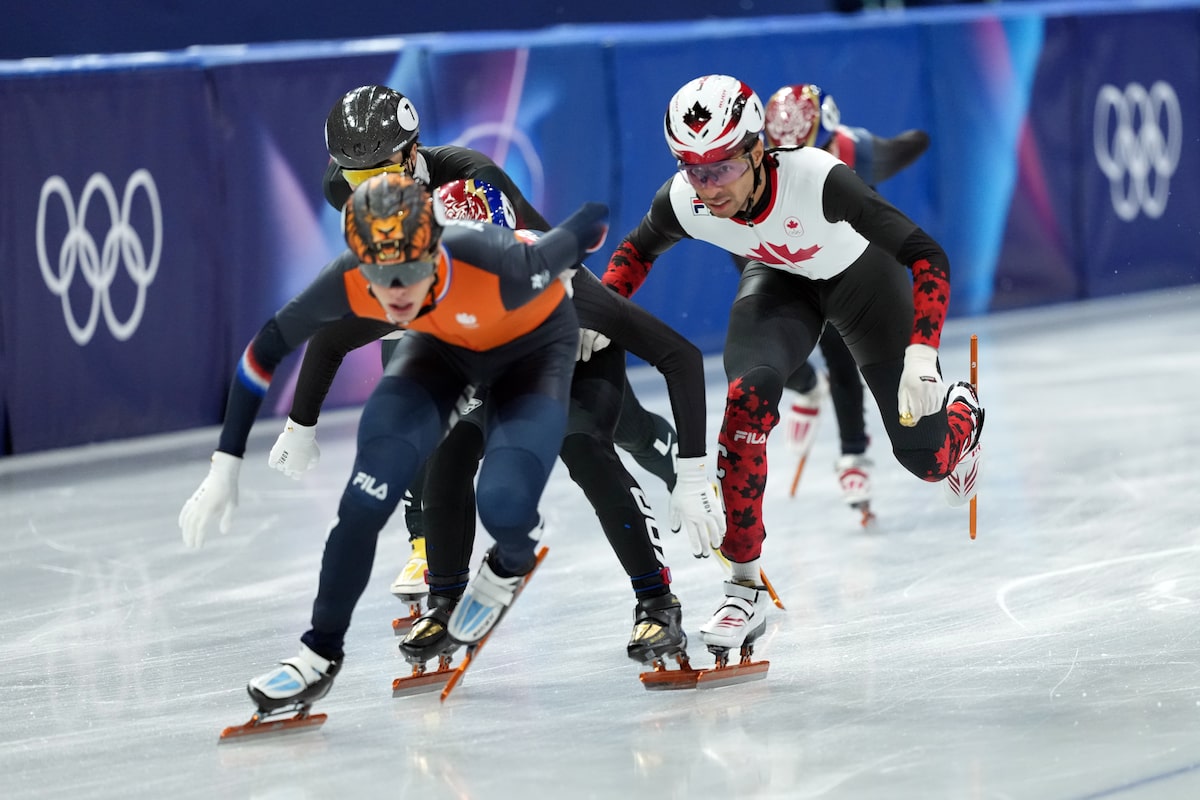
Later on Saturday night, William Dandjinou – the would-be Canadian star of these Games – had another tough night at the Milano Ice Skating Arena. He finished fifth in a chaotic 1,500-metre short-track final. That’s two non-medal finishes in races he’d hoped to win.
When everyone was making their ‘Canada’s still in there with the very best of them’ predictions, it was assumed Dandjinou would clean up here. He hasn’t, making the whole thing more of a quick tidy.
Then there’s the geezer factor. If you count teams as individuals, the average age of Canadian medalists thus far is 29.
That’s not ancient, but it’s a long way from fresh-faced. It suggests a program on the far edge of its prime, and just about to go off a cliff.
What’s the answer to this? I don’t know. What would you like the answer to be? It’s up to you.
There are two ways to go about this. Leave the COC and its component organizations to raise their own money from the private sector, which they do. The other is to get government more involved than it already is to push funding over the top.
This was a national priority before Vancouver 2010, and resulted in all of our Olympic teams moving up a level. For the better part of 20 years, we got used to being among the best. Now that swell is beginning to recede.
Since Vancouver, Canada’s gold medal totals in winter Games have gone 14, 10, 11, 4 and, currently, 0.
Analysis: Time is running out for Canada’s women’s hockey team to clean up its game
This is no disaster. There’s no rule that says a country doesn’t matter if it doesn’t win Olympic events. Places like Spain and Brazil don’t put the Olympics at the centre of their cultural project, and their sense of national identity seems to be fine.
The question we might ask ourselves going forward is, ‘If not the Olympics, then what?’
What else performs the same function as the bi-annual Games in bringing the country together, and has the same impact in bolstering our sense of pride?
Brazil and Spain have the World Cup. We have, what? The 4 Nations Face-Off? The Calgary Stampede? The Toronto Film Festival?
We don’t have anything else like the Olympics. Maybe we should think about a replacement before we let something that’s working run to seed. It’s totally reasonable to think the taxpayer shouldn’t be the one paying for Laurent Dubreuil’s hotel room in Holland.
But if so, did it make you feel good – feel Canadian – watching him get up on the podium in our colours on Saturday? Did you share that moment with someone you love? Did it make you feel more connected to your country and the people who live in it?
Because you can’t think that, and then expect to have all those other things as well.
Follow our live daily coverage of the Winter Games.