
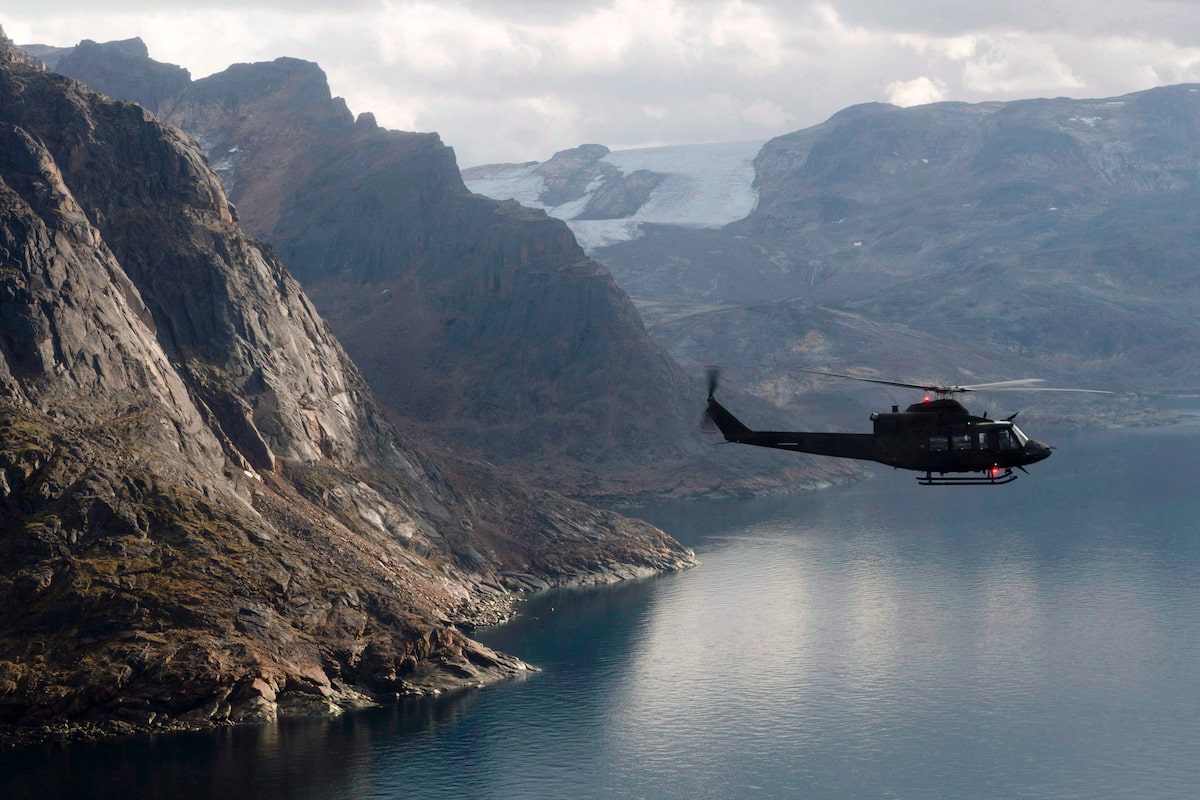
A Canadian military helicopter flies along the shoreline of Baffin Island. Canada has signed an agreement with Denmark to work more closely together on matters of Arctic security and defence.Adrian Wyld/The Canadian Press
Canada signed an agreement with the Kingdom of Denmark to work more closely together on matters of Arctic security and defence, as global leaders assembled at the Munich Security Conference in Germany on Friday.
The signing, done by Defence Minister David McGuinty, was one of several opportunities Mr. McGuinty took at the international conference to speak about how Canada’s approach to defence is changing. And quickly.
“In Canada, people have finally woken up to one fundamental factor. Our geography will no longer protect us,” he said during a panel about strengthening defence industrial co-operation.
The Munich Security Report, published ahead of the conference, pointedly addresses the elephant in the room, or the “United States’ evolving view of the international order,” the report states.
Canada wants NATO’s new Arctic Sentry security mission to become permanent, Anand says
Opinion: Keeping Canada’s options open on nuclear weapons is not as simple as it sounds
This theme hung heavy in the air throughout many of the discussions on Friday, the first of three days during which world leaders are gathering in Munich to discuss security, trade, climate and foreign affairs, among other things. U.S. President Donald Trump is not in attendance, but a number of representatives from the country appeared on several panels throughout the day, including Michael Waltz, ambassador of the U.S. to the United Nations and Gavin Newsom, Governor of the State of California.
Secretary of State Marco Rubio is scheduled to speak Saturday morning. Prime Minister Mark Carney cancelled his trip to Munich last-minute on Wednesday, after the school shooting in Tumbler Ridge, B.C.
Canada’s agreement with the Kingdom of Denmark, which includes Greenland and the Faroe Islands, highlights each countries’ desire to build up their presence in their North, and their ability to defend it.
A Royal Danish Navy vessel patrols near Nuuk, Greenland, in January.Evgeniy Maloletka/The Associated Press
“Today, we send a clear message: the Arctic is secure, and we will keep it that way,” Mr. McGuinty said in a written statement. The agreement also encompasses collaboration on industrial co-operation, logistics support, personnel, training, exercises and education.
While at the conference, Mr. McGuinty also took care to promote Canada’s leading role in the multinational Defence, Security and Resilience Bank, which it’s helping establish. In an interview, he said Canada is “at the forefront” of the bank, which will be dedicated to financing defence projects for member countries.
He said he spoke with his British counterpart in Brussels on Thursday about the bank, adding that “there are a number of countries that are interested in hearing more about this.”
In terms of the headquarters of the bank, which several Canadian cities are currently competing over, Mr. McGuinty said it’s one step at a time and there are several steps to take before then.
“Let’s get the bank first, because the bank doesn’t exist yet,” he said.
From left: Croatia’s Defence Minister Ivan Anusic, Denmark’s Defence Minister Troels Lund Poulsen, Finland’s Defense Minister Antti Hakkanen and Canada’s Defence Minister David McGuinty at NATO headquarters in Brussels on Thursday.Geert Vanden Wijngaert/The Associated Press
Canada’s defence industrial strategy, which was meant to be released prior to the conference but was delayed owing to the shooting in B.C., also came up several times during Mr. McGuinty’s time on stage. While the specific content of the strategy hasn’t been released, the Defence Minister said Canada will be identifying ten sovereign capabilities to prioritize within the industry and adopting a build, partner, buy framework to guide the growth of these capabilities.
“What can we build? If we can’t build it, with whom would we partner? And if we can’t do that, where are we going to buy? What like-minded countries do we want to buy from? We’re looking at a complete rebuild of the Canadian Forces, top to bottom,” he said.
Mr. Carney’s presence may be missed in Munich, but his words are still making waves with the world leaders in attendance. By far the most enthusiastic response Mr. McGuinty received during the evening panel he took part in came when he brought up the Prime Minister’s speech from Davos, Switzerland, a few weeks ago. Speaking on stage beside politicians from Australia, France and the U.S., Mr. McGuinty reinforced the Prime Minister’s messaging that middle powers need to stick together.
“The depth of research, engineering, AI, quantum and cryptography in countries represented in this Munich conference is unbelievable,” he said. “What we need to do is come together and mobilize.”