
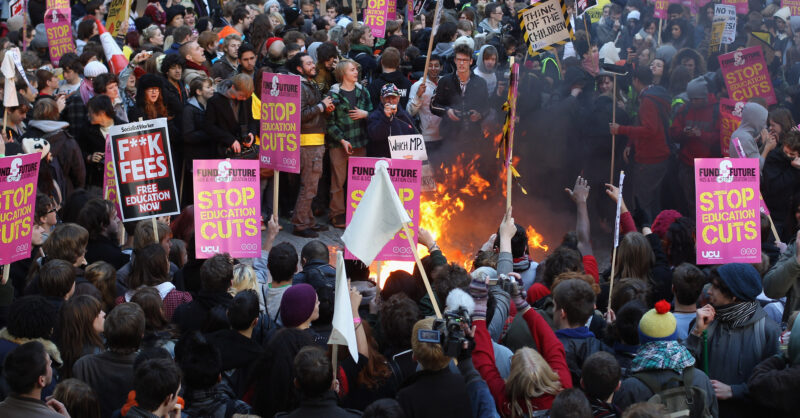
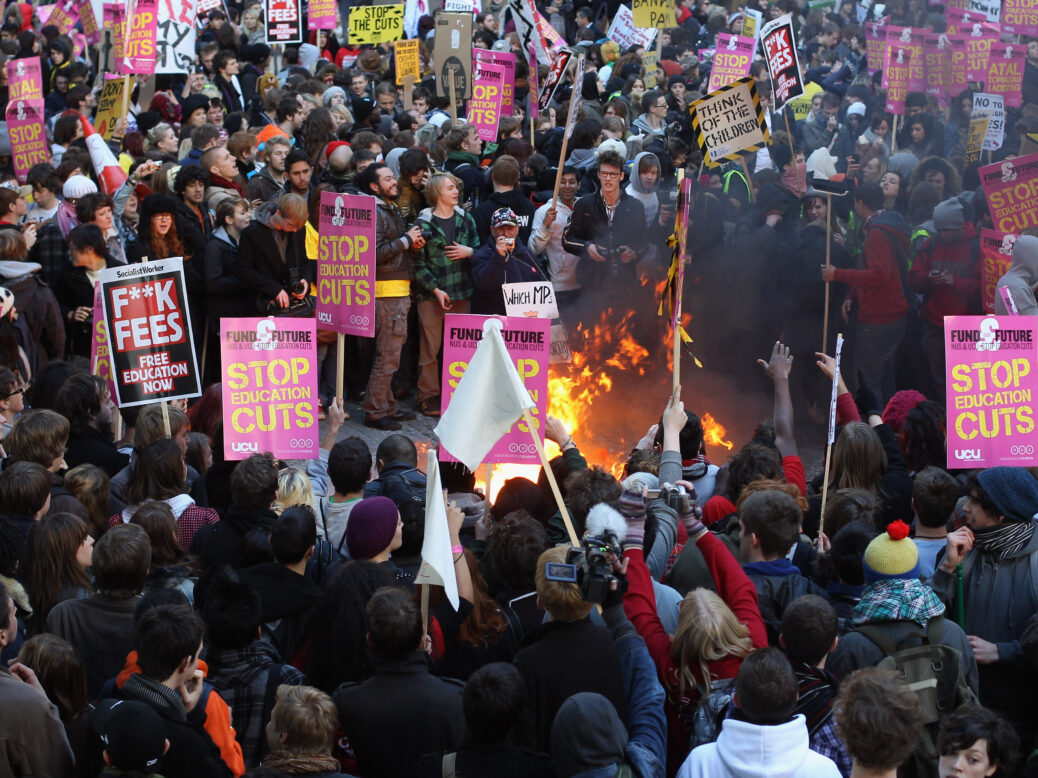
Photo by Dan Kitwood/Getty Images
On 3 November 2010, a little more than an hour after the Coalition government announced that it would be raising the cap on tuition fees to £9,000, MPs headed to Westminster Hall to debate it. A brief glance over the transcript on Hansard reveals contributions from several MPs who now find themselves seated around Keir Starmer’s cabinet table. The system they discussed has been in place for more than a decade; but the concerns raised in impassioned contributions and points of order continue to haunt us.
During the debate, Jonathan Reynolds (now the Chief Whip) urged the government to consider the effect of young people holding on to such high levels of debt for so long (the repayment term at the time was 30 years). “No one seems to look at the fact”, Reynolds told his fellow MPs, “that the sheer amount that people pay on their loans every month diminishes their capacity to spend money on other things.” David Lammy – now the Deputy Prime Minister – led the debate. At one point during the proceedings, he boomed: “Does the Minister honestly believe that students from the poorest backgrounds will not be put off by these staggering sums of money?” (Similar points are still being made today.)
Fifteen years later, and the Labour government which Lammy and Reynolds are now part of is facing pressure to reform the system they objected to back in 2010. It gained momentum after the Chancellor Rachel Reeves froze the repayment threshold – the amount graduates must earn before they begin to make repayments – in her November budget. It spiked once again this year, when an investigation in the Times revealed that two thirds of graduates aren’t even paying off the interest on their loans. (As a graduate on a Plan Two loan, I can anecdotally confirm this. From May 2025 to January 2026 I was charged £1,800 in interest, but only paid off £900.) In an interview with the BBC at the end of January, Reeves described the system as “fair and reasonable”.
Even so, senior Labour figures have begun to comment on the system. In separate appearances on LBC, both the Labour Deputy Leader, Lucy Powell and the Health Secretary, Wes Streeting have been asked for their views. Powell described the interest rates on loans as “unfair” and “egregious” while Streeting said a serious discussion about the current repayment system is needed.

Subscribe to the New Statesman today for only £1 a week.
The threat of being outflanked politically is already looming for Labour. According to recent polling by Organise, nearly 85 per cent of young people said that fairer student loans would affect how they voted. And both Reform and the Greens have already started thinking about how they might position themselves on this issue.
Labour backbenchers have begun to take notice and are thinking about how they might work with the government to reform the system. The 2024 general election ushered in a larger group of MPs who themselves took out a Plan Two loan. Members of this younger cohort of the Parliamentary Labour Party are starting to get organised: could this soon become an issue that the government can’t ignore? “We’re in our thinking caps phase,” one Labour MP involved in organising to highlight the injustice of student loans told the New Statesman, “the genie is out of the bottle.”
Luke Charters, a Labour MP on a Plan 2 loan himself, has been vocal about this issue, as has Chris Curtis, the chair of the Labour Growth Group. In a debate in Parliament, Charters said: “Plan 2 borrowers, including me, were never clearly told that higher graduate earnings meant higher loan interest.” He described the fact that interest rates are linked to income as a “mis-selling scandal waiting to unfold”.
Privately, some Labour MPs have criticised Reeves’s suggestion that the system is “fair and reasonable”. One told the New Statesman that the Chancellor should have distanced herself and the government from the current model for repayments, pointing out that Plan 2 loans were introduced by the Coalition, not the Labour Party and that the government will look at the system carefully. Others have suggested it could be a crucial issue in any upcoming leadership election. Of the rumoured contenders, Streeting is the only figure to have recently expressed a public view.
Behind the scenes, several Labour MPs have pointed out that the longer the party waits to take a position, the bigger the risk it runs of being outflanked on the left and on the right. A rumour has been doing the rounds among Labour backbenchers that Reform is about to mount a campaign to scrap student loans (a Reform source confirmed the party is working on a new offering, but not did not confirm whether it would include this specific pledge). A source from the party told the New Statesman, “we are prepared to end the justice of high student debt. Young people should learn vocational skills that earn good wages – or degrees that are genuinely useful to them and the country.”
The Green Party’s 2024 manifesto included a promise to scrap tuition fees and to write off existing loans. Ellie Chowns, the party’s Parliamentary Leader told the New Statesman, “the current system for loans is clearly unfair, treating higher education like a private debt rather than a public investment”. She added: “We also recognise many of those paying back student loans are currently at a breaking point in the cost-of-living crisis and need support now, and therefore support the implementation of a number of immediate measures to help ease the burden within the existing system.”
The party’s leader, Zack Polanski, is also doing some thinking about the party’s position on student loans as part of a wider programme he and his team are currently undertaking to develop his vision for the Greens (which was delayed slightly, owing to the unexpected announcement of the Gorton and Denton by-election). A source close to him said “it’s not just that it’s insanely unfair, it’s also a real pressure on people’s living standards. It’s obviously such a massively complicated issue and we really want to get it right on this.”
Still reeling from the Mandelson crisis and the shake-up of officials in No.10 that this has catalysed, reforming the student loans system is unlikely to be at the top of the list of government priorities. (As the NS has pointed out, the PM is currently without a permanent chief of staff, director of communications or cabinet secretary). But this is unlikely to be the last the government hears from the 5.8m people on Plan 2 loans – including those sitting behind them on the Labour benches.
[Further reading: The student loan rebellion is only just beginning]
Content from our partners