
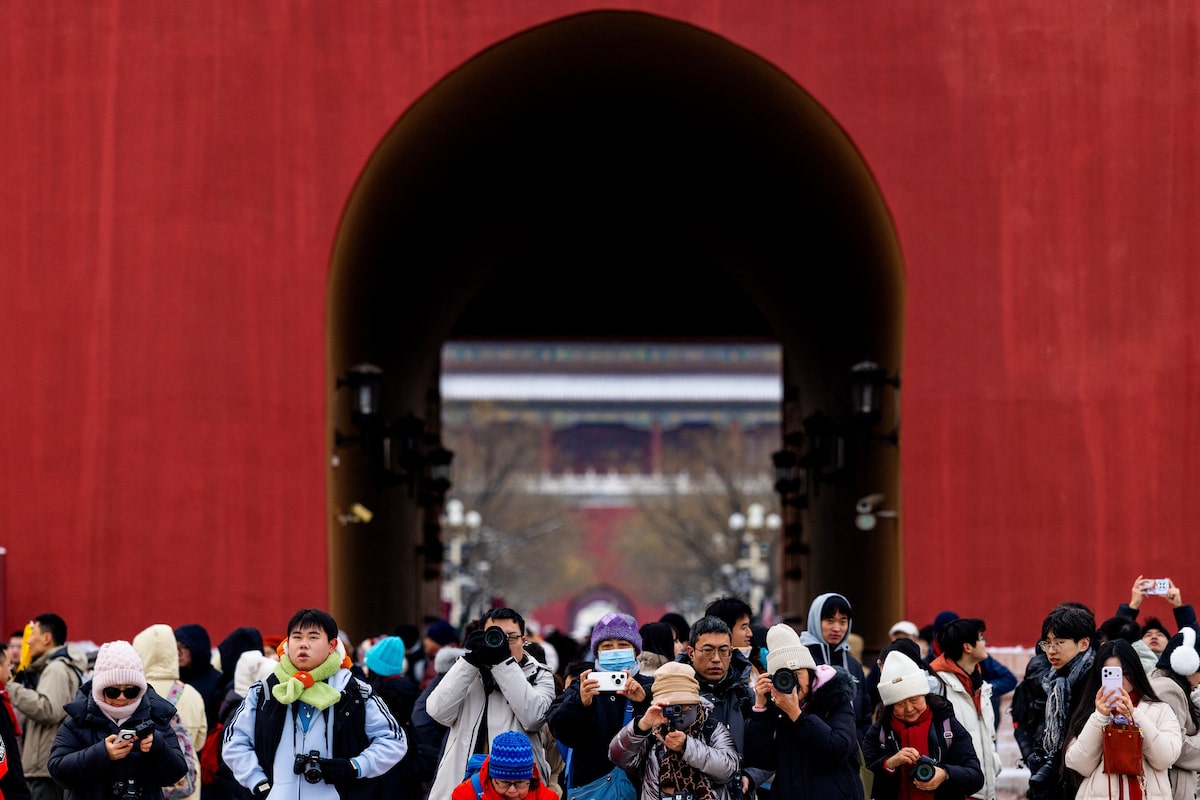
Tourists take photos at the Forbidden City in Beijing.Carlos Osorio/Reuters
China is suspending its visa requirement for Canadian tourists and business travellers for the rest of the year in a move it says is aimed at facilitating cross-border travel.
Last month, Prime Minister Mark Carney came out of talks with Chinese President Xi Jinping in Beijing saying that Mr. Xi had committed to removing visa requirements for Canadians travelling to China.
On Sunday, China followed through. The new visa initiative takes effect on Tuesday, and will be in place through to Dec. 31, said a statement from China’s foreign ministry.
Foreign Affairs Minister Anita Anand said in a statement on Sunday that Beijing’s visa move will make travel easier, support business exchanges and strengthen people-to-people ties between Canada and China.
In its statement, China’s foreign ministry said it was extending its visa waiver policy to ordinary passport holders from Canada and Britain “to further facilitate cross-border travel.”
Andrew Coyne: No, Canada is not selling out to Beijing
It also said that ordinary passport holders from the two countries will be exempt from needing visas to enter China and stay for up to 30 days for business, tourism, visiting family and friends, exchanges and other transit purposes. The new policy will effectively eliminate fees of about $140.
Mr. Carney visited China to bolster economic ties with Canada, seeking to diversify trade and increase investment into this country. The two countries reached an agreement to allow about 50,000 Chinese-made electric vehicles into Canada at a low tariff rate, while China reduced its levies on canola seeds and promised to eliminate tariffs on other products.
Guy Saint-Jacques, Canada’s ambassador to China from 2012 to 2016, said the visa change is a good sign for the two countries’ relationship.
“This means that we are back in the good graces of the Chinese regime and it is a reward for the efforts made by PM Carney to normalize the bilateral relationship,” Mr. Saint-Jacques said in a statement.
He said China has granted the privilege of visa-free access to nationals of some 60 countries, and it was just a matter of time before it was extended to Canadians.
Canada reaches tariff deal with China on electric vehicles, canola
Asked about China’s decision to make this almost a year-long commitment, the former diplomat said it’s related to other decisions, such as a drop on tariffs on canola seeds that also runs to the end of the year.
“They want to make sure that we will implement all decisions on our side as agreed,” Mr. Saint-Jacques said.
Now, however, he said Mr. Carney needs to reassure Canadians that more efforts will be made to counter Chinese interference in Canada.
He said he hopes the planned registry for foreign agents will be launched soon and more resources devoted to the RCMP to counter China’s harassment of Canadians of Chinese origin.
In the first quarter of 2025, Canadian travellers made about 221,000 visits to China, up from about 100,000 in the same period in 2024, according to federal government statistics.
Candace Laing, president and chief executive officer of the Canadian Chamber of Commerce, welcomed the new policy.
“After years of fluctuation, renewed travel opportunities will help Canadian companies connect with one of the world’s largest markets,” Ms. Laing said in a statement.
China’s policy will support sectors from agriculture to tourism, technology and investment, Ms. Laing said.
“While lowering travel barriers is a welcome step, Canadian companies will continue to assess economic opportunity alongside market access and risk considerations as they make decisions about where to invest and grow.”
With a report from The Canadian Press