
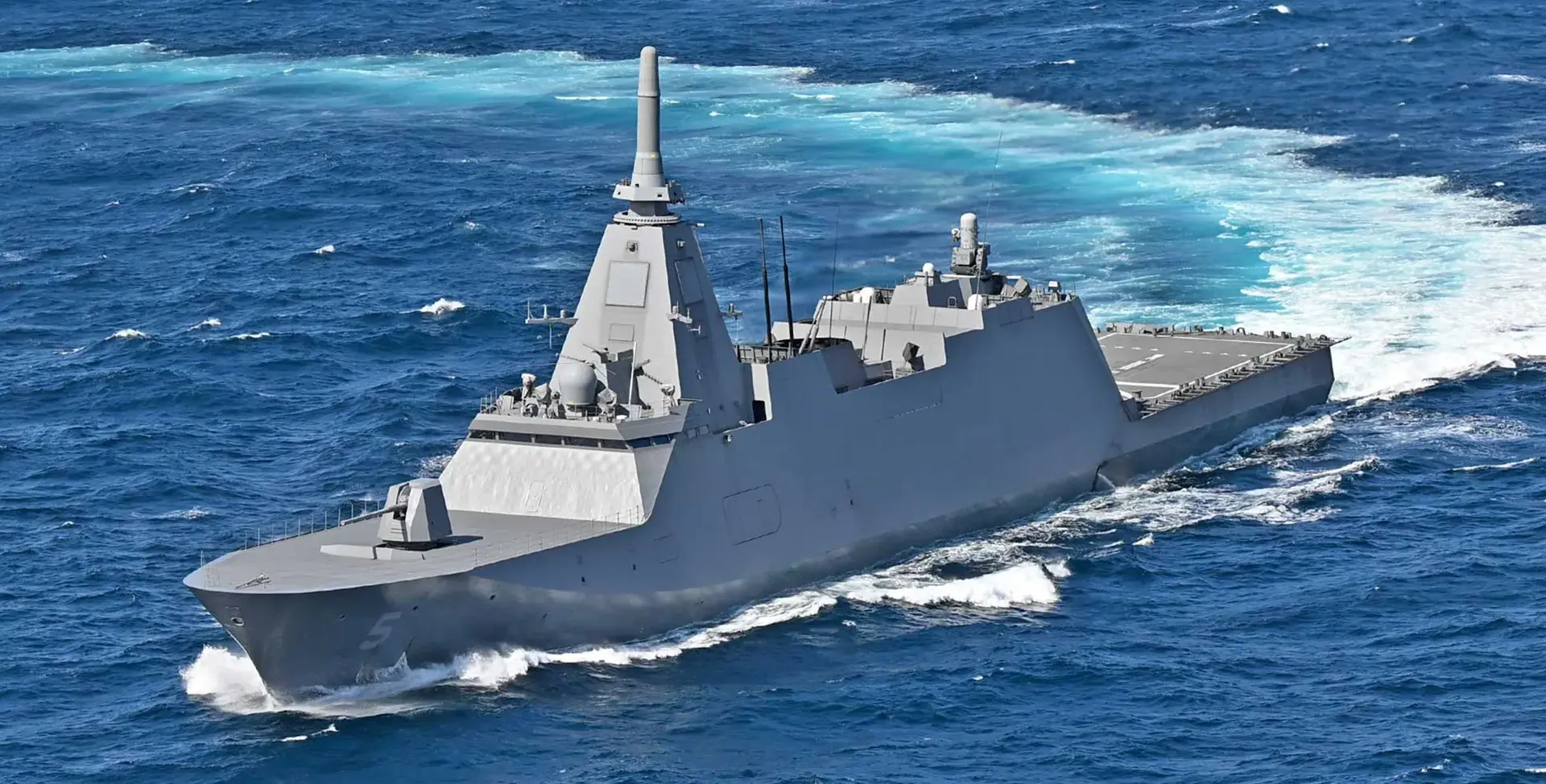
Australia looks likely to become the first customer for a Japanese-built warship since before the Second World War. The Nikkei Asia reports that the Royal Australian Navy is poised to acquire up to 11 of the enhanced FFM version of the Mogami-class frigates.
The RAN’s Surface Combatant Fleet Review, which was published in 2024, recommended a rapid procurement of warships to replace the ageing ANZAC-class, which have been in service since the mid-1990s. The Type 26-based Hunter class ASW frigates programme remains the Tier 1 combatant capability but the review recognised they would not be delivered fast enough, and a Tier-2 option was needed to increase hull numbers and in a shorter time scale.
Although there were faint hopes in the UK that a Type 31 derivative might be an option, the only remaining alternative to the Mogami left in contention is Germany’s MEKO A-200 from ThyssenKrupp Marine Systems (TKMS). While both vessels meet Australia’s requirement for an ‘off-the-shelf’ warship, the Mogami appears to have gained the upper hand. Japanese sources claim Australia has indicated its preference during a recent National Security Committee meeting, with a formal decision expected before the end of the year.
The first three ships will be built overseas, with the remaining eight constructed in Western Australia. Mitsubishi Heavy Industries, which is building the Mogami for the Japanese Maritime Self-Defence Force (JMSDF), is expected to deliver the first ship to the RAN by late 2029. MHI has already completed 8 ships for the JMSF since the first was laid down in 2019. Japanese warship construction speed far outpaces the majority of Western nations’ capabilities, especially in Europe.
The Mogami FFM is a 142-metre, 6,200-tonne (full load) vessel with a full suite of ASW, anti-air, and mine warfare capabilities. Featuring a 32-cell Mk 41 VLS, double that of the current German proposal, and improved endurance. Like the Hunter-class, the ship is fitted with a Rolls-Royce MT30 gas turbine but in a CODAG arrangement, combining with the twin diesel engines for a top speed above 30 knots and the long range needed in the Pacific region.
Built with survivability in mind, the ship features a stealthy hull and superstructure, a reduced radar cross-section, and infrared suppression measures. The Combat Information Centre (CIC) is heavily armoured and located below decks, allowing the ship to continue fighting even after taking damage. The CIC’s ergonomic design enables efficient command with a crew of just 10, part of a total complement of around 90, significantly lower than many legacy frigates. Like the Royal Navy, the RAN is struggling to recruit and retain personnel, generating enough trained sailors for its growing fleet is a major issue.
If the deal goes ahead, this would be Japan’s first warship export and only its second major defence package sold abroad, following the delivery of radar systems to the Philippines. Japan has strongly committed to the export push, mobilising ‘all-of-government’ support to the project, with senior defence and industry officials emphasising delivery reliability and strategic alignment with Australia. Mitsubishi’s production line is already delivering two frigates per year to the JMSDF and expects to scale up to three annually. The company will provide full intellectual property rights and long-term support for the Australian variant, enabling local sustainment over the ship’s projected 40-year lifespan.
Beyond industrial considerations, the choice of the Mogami signals a tightening strategic partnership between Canberra and Tokyo. As the Indo-Pacific becomes more contested, both nations are investing in naval deterrence, interoperability, and greater supply chain resilience. The export of a major surface combatant from Japan to a close regional partner is not just a procurement milestone, it is a symbol of shared intent in response to rampant Chinese military expansion.