
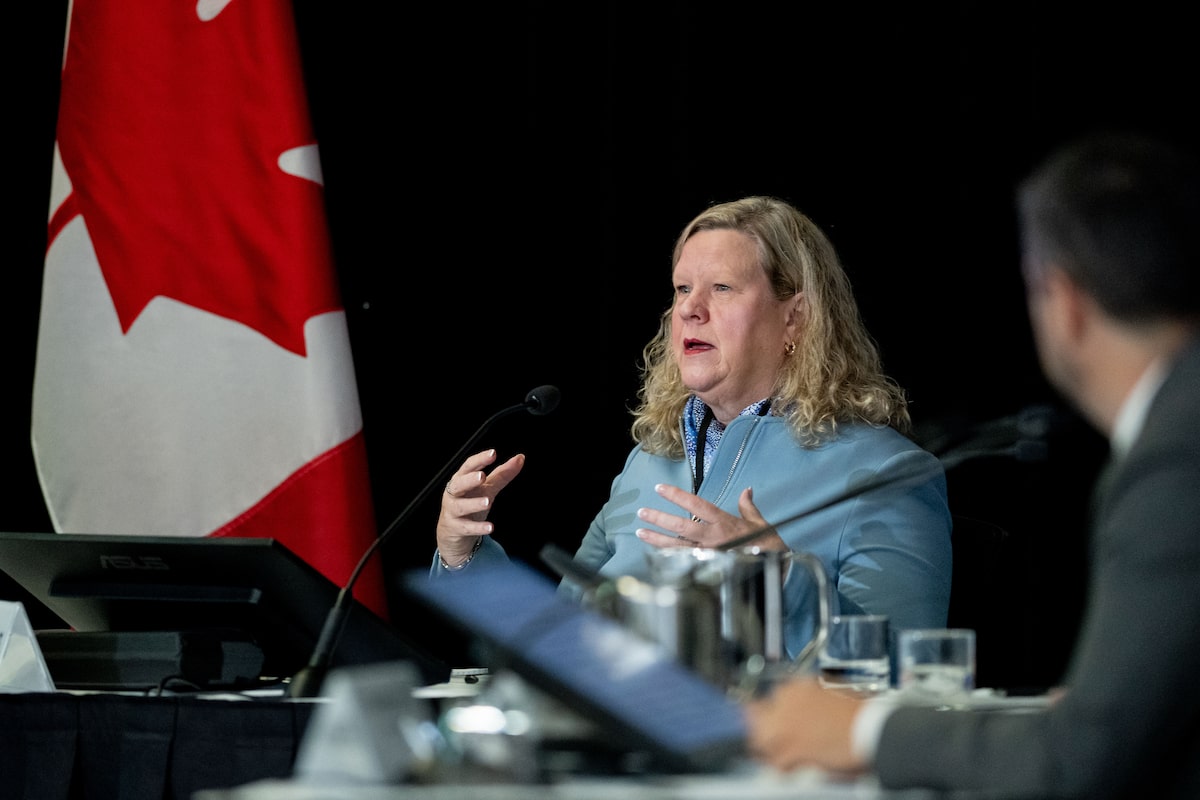
Janice Charette, seen here in Ottawa in 2024, becomes chief trade negotiator with the U.S. at a pivotal time when Canada is heading into a review of the continental free-trade agreement.Spencer Colby/The Canadian Press
Mark Carney has appointed Janice Charette, a former Privy Council Clerk and high commissioner to the United Kingdom, as chief trade negotiator with the United States barely four months ahead of a high-stakes continental free-trade-deal review.
Ms. Charette will serve as a senior adviser to the Prime Minister and will also work closely with well-known financier and former pension-fund executive Mark Wiseman, who replaced Kirsten Hillman as Canada’s ambassador to the U.S. this week.
Splitting the trade negotiator and ambassador roles into two positions – Ms. Hillman previously did both jobs – highlights the importance Mr. Carney is placing on a coming review of the United States-Mexico-Canada Agreement, set to begin on July 1.
The USMCA provides the foundation for the more than $1-trillion in Canada-U.S. trade and has served as Ottawa’s primary defence against Donald Trump’s tariffs, with the agreement allowing more than 85 per cent of Canadian exports to the U.S. to cross the border tariff-free.
Four challenges Canada’s new ambassador to the U.S. will face
Over a 40-year career in the public service, Ms. Charette has twice served as Clerk of the Privy Council – the head of the public service – and secretary to cabinet. She was also the high commissioner for Canada in the United Kingdom from 2016 to 2021.
When reached for comment, Ms. Charette referred questions to the Privy Council Office, which in turn referred to the Prime Minister’s announcement.
Brian Clow, deputy chief of staff and Canada-U.S. relations lead in the office of former prime minister Justin Trudeau, described Ms. Charette as being “smart, thoughtful and incredibly diligent.”
But, he said, “She can also be tough when she needs to be.”
“For the role of chief negotiator in what is probably the most important negotiation this country has faced in a long time, I think she is really great for the role,” he added.
Mr. Clow was directly involved in the initial USMCA negotiation during Mr. Trump’s first term and has worked with Ms. Charette in her prior roles. Having led the public service during then-prime minister Stephen Harper’s administration and her subsequent posting to London gave Ms. Charette the expertise needed to do well in her new role, he said.
In the waning days of Mr. Harper’s tenure, Canada was embroiled in complex talks on the Comprehensive and Progressive Agreement for Trans-Pacific Partnership, a multilateral trade treaty that Canada eventually did join. As Canada’s envoy to Britain during the chaotic post-Brexit period, Ms. Charette helped maintain trade ties across the Atlantic. Britain later joined the CPTPP.
“Her experience in government actually put her on the front lines of a number of very big trade negotiations and trade issues that I think sets her up well for this,” Mr. Clow said.
Departing envoy to U.S. says it’s unclear whether USMCA review will conclude in 2026
Jason Kenney, who served in Mr. Harper’s cabinet and was subsequently premier of Alberta, praised Ms. Charette in a social-media post as being “one of Canada’s most capable public servants.”
“No nonsense, results-oriented, highly trusted,” he said. “Thanks to her for taking on this tough job.”
Christopher Hernandez-Roy, senior fellow and deputy director of the Americas program at the Center for Strategic and International Studies in Washington, said by splitting the role of ambassador and chief trade negotiator into two jobs, Mr. Carney is signalling that he views the coming USMCA review “as a high-stakes and whole-of-government effort.”
“Ambassador Wiseman’s role is primarily maintaining relationships and political access in Washington and is a representational role,” Mr. Hernandez-Roy said. “A chief negotiator, on the other hand, directs strategy, establishes limits and red lines, co-ordinates government departments, and reports directly to the Prime Minister.”
Ms. Charette is “known for a firm, straight-talking approach,” Matthew Holmes, executive vice-president and chief of public policy at the Canadian Chamber of Commerce, said in an interview.
“In order to focus on diversification and other files, this seems to be another move by the Prime Minister to bring his trusted circle to the fore to tackle the challenges of our times,” Mr. Holmes said.
In a statement, Conservative Party of Canada deputy leader Melissa Lantsman criticized Mr. Carney for making another high-profile appointment instead of making a deal with the U.S.
“We don’t need another bureaucrat or negotiator,” she said, “we need results for the thousands of auto, lumber, and steel making jobs lost to the United States.”
Ms. Charette spoke about Canada-U.S. relations during the Trump era in a March, 2025, webinar held by the Institute for Research on Public Policy. At the time, Ms. Charette had retired from the public service but was a member of the institute’s board.
In the webinar, which took place before Mr. Trump imposed tariffs on nearly the entire world in early April, Ms. Charette said that at some point, Canada was going to have to face a renegotiation of USMCA.
“In the current moment, we have to get through a big door, and the big door is, right now, the tariff door,” she said. “And if we’re able to get through the tariff door then I think, actually, we can have extremely productive and extremely constructive conversations around a whole host of areas where we have shared interests, energy and critical minerals.”
“The near-term challenge is the fact that we are in a moment of political uncertainty,” Ms. Charette said, adding that the Canada-U.S. relationship has “been built on a certain paradigm.”
“Is that paradigm out the window? What does the new paradigm look like?”