
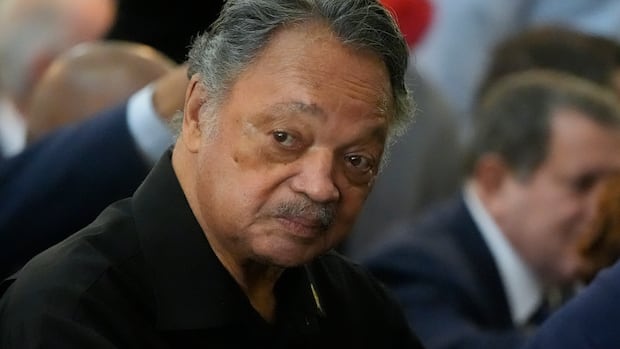
Jesse Jackson, the Martin Luther King protégé whose two bids for the U.S. presidency highlighted a lifelong fight for social and economic justice for all Americans, has died at age 84, his family said in a statement on Tuesday.
The family statement did not specify a cause of death. Jackson announced he had been diagnosed with Parkinson’s disease in late 2017 and had been hospitalized for several weeks late last year.
“Our father was a servant leader — not only to our family, but to the oppressed, the voiceless, and the overlooked around the world,” the Jackson family statement said, adding that he died at home on Tuesday.
Born Oct. 8, 1941, Jackson became a force in U.S. politics for decades, often through force of will, as he never held an elected position.
“Born to a teenage mother who was born to a teenage mother,” as he often said, Jackson was a 23-year-old transplant to Chicago in seminary college when he felt compelled to head to Selma, Ala., in 1964 for the march for Black voting rights.
He engineered a meeting with King and before long was doing outreach for the Atlanta preacher in Chicago. Their relationship lasted just three years, but the imprint was indelible.
In a 2018 interview with the Guardian on the 50th anniversary of King’s assassination, Jackson hailed him as the “universal frame of reference for moral authority, the global frame of reference for non-violent justice and social change.”
‘Rainbow coalition’
Through initiatives like Operation Breadbasket and PUSH (People United to Save Humanity), Jackson helped register untold numbers of African Americans to vote. Jackson also used persuasion, pressure and boycotts to encourage U.S. companies to hire and train Black employees and to invest in impoverished neighbourhoods.
Jackson, who got a D grade in oration in seminary school because he balked at pre-writing his sermons, would leave audiences rapt through the years in speeches filled with rhythm, alliteration and rhyme.
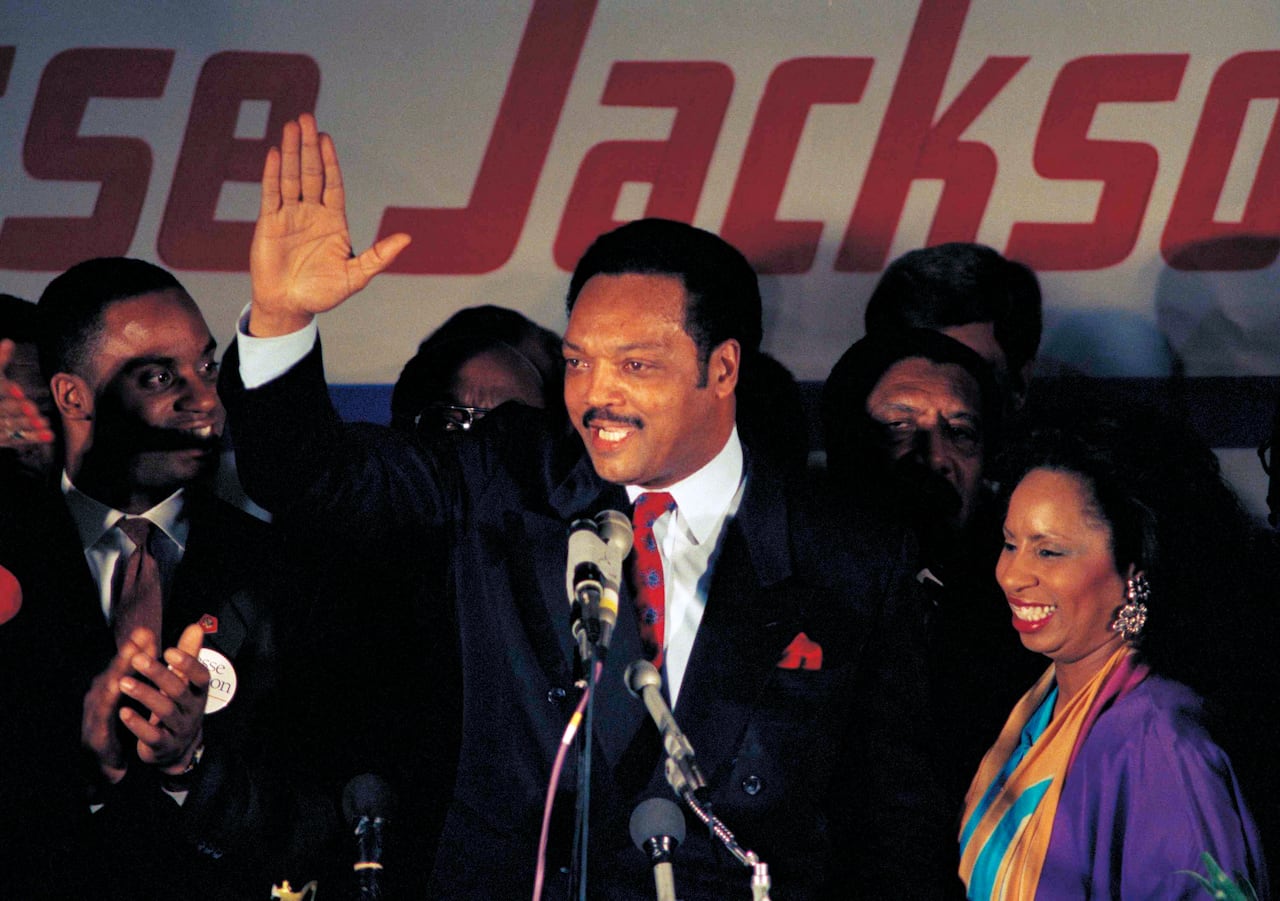 Jesse Jackson is shown with his wife Jacqueline during the 1988 presidential campaign, on March 16, 1988, in Chicago. (Lisa Genesen/The Associated Press)
Despite an atypical resumé for Washington politics and little in the way of institutional party support, Jackson won 15 Democratic primary contests in his 1984 and 1988 presidential campaigns. He had been preceded by Channing Phillips (1968) and Shirley Chisholm (1972) as Black presidential candidates for the Democratic Party, but Jackson’s campaign was the most successful up until that point — and for many years afterward.
“When they write the history of this [campaign], the longest chapter will be on Jackson,” New York Gov. Mario Cuomo said in 1984. “The man didn’t have two cents. He didn’t have one television or radio ad, as far as I could see, and look what he did.”
Jackson delivered electrifying speeches at the 1984 and 1988 conventions, speaking of a “Rainbow Coalition” of diverse, everyday Americans who could prosper if politicians found “common ground” and invested more in education, health care and infrastructure.
“[We find] common ground at the hospital admitting room, where somebody tonight is dying because they cannot afford to go upstairs to a bed that’s empty waiting for someone with insurance to get sick,” he told the convention audience in Atlanta in 1988. “We are a better nation than that. We must do better.”
It was a sign of the racial chasm in a country riven by the wounds of slavery, the lynchings of Black people and segregation that when Jackson received 12 per cent of the white vote in the 1988 primaries, more than one political pundit hailed it as a significant achievement.
In both campaigns, Jackson required a bulletproof vest.
‘He’s Jesse Jackson’
Twenty years later, a gripping image of Jackson would be broadcast worldwide after another presidential race. Tears streaming down his face, he listened intently with thousands more in Grant Park to a historic victory speech by a fellow Black Chicagoan, Barack Obama.
Jackson told NPR he was gripped by seeing the president-elect “standing there looking so majestic,” but that he was also thinking of those not there to bear witness, especially King and Mississippi civil rights activist Medgar Evers. Both were slain by white supremacists in the 1960s.
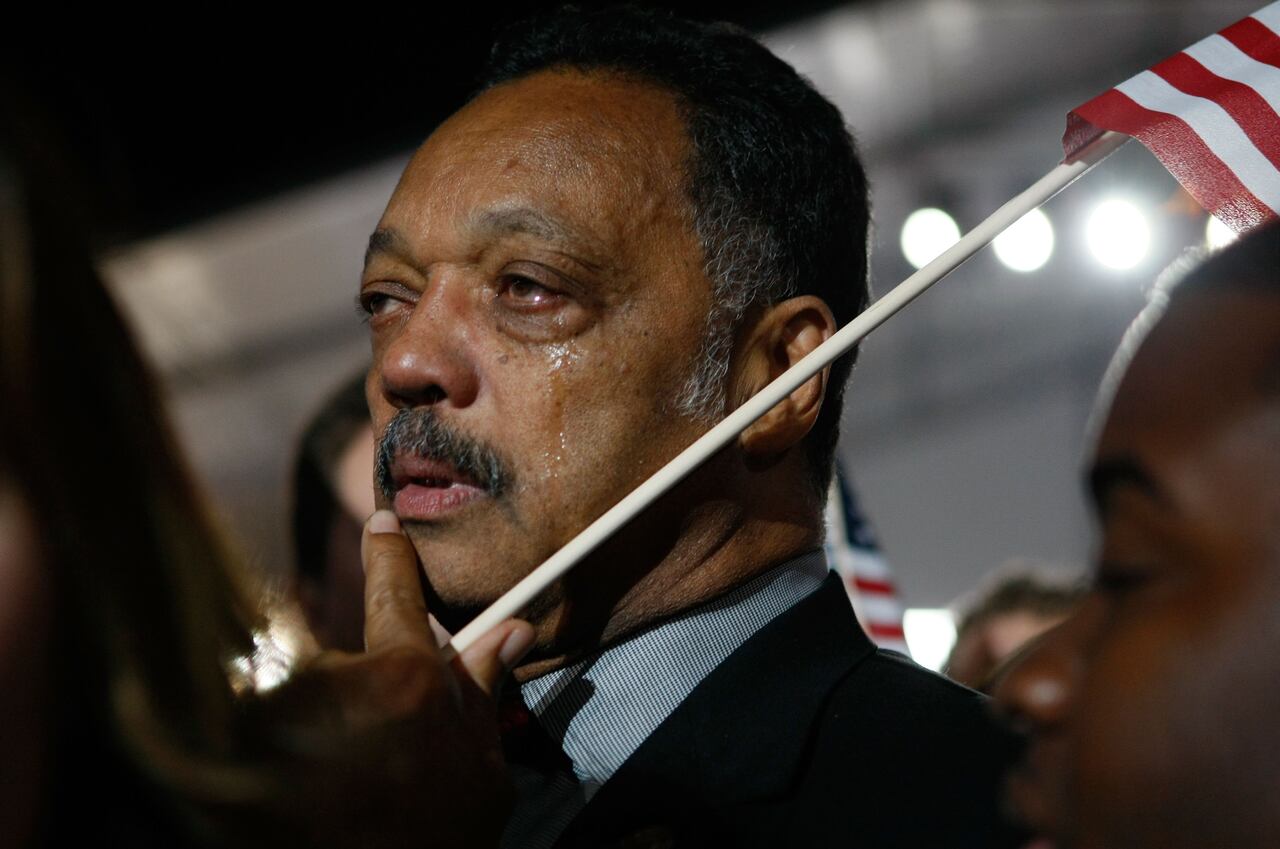 Rev. Jesse Jackson reacts after projections show that Sen. Barack Obama would be elected to serve as the 44th U.S. president during an election night gathering in Chicago’s Grant Park on Nov. 4, 2008. (Joe Raedle/Getty Images)
Jackson was sometimes criticized for his omnipresence and his peripatetic approach. Depending on the day, he might be found advocating on behalf of striking coal miners or professional athletes, praying with the parents of an incapacitated woman, Terri Schiavo, embroiled in a controversial end-of-life legal battle, offering comfort in Armenia after a devastating earthquake or freelancing as a de facto mediator in meetings with autocrats who vexed U.S. administrations, like Cuba’s Fidel Castro and Yasser Arafat of the Palestine Liberation Organization.
“There are tree shakers, and there are jelly makers,” Jackson would explain in response.
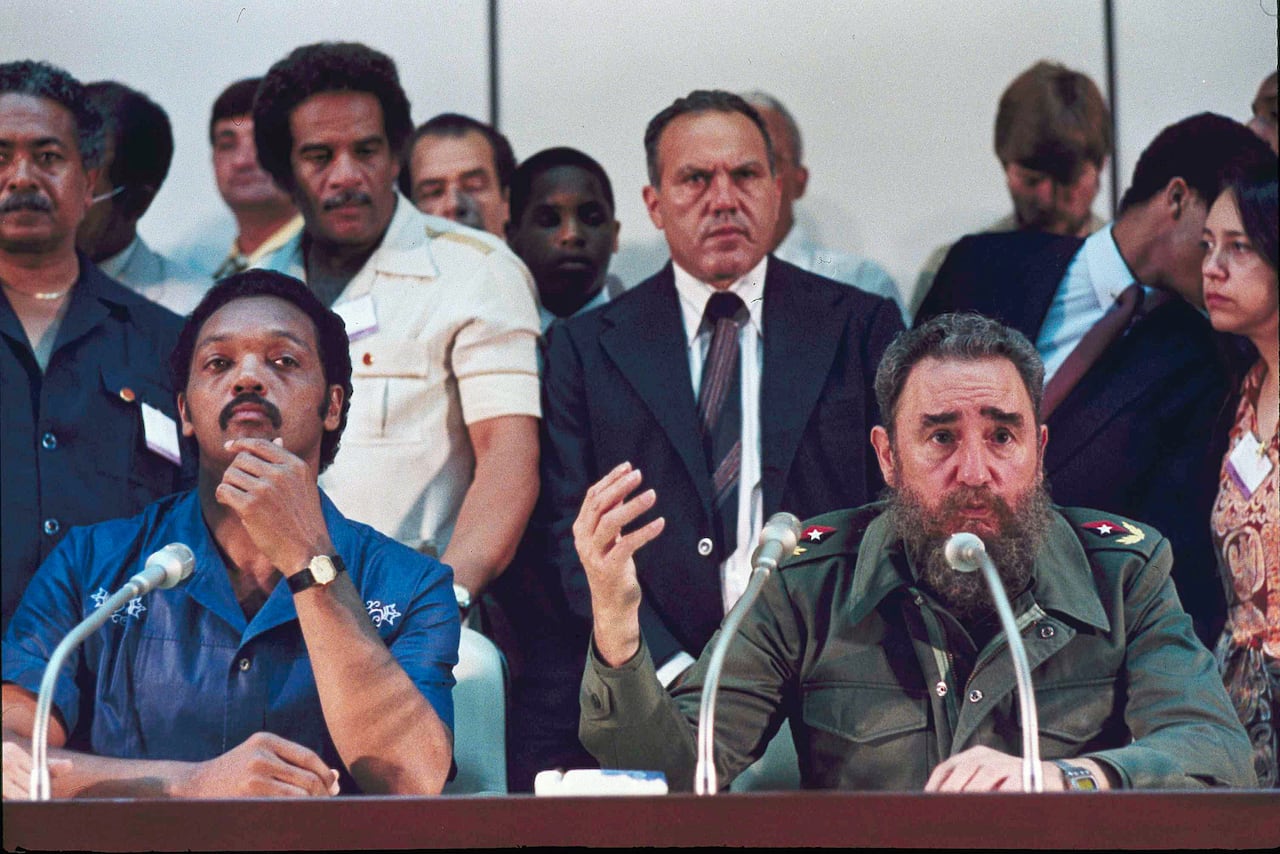 Cuban President Fidel Castro, right, and Rev. Jesse Jackson talk to the international media during a joint news conference at Havana’s National Palace, on June 27, 1984, when it was announced that 22 Americans would be freed from Cuban jails. (Charles Tasnadi/The Associated Press)
He could be enigmatic even to his own family.
“When they ask you what your father does, what can you tell them? He goes around talking to people, trying to help them?” son Jonathan once told a biographer. “Frankly, I never knew exactly what to tell them. When they’d ask me what he did, I’d just say, ‘He’s Jesse Jackson.'”
Purpose fuelled by late grandmother
Jackson knew well the privations of racism and poverty growing up in segregated Greenville, S.C.
The product of a liaison between his teen mother and a much older man from the neighbourhood, Jackson eventually took the surname of his stepfather.
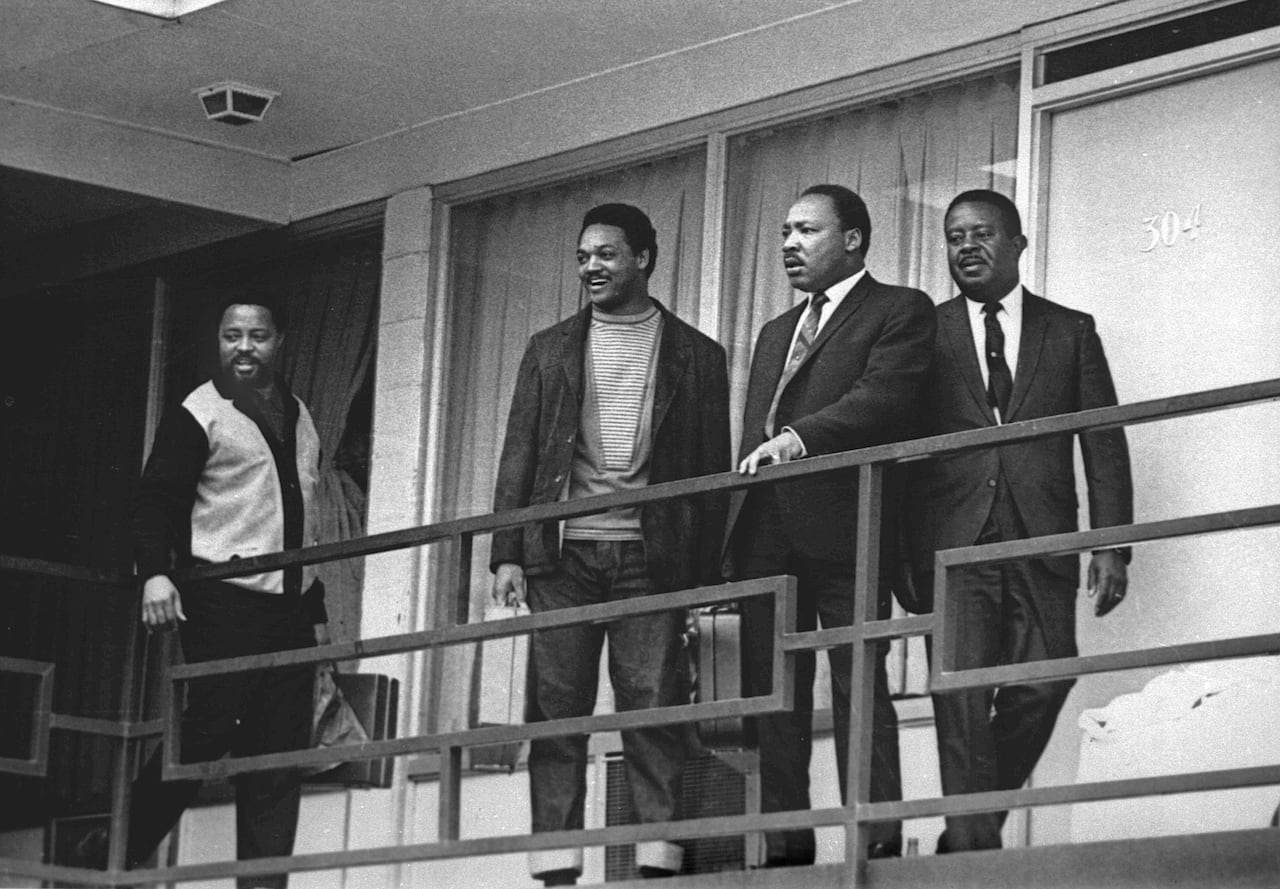 Rev. Martin Luther King Jr., second from right, stands with Hosea Williams, left, Jesse Jackson, second from left, and Ralph Abernathy, right, on the balcony of the Lorraine Motel in Memphis, Tenn., on April 3, 1968, a day before King was assassinated outside the motel. (Charles Kelly/The Associated Press)
Hometown friends would later tell reporters that Jackson had an unswerving sense his life held greater purpose, a belief fuelled by the dominant loving figure in his life, his grandmother.
He starred in football at his segregated high school and then attended North Carolina A&T State University, where his activism first took root.
He didn’t end up completing his studies at the Chicago Theological Seminary, but established a chapter of King’s Southern Christian Leadership Conference organization there.
“We were really and truly a very close band of brothers,” Andrew Young, U.S ambassador to the United Nations and SCLC member, told PBS’s Frontline in a 1996 documentary. “But like brothers, we often disagreed.”
Jackson was at the Lorraine Motel in Memphis on April 4, 1968, the night King was gunned down. Jackson informed Coretta Scott King her husband had been shot, though at the time of the call, he couldn’t bear telling her the Nobel laureate had already died.
Jackson’s actions in the aftermath of King’s assassination rankled some SCLC members. He immediately flew back to Chicago, making himself available as a group spokesman for national interviews.
WATCH | Jackson on MLK’s legacy:
Witness to Martin Luther King’s dream
Civil rights activist Jesse Jackson remembers Martin Luther King’s ‘I have a dream’ speech
Jackson was eager to fill the leadership void created by King’s death and within a few years, he would leave the SCLC. In contrast to the more militant stances of the Black Panthers and Nation of Islam, Jackson promoted advancing the cause of African Americans by working within the existing system.
“For all its faults, America is the only country with the capacity to save the world, even at the very moment that we seem bent on destroying it,” he explained in a 1969 Playboy interview.
To Black audiences, the Baptist preacher imparted a message of prideful non-violent activism, punctuated by a rousing call-and-response coda adapted from a 1950s poem by the preacher William Borders:
“I am … somebody!
I may be poor, but I am … somebody!
I may be on welfare, but I am …. somebody!
I may be unskilled, but I am … somebody!”
Jackson wasn’t viewed through a partisan lens in the 1970s. He was invited to speak at the Republican National Committee in 1978 as the party struggled to gain Black voters, and he would later admit that the pro-choice and gay rights stances of the Democrats had required an evolution in his thinking.
WATCH | Jackson’s I Am Somebody poem at Wattstax, Los Angeles, 1972:
Antisemitic controversy
Jackson’s trailblazing 1984 campaign made a splash but its momentum would stall when, during a conversation with a Black journalist, he used an antisemitic slur to describe New York City.
Jackson, whose PUSH operation was housed in a former synagogue, apologized.
He ultimately finished third in that primary. In 1988, he trailed only nominee Michael Dukakis, placing ahead of future White House occupants Al Gore and Joe Biden.
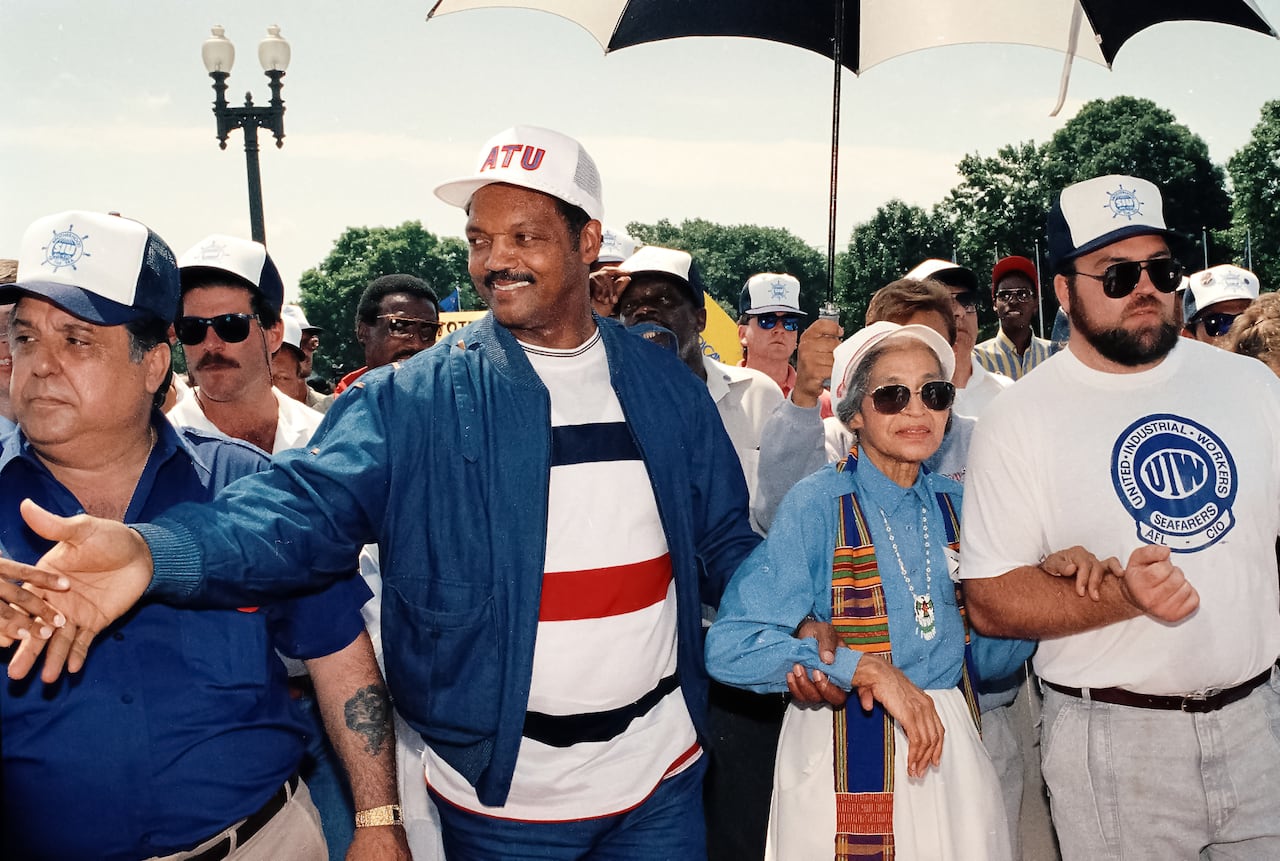 Rev. Jesse Jackson, centre left, walks with civil rights pioneer Rosa Parks, centre right, as they joined striking Greyhound workers at a rally in front of Union Station in Washington, D.C., on June 19, 1990. (J. Scott Applewhite/The Associated Press)
The rise of Bill Clinton was among a number of factors that saw Jackson’s electoral prospects dim in the 1990s and beyond. But in the racial conflagrations that too often roil America, his counsel was never far away.
Jackson was ever-present after the Rodney King beating in 1991 and its riotous aftermath when police officers were acquitted, and following the shooting deaths of Black teens Trayvon Martin and Michael Brown.
The fly-in approach to activism inspired a 2007 South Park episode and led to resentful coverage in the burgeoning right-wing media, who accused Jackson of “playing the race card.”
But on at least four known occasions through the years, Jackson returned to U.S. soil with American citizens or service members who had been detained without trial or held hostage overseas.
“If it were not for the grace of God and Jesse Jackson, we would not be here. The State Department has not lifted a hand for us,” said a 76-year-old man after being one of 47 let go in Kuwait in 1990 after Jackson met with Iraqi leader Saddam Hussein.
Troubles for father and son
In later years, Jackson had troubles beyond the pundits to deal with. In 2001, after being married to his wife, Jackie, for 40 years, Jackson admitted to having fathered a daughter out of wedlock two years earlier.
In 2013, his oldest son’s promising political career came crashing down. Democratic House Rep. Jesse Jackson Jr. was sentenced to prison for using campaign funds for personal use.
Despite the personal turmoil, Jackson always found new campaigns to mount, from taking on the giant tech companies for their poor scores on diversity to criticizing the Trump presidency.
WATCH | Jackson worried about voter suppression:
Reverend Jesse Jackson: Trump is ‘leading a counter-cultural revolution…it’s part of his backward surge to make America worse than it ever was’
Jackson sits down with Terry Milewski to discuss Donald Trump’s presidency
Not long after George Floyd was killed in May 2020 by a Minneapolis police officer, Jackson helped lead the call for nationwide protests to affect change.
“Black lives matter, for real. And the problem we’re having is Blacks are being brutalized without consequences and the health-care gap, the job gap, education gap, the criminal justice gap … these gaps must be addressed,” he told a reporter.
For Jackson, the battle for progress was ongoing, even decades after the Civil Rights Act.
“We slew Goliath,” he would often say. “But Goliath had some sons.”