
The trial, set to begin in Avignon in the autumn, was fast approaching. I thought about it all the time. My two lawyers — Stéphane and Antoine — and I were busy preparing for it. I always referred to them now as “the boys”, an affectionate term that reflected how important they were in my life. They were still unfailingly tactful and reserved with me. In that respect, we were all very much alike.
My lawyers had requested that I read the writ of indictment in its entirety. Four hundred pages. A full account of everything I had discovered and been told over the last few years. This time it was not going to be possible to take in the facts bit by bit, as I had always insisted on doing. I was going to have to read it all in one go, the detailed descriptions of how my husband and dozens of strangers had raped me over the course of ten years.
My partner Jean-Loup printed the whole thing out for me — I didn’t want to read it on a computer screen. I wanted to be able to go through the big sheaf of pages alone, curled up inside or out in a comfortable chair.
The account began with a long list of the accused. Their names, occupations, addresses. I highlighted their dates of birth. 1997… 1988… I was born in 1952. Their youth was baffling, and made it all the more appalling. Then, for each one, the facts.
Abhorrent, unspeakably cruel. And entirely absent from my memory, so distant from anything I could imagine, almost unreal, despite being written down in black and white in language that managed to be both vulgar and official. And present throughout, this inert woman, whom they manhandled and dared to describe as consenting.
My stomach tightened. I had to keep putting the pages down to catch my breath. The dates were particularly distressing. I could picture where we were, what had happened before and afterwards, what we were doing then in our lives, what I thought was happiness. That was my birthday. That was the New Year’s Eve we’d decided for once to stay in, just the two of us, after the children had gone home.
Jean-Loup was reading the pages at the same time. It didn’t make me feel uncomfortable. “How on earth did your body tolerate all this?” he asked me once or twice. Being asked this unanswerable question felt like plunging straight into the horror of what had happened, while at the same time watching it drift away and hearing myself say I had survived.
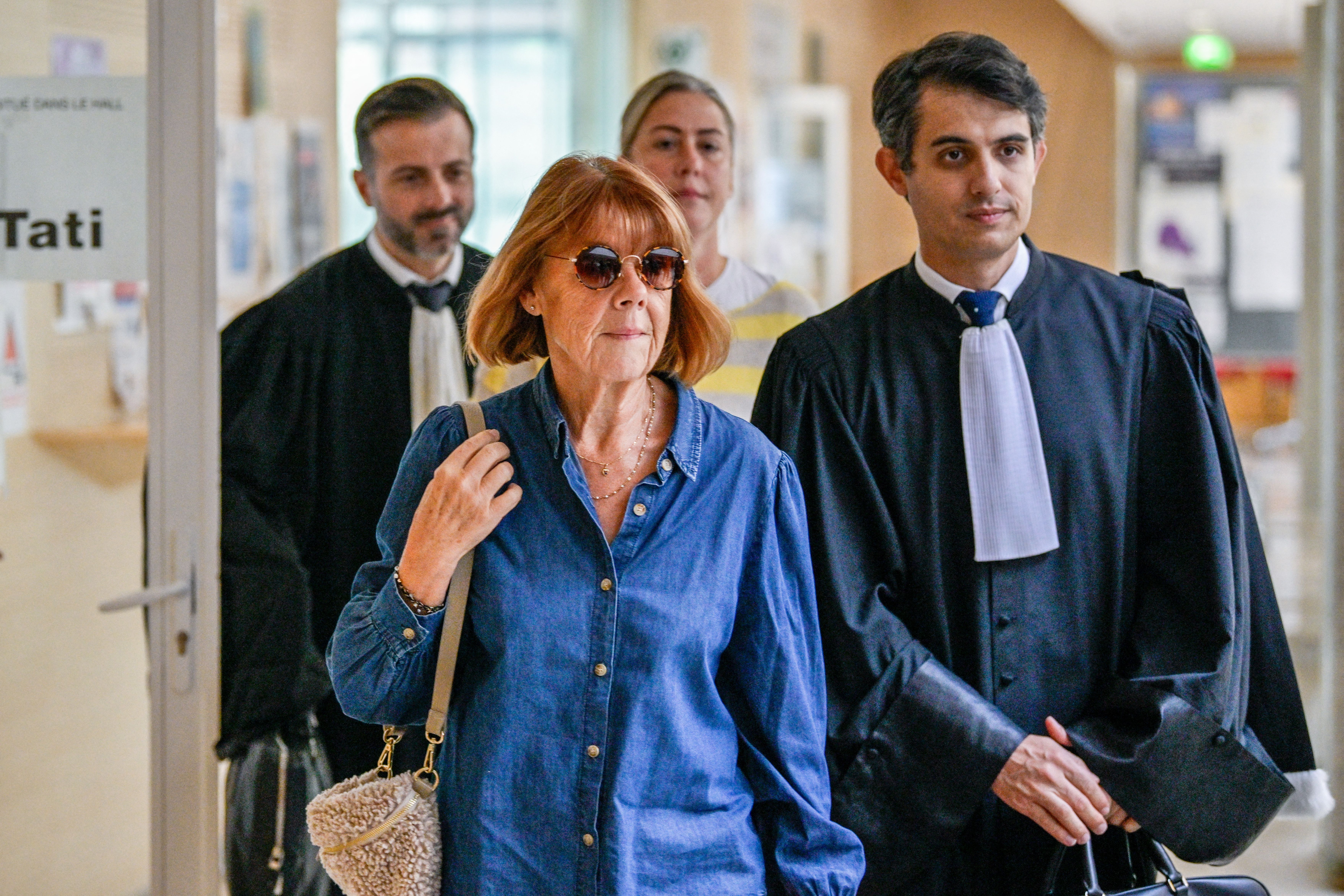
Gisèle Pelicot arrives at the Avignon courthouse with her lawyer, Stéphane Babonneau
COUST LAURENT/ABACA/REX/SHUTTERS
I realised I was ready. Antoine and Stéphane didn’t conceal from me the aspect of the trial that was extremely unusual for them too: the fact that there were 51 defendants. A pack of rapists. Fifty strangers and the man who was once my husband.
I was impatient to see Dominique in court. The others I feared because of how many they were. I found myself worrying more and more about the closed door of the courtroom, which was supposed to protect me from the prying eyes of the public and the media. I was beginning to realise that a closed hearing meant I would be alone with them. Locked in with them. It was a vague sense I had, difficult to formulate in words. I hadn’t discussed it with anyone, but as the trial drew near I kept imagining myself hostage to their gaze, their lies, their cowardice and their contempt. The charges against them were overwhelming, the evidence unprecedented, but the fact remained that there would be 51 men gathered in the courtroom. Their voices would be louder than mine. And all their eyes would be on me as they stood shoulder to shoulder, like a wall.
Maybe I was handing them a gift. Maybe I was actually protecting them by asking for the trial to be held behind closed doors. No one would ever know what they had done to me. There would be no journalists present to say their names and describe their crimes. No one beyond those involved in the trial would see their faces, look them up and down and wonder how to pick out the rapists among their neighbours and colleagues, though apparently it is so very easy to recruit them.
Perhaps most importantly of all, no woman would be able to enter the courtroom and feel a little less alone; if I hadn’t noticed anything, it must surely have happened to others. Apart from the judges, there would be only me, my children and my lawyers, Antoine and Stéphane, facing a horde of men and their 45 defence lawyers.
I had ardently wanted a closed hearing. I had said it again to the magistrate a few months earlier. It was so clear to me that I hadn’t even discussed it with my lawyers. When my previous lawyer had suggested having an open hearing as a way of staging a massive public trial of violence against women, I had categorically refused. I did not wish to have my relationship with Dominique exposed to the eyes of the world. I believed that justice must be done but I did not want to be for ever the victim, “that poor woman” — she wasn’t me, and she wasn’t the person I wanted to be.
But then, one day in May, I changed my mind. I was walking alone through the forest with the intention of coming back along the beach. The more I walked, the more my doubts grew. If Dominique had been alone in the dock, I would have felt there was no alternative to a closed hearing, but now? A flood of questions filled my head, a strange blend of dread, anger and confidence too, for I was stronger, no longer the person who had lost everything.
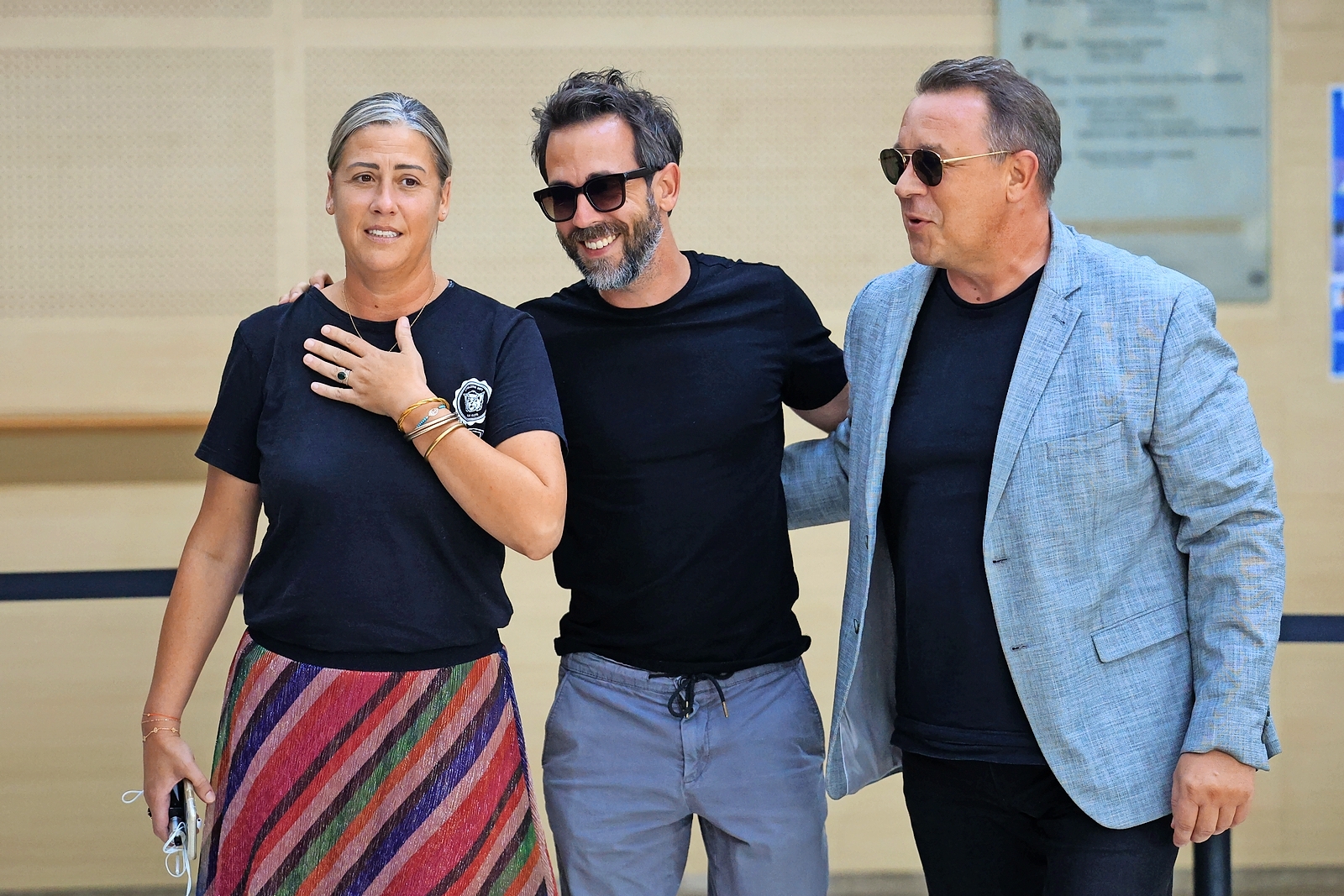
Pelicot’s sons Florian, centre, and David and her daughter Caroline outside court in Avignon
EPA/GUILLAUME HORCAJUELO
Jean-Loup and I were living together now. Most importantly of all, I had my own children back. The summer we had spent together, followed by Christmas and New Year, seemed to have brought us closer. My family was healing. I was happy that we were speaking on the phone more often. I kept up to date with their news, heard the voices of my grandchildren whom I had missed so much. We were each privately dealing with the trial of the father and husband in our own way, but we would be in court together, to seek, if not meaning in all that had happened to us, at least some kind of closure.
• Gisèle Pelicot: Rape victims should never be ashamed
I arrived at the beach. The sea air was brisk, it filled my lungs, I felt exposed to the elements, small but utterly alive. I had the physical sensation that I needed the rest of the world. I didn’t want to be alone any more. So many strangers had shown me such kindness, made me feel welcome when I had nothing left. I wasn’t scared of being seen now, of people knowing.
Shame has to change sides. The words I’d first heard over a decade ago, a slogan supporting women who had survived rape and domestic violence, came into my head like a refrain, as if tiny blades were honing my thoughts. Everyone needs to see the faces of the 51 rapists. They should be the ones to hang their heads in shame, not me.
At the top of the hill I stopped on the coastal path for a moment and gazed into the distance where the sky meets the sea. I knew then that the door to the courtroom had to be opened.

I got home to find Jean-Loup setting the table for lunch. I told him I had decided that I wanted the court proceedings to be open to the media and the public. Very calmly, he replied that it was up to me and he understood. Almost as if he had known it was coming. After we’d finished eating, I called Stéphane.
“Are you sure, Gisèle?” he asked, astonished at my change of heart.
A little later he and Antoine called me back to ask me to think it over. They gave me a week. But I had made my decision. It liberated me. The next morning I called to tell them I was sure. Straight afterwards I phoned my daughter Caroline. She was pleased. David and Florian also approved. Of course, none of us could imagine the coming storm — it was impossible to foresee. Nor did I wish for it.
• My interview with Caroline Darian was devastating, like no other
We agreed that I would be in court for the first two weeks of the trial, after which my lawyers and their team would speak on my behalf. When I’m struggling, I hide myself away. And it was those bastards I wanted to be put in the spotlight, not me.
Today, looking back on the moment I made the decision, I am aware that had I been 20 years younger, I probably wouldn’t have dared request that the case be heard in open court. I would have been too afraid of the looks: those damn looks that women of my generation have always had to contend with; those damn looks that make you waver in the morning between a dress and trousers, that follow you or ignore you, flatter you or embarrass you; those damn looks that seem to tell you who you are or what you’re worth, only to forsake you as you age.
It was exactly that nerve Dominique pressed when he told me I should be glad my husband still desired me whenever he photographed me coming out of the bathroom. I was, no doubt, still susceptible to it. It’s foolish, but that’s how we were — freer, more autonomous women, yet still afraid of being abandoned, still longing to be saved. Maybe the shame lifts once you hit 70 and no one looks at you any more. I don’t know. I wasn’t afraid of my wrinkles or my body. I loved Jean-Loup and he loved me. Happiness was certainly a factor in my decision.
“This changes everything, Gisèle,” Antoine and Stéphane told me. “We shall have to prepare for this in a different way.” They explained that the projection of so many videos of this nature had never occurred before in the entire history of the legal system, and that it was bound to be widely reported and discussed in the media. It was imperative that I watch them beforehand to prepare myself so that it didn’t blow up in my face during the trial. I hadn’t thought of that. I’d imagined I’d be able to leave the courtroom while the videos were being shown, irrespective of whether the trial was held in public. But no, I wasn’t going to be able to avoid them. It would be impossible for the public to see them and not me. So one day I sat down in the study in front of the computer. Jean-Loup sorted out the technical settings, then I asked him to leave the room and made him swear that he would never watch what I was about to see. He closed the door behind him. I knew that he would remain close by in case I called for him.
Stéphane was online from his office in Paris, though I would have preferred him not to be. I’d rather have been alone while I watched them. We switched off our cameras so I could just hear his voice. He would be sending the links to the videos, one by one. I opened the first one. I saw a dead woman in darkness. She was snoring loudly. I saw her hands were bound. Her feet too. “If it’s too much, we’ll stop,” Stéphane said.
I said I wanted to continue.
He sent another video. Then another. Each time, he told me what I was about to see. I saw her mouth forced open. I saw her suffocate and choke. And the husband and the rapist didn’t stop. I saw animals. I heard them whispering. I saw a courgette. I heard Dominique mutter, “Easy does it.” I saw him rape me. Dominique, almighty in the cesspool of the human soul.
My body, the dumping ground of his fantasies. Punished for what it had refused him. Cast unconscious into the pit of men. My body tortured. It wasn’t me. It happened to me, but it wasn’t me.
I kept saying that to myself. Not the way I’d said it on that day in Deputy Sergeant Perret’s office, when my brain had shut down at what I was being told. Now, my brain was functioning. It remembered nothing of what it saw. It didn’t inhabit that body, which was just a shell. My corpse. A doll made of flesh and blood. I didn’t see my life there. They had chased it away, driven it out of my body. I have no idea where it was. Was it hiding under the bed, as I was in the nightmares from long ago that warned me that men would come for me, even in my room? Or had they destroyed it? Destroyed my life. Let me go mad. Killed me. But no. I was here, alive. Sitting, rigid, in front of the computer. Bystander to my own past, to my own body, filmed by Dominique so he and other men could ejaculate over the body of a woman transformed into a piece of junk.
Now, at last, these images were turning against them. I knew who I was. I wanted to see it all.
I watched everything that Stéphane had planned to show me. I have no idea how long it took. I came out of the study.
I said to Jean-Loup, “Don’t be upset, I’m going for a walk, I need to be on my own.” I sidestepped his embrace. I didn’t want him to hug me. I fled his support, his shoulder to lean on, his kindness, all his attempts to assuage my suffering. I mustn’t let it out, I mustn’t crack. If I allow the full extent of my pain to be seen, all my pain, I will drown in it. I have no choice but to be invincible.
Jean-Loup watched me go. Again, I took the path through the forest. Tears rolled down my face. They were dried by the wind, only for fresh tears to flow, and the wind to come back and sting my eyes, sweep away my shame and console me. It wasn’t me. That woman between sleep and death was not me. I walked for a long time until I stopped crying. Then I turned and went back home for lunch.
© Gisèle Pelicot 2026. This is an edited extract from A Hymn to Life by Gisèle Pelicot, to be published by Bodley Head on Feb 17 at £22. To order a copy of A Hymn to Life go to timesbookshop.co.uk. Free UK standard P&P on orders over £25. Special discount available for Times+ members