
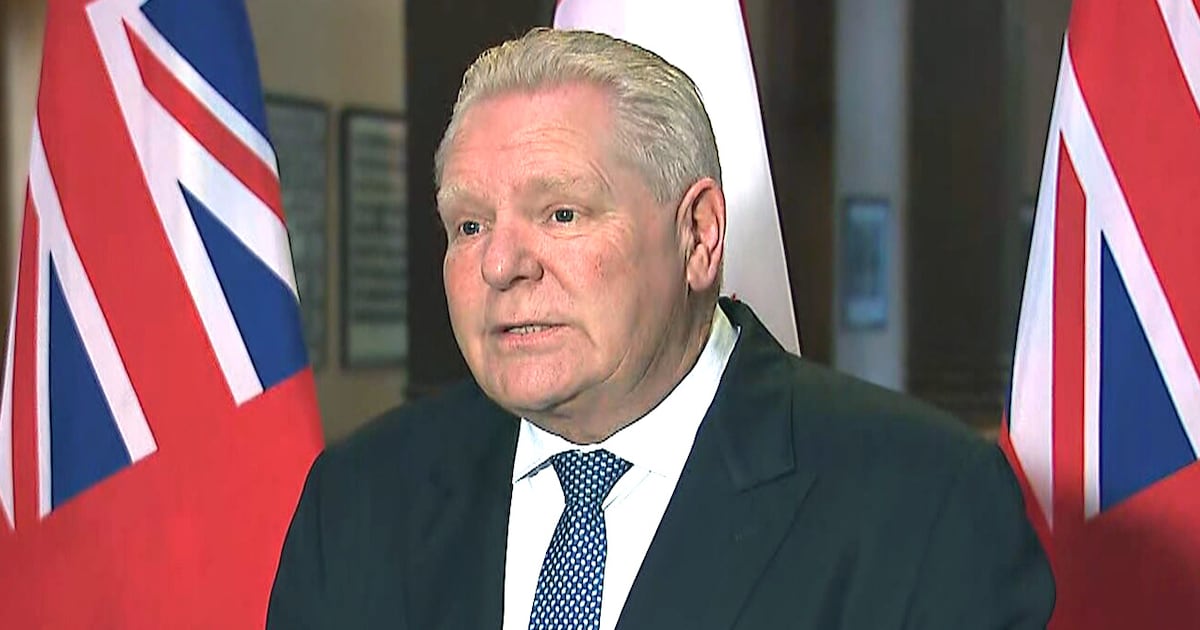
Ontario Premier Doug Ford addresses the backlash over the province’s decision to hike tuition fees and make cuts to OSAP grants.
Ontario Premier Doug Ford is standing behind his government’s decision to lift a freeze on college and university tuition, telling reporters that some institutions could have been forced to close without the ability to generate additional revenue.
The PC government announced last week that it would allow colleges and universities to increase tuition by up to two per cent per year for the next three years, ending a freeze that had been in effect since 2019.
At the same time, the government said that it would decrease the proportion of grants offered through OSAP from roughly 85 per cent of total funding to a maximum of 25 per cent starting in the fall.
“Folks, it was in the red, it was just not sustainable and the sector was telling me it was not sustainable,” Ford said at Queen’s Park on Tuesday. “If we continued going we would be closing down colleges and universities.”
Ford said on Tuesday that he has received “thousands” of calls from students upset about the changes to OSAP and the lifting of the tuition freeze.
He said that for years he resisted lifting the freeze despite “massive pressure from the heads of the colleges and universities” but ultimately had to do something to support colleges and universities that have struggled financially amid new limits on international student enrollment.
He said that his message to students in the wake of the changes is that “they have to invest in their future and in in-demand jobs.”
“A lot of the students, you know, you are picking basket-weaving courses and there are not too many baskets being sold out there. Go into healthcare, go into trades, go into jobs of the future, focus on STEM (Science, Technology, Engineering, Math)” Ford said. “Those are where the jobs are.”
$6.4B in additional funding
As part of the changes announced last week, the Ford government also committed an additional $6.4 billion in funding for the post-secondary sector over the next four years.
The changes, however, have been widely criticized by student groups and opposition leaders.
Last week, Canadian Federation of Students’ Ontario branch Government Relations and Policy Co-ordinator Kayla Weiler told The Canadian Press that the changes to OSAP, in particular, will be “a huge disadvantage for students” and will likely result in the next cohort of students graduating “with more student debt than ever before.”
Meanwhile, NDP critic Peggy Sattler said that “instead of fixing the affordability crisis” the government is telling students “to take on more debt and hope things somehow work out.”
For his part, Ford said that he hopes that by contributing more postsecondary students will be “more accountable.”
Ford also appeared to suggest that some students are taking advantage of OSAP, telling reporters he has heard “nightmare stories” about “kids going out there and buying fancy watches and cologne.”
“If they have investments into their education and their parents have investments in their education they are going to focus on it and they aren’t going to drop out and they aren’t going to be looking for a different job after going to school for one type of sector and finding out that there is no more jobs,” he said.