
Photo by Jeff Overs via Getty Image
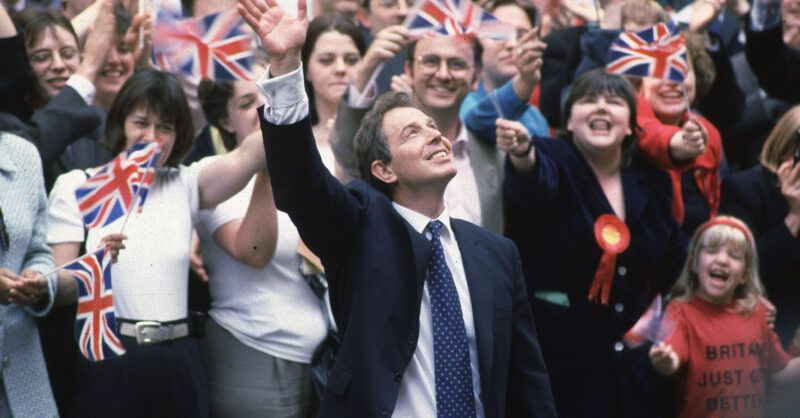
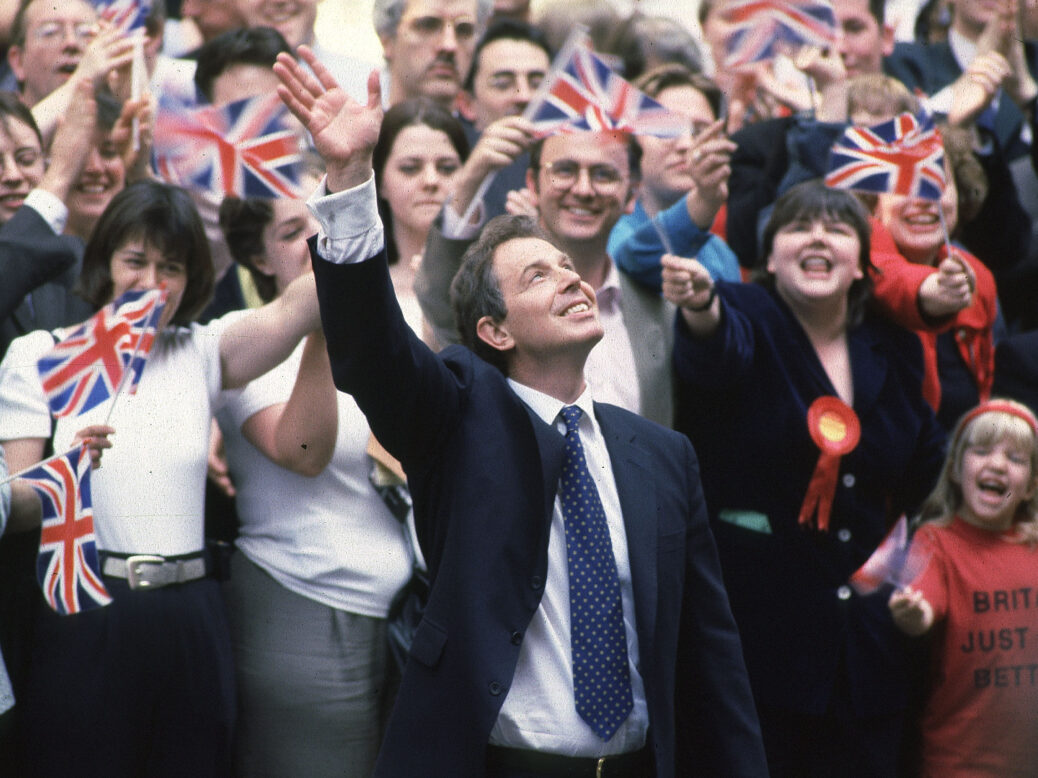
When did he forget how to grin? He used to do it too much. Those late-Nineties walkabouts: one arm raised and waving, Cherie tucked tight in the crook of the other, and Tony beaming at anyone who crossed his path. Even in Iraq, jogging off the RAF jet, and greeting the saluting soldier with a smile. But then, sometime around the 2005 election, the face lost some of its width and contracted into that dyspeptic grimace, like someone showing their coffee stains to the hygienist.
The Tony Blair Story is the story of that smile, its falter and decay, the euphoric promise of 1997 twisting into the taint of 2026. It’s being billed as “landmark”, which here just means long – four hours of archive footage chopped up with chit-chat from Tony, his family and an impressive cast of players from the New Labour era. Peter Mandelson does the for, Jeremy Corbyn does the against, and the novelist Robert Harris does the withering disappointment.
Searching for Blair’s compound, his irreducible core, the programme follows the conventional narrative back to early tragedies: his father’s stroke, which ended his own political ambitions, the suicide of Blair’s childhood friend Ewan, and his mother’s death around the time he finished university. The last two coming when Blair was receiving religious instruction from the Australian priest Peter Thomson, there is a sense these events gave Blair his hard, unreflective drive, and his wilfully Manichaean world-view. When he says, as he does often, that something was “the right thing to do”, you know you’re witnessing not a statement of political rhetoric, but one of political belief.
Blair thinks that his domestic achievements have been undervalued at the expense of his foreign policy. That is also the case here, rattling through constitutional reform and the minimum wage to instead centre the grand summits and sweaty negotiations of Northern Ireland, Kosovo, Iraq. You can see how Blair’s interventionism developed by degrees, how he became used to the hand of history, to the crowds of liberated children greeting him at airports.

Subscribe to the New Statesman today for only £1 a week.
The Iraq debate is relitigated in familiar terms: Blair is still assured of his “conviction” and “belief”, and his critics despairing at the kind of drunken self-confidence that overtook him at this point. Corbyn describes Blair as living in a “messianic trench”, and in his rebuttals, on this issue and others, Blair doesn’t exactly prove him wrong. He is mostly sober and insistent, though with the occasional outburst. “Money’s money!” he blurts when pushed on the funding of his post-premiership work. “It just allows you to do things!”
From Basra, it’s a short story to Gordon Brown’s elevation, selling the house in Sedgefield, and the second life as a statesman without the nation state. (We hurtle towards the present so quickly, in fact, that we receive analysis from a clean-shaven young political commentator called Tom McTague.) We could have lingered more here. Twenty years out of office, Harold Wilson was dead and Margaret Thatcher couldn’t finish her own sentences; neither remained the most influential British person on the planet. And Blair’s ongoing prominence sharpens his relationship with the politics of today. He is given a brief moment to chuckle over Nigel Farage’s ascendancy in a “fancy that” kind of style. But Nigel Farage’s shadowing of Blair’s career, and his ambitions to deconstruct his domestic legacies are not discussed or questioned.
Nor are the domestic legacies the Labour Party continues to live with discussed or questioned. “He didn’t really bring on a generation to carry on his revolution,” says Robert Harris. But watch the interviewees. Jonathan Powell, back in government. Alastair Campbell, a widely consulted political commentator. Peter Mandelson, until recently the most senior diplomat in the country, and, despite his further disgrace in recent weeks, left in the edit to purr and giggle (at least in the version I saw). Whether all these men are all true Blairites – believers on Blair’s own level – it’s a level of elite continuity one might expect of ancien régime France. Blair’s life and its epic dilemmas always bear retelling. But the conflict of the present is between these old men – including Blair – and the revolutionary forces agitating to unseat them. The outcome of that struggle will truly shape how we see what Blair did, and who he left behind.
The Tony Blair Story
Channel 4
[Further reading: Peter Mandelson is gone, and so is New Labour]
Content from our partners