
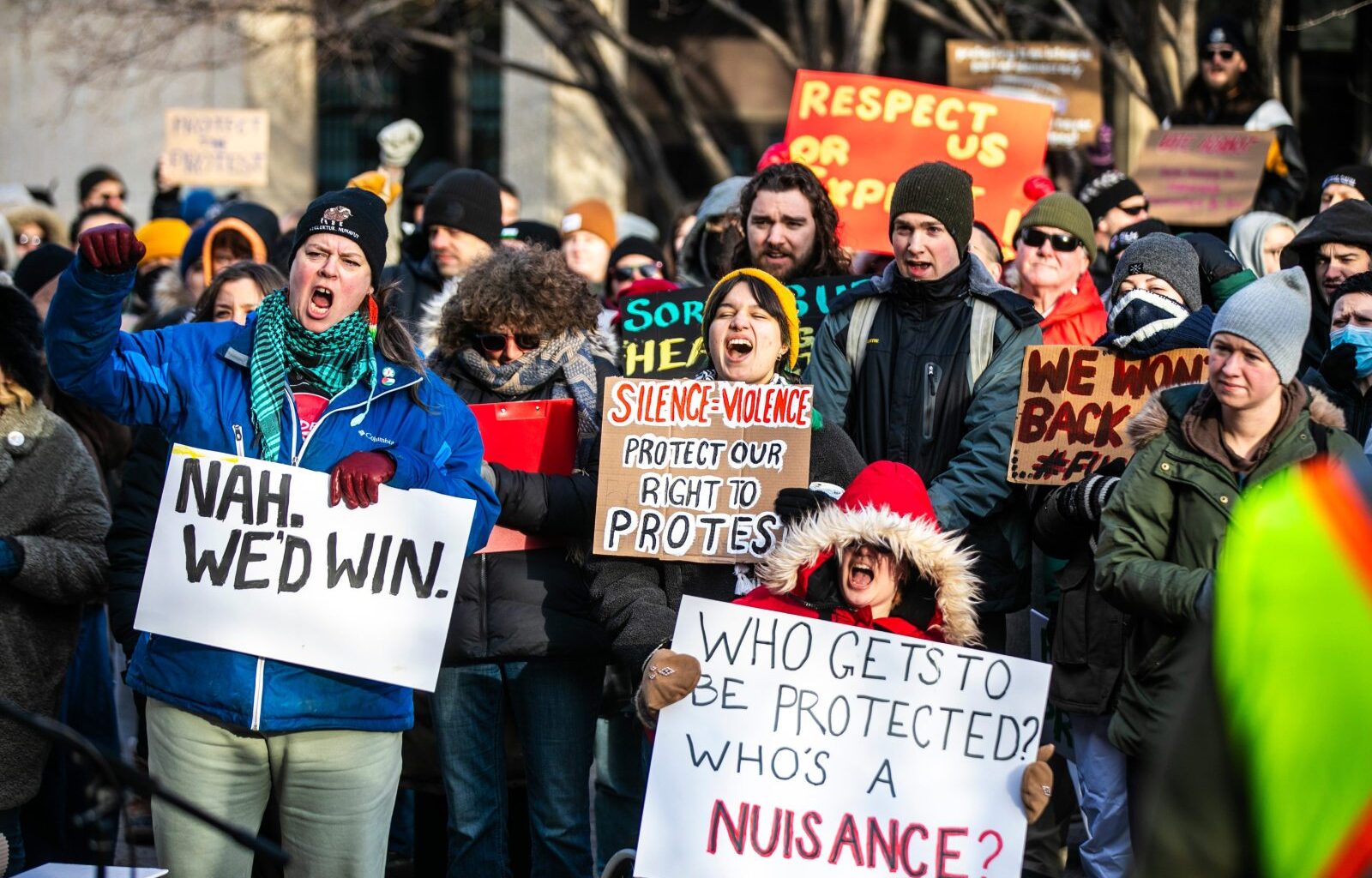
A bylaw that proposed a ban on “nuisance” protests within 100 metres of certain locations has been shelved indefinitely after intense public pushback and a protest that drew hundreds to city hall Tuesday.
City council’s executive policy committee heard from about 100 members of the public Tuesday, who gave speeches in opposition to the proposed Safe Access to Vulnerable Infrastructure bylaw. The proposal was drawn up to limit “nuisance” demonstrations and intimidation within 100 metres of schools, places of worship, libraries, cultural centres, hospitals and other locations.
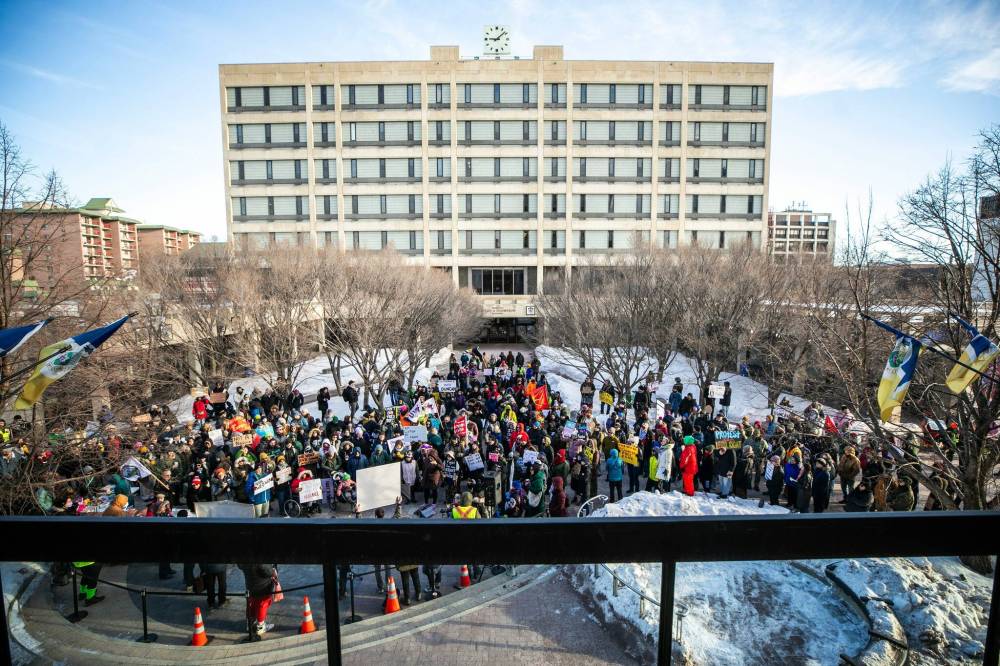
Hundreds rally at City Hall on Tuesday opposing a proposed bylaw restricting “nuisance” demonstrations. (Mikaela Mackenzie / Free Press)
The proposed bylaw would have prohibited any protest that blocked access to spaces for people or vehicles and used megaphones or voice amplifiers, with fines starting at $500 for a first offence, up to $5,000.
“Too broad.”
Coun. Evan Duncan (Charleswood-Tuxedo-Westwood), who put forward a motion calling on council to draft the bylaw in September, said Monday he changed his mind and would pull the proposal after receiving much public feedback. He added that he had the support of Mayor Scott Gillingham and fellow members of EPC to shelve the bylaw and criticized some of the response as “misinformation.”
He said he stood by that decision Tuesday, but was “still supportive of safe spaces within the City of Winnipeg.”
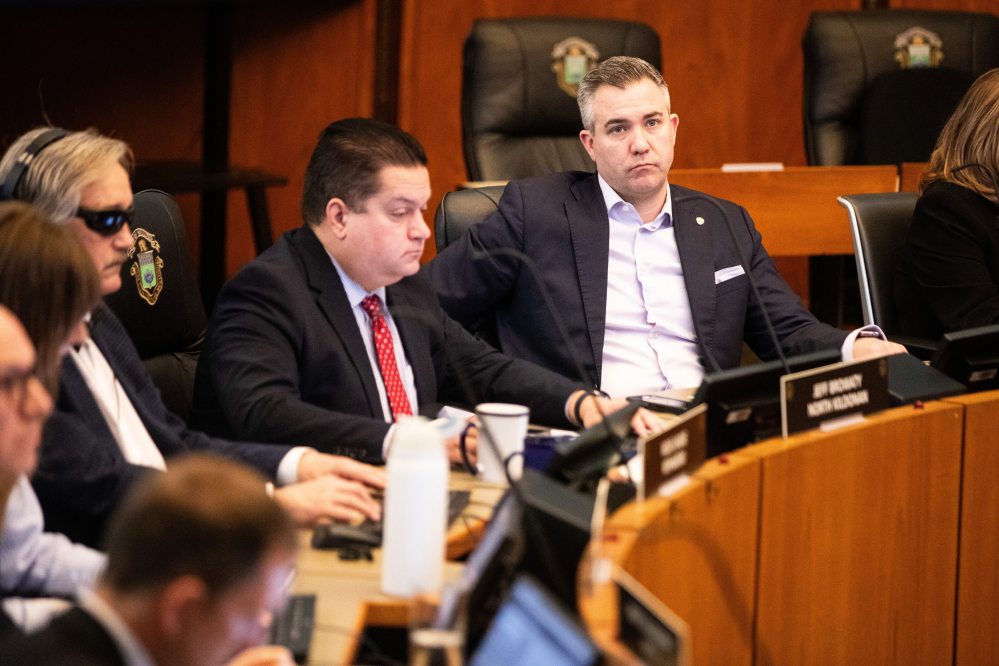
Coun. Evan Duncan, right, during Tuesday’s executive policy committee meeting. (Mikaela Mackenzie / Free Press)
“We have several factors of this bylaw that potentially need to be revisited, as we heard from several groups today, (it’s) too broad,” he said in a break between delegations Tuesday afternoon.
“OK, that’s a great point that the community is making here. My bad for not doing the extensive community consultation that is needed in this case.”
Duncan said he believed federal Bill C9, with proposed amendments to the Criminal Code that would create new offences for obstruction and intimidation around places of worship, could cover many of the concerns he had outlined in his bylaw, but if it didn’t move forward, “we can always revisit.” That hate speech legislation is currently on hold in Ottawa.
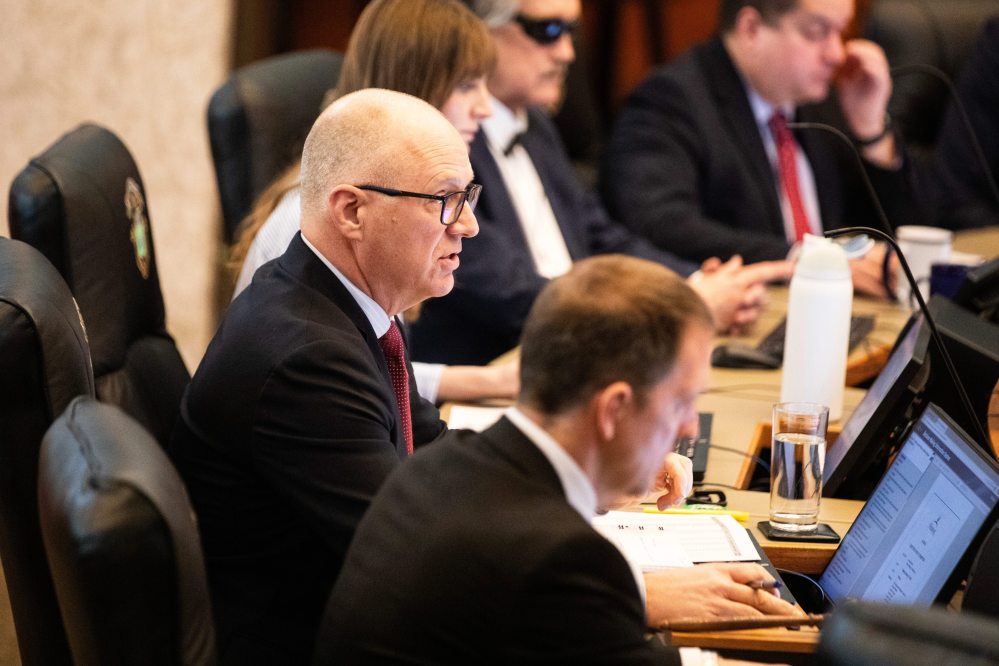
Mayor Scott Gillingham says he doesn’t think the now-shelved proposed bylaw will be revised. (Mikaela Mackenzie / Free Press)
Mayor Scott Gillingham described the strong public response as “democracy at work.”
“I don’t see this bill going back to the drawing board,” he said.
Gillingham said the executive policy committee would vote Tuesday to receive the bylaw as information.
Regardless, several hundred protesters took to city hall ahead of the Tuesday meeting, some with signs critical of the proposal and of Duncan.
Councillors listened as speakers said they were thankful of the decision to rescind the bylaw proposal, but concerned it could be brought back in the future.
“Democracy at work.”
Andrew Kohan, one of the organizers of the rally and a speaker at the meeting, said the wording of the bylaw sought to fine people hundreds of dollars for exercising their democratic rights all over Winnipeg.
“There is no way around it. The language of the bylaw, as written … prohibits that activity, that Charter-protected activity, ” he told reporters. “It does it broadly, not narrowly.”
Others worried unrest south of the border was creeping into Manitoba policy.
“Authoritarianism always begins with new layers of law enforcement and increased power of the state to suppress groups who speak on behalf of vulnerable populations … Does Winnipeg want to be part of this trajectory?” delegate Byron Rempel-Burkholder, the chair of the Mennonite Church of Canada’s Palestine-Israel Network, told councillors.
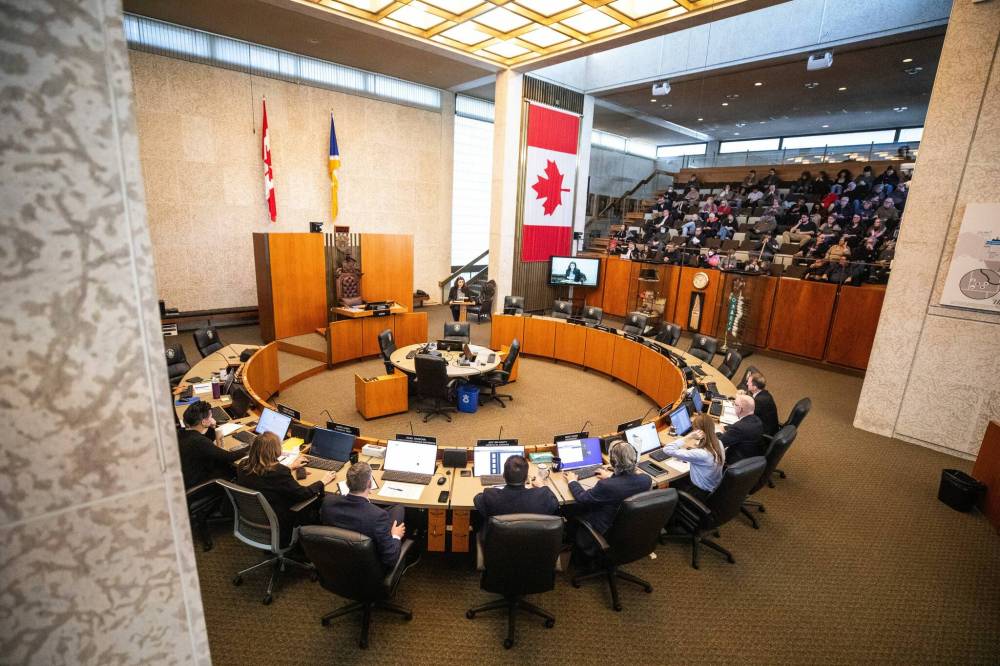
Hundreds of protesters showed up at city hall prior to an executive policy committee meeting Tuesday in support of the right to peaceful protests. (Mikaela Mackenzie / Free Press)
Several spoke in support of the proposal at Tuesday’s meeting.
One was Gustavo Zentner, the vice president of the Centre for Israel and Jewish Affairs, who said Jewish people in Winnipeg were facing “harassment and intimidation” in the midst of protests related to Palestine and Israel, and said the police were limited in what they could do to fight it.
“These are spaces serving children, seniors and other vulnerable individuals,” he said. “While protest is a fundamental right, these demonstrations have often become intimidating.”
“These demonstrations have often become intimidating.”
Several councillors outside of EPC gave their two cents. Coun. Russ Wyatt (Transcona) told the committee he believed they “need some time to retool” the bylaw, while Coun. Sherri Rollins (Fort Rouge) said the proposal was not properly communicated with council before being pushed forward.
“At no point was there a council seminar on the matter pertaining to public safety of this magnitude, at no point did the public service formally present their analysis to council,” she said.
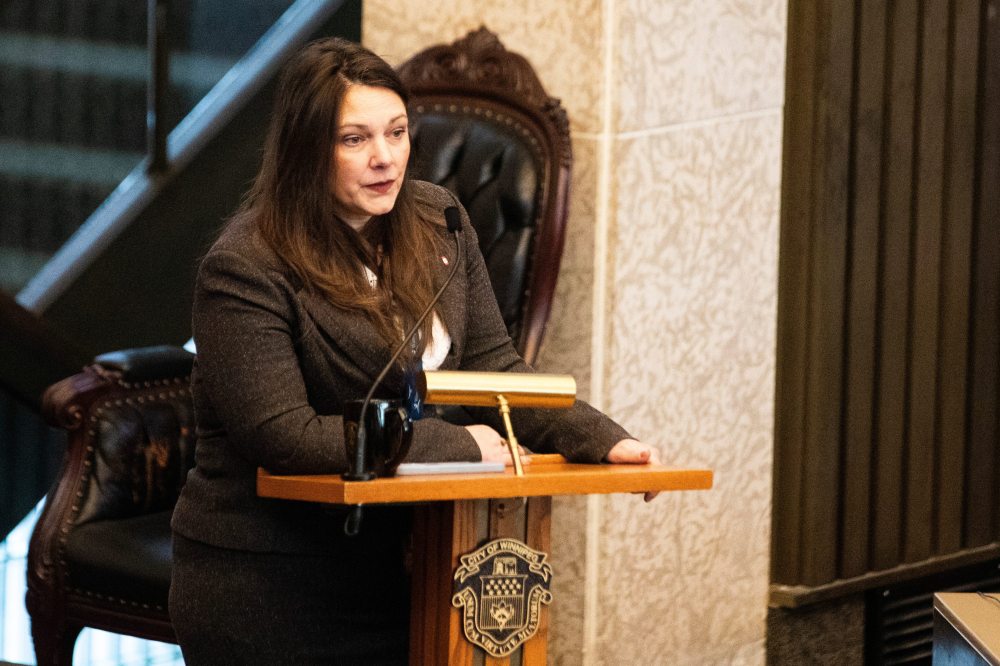
Coun. Sherri Rollins speaks during Tuesday’s executive policy committee meeting. (Mikaela Mackenzie / Free Press)
A number of groups organized in opposition to the proposed bylaw after it was proposed last week. In a letter to Gillingham sent last week, Assembly of Manitoba Chiefs Grand Chief Kyra Wilson said the organization had received a legal review of the bylaw and had concerns with its “potential impact on First Nations peoples and grassroots movements who rely on public assembly and protest as lawful and historically grounded forms of expression.”
Caryn Douglas, a United Church of Canada minister, told protesters and councillors to not “let the rising tide of fear of the other shape us.”
“Denying access to be seen and heard on the streets is denying advocacy for justice,” she said.
malak.abas@freepress.mb.ca
Winnipeg Free Press | Newsletter

Malak Abas is a city reporter at the Free Press. Born and raised in Winnipeg’s North End, she led the campus paper at the University of Manitoba before joining the Free Press in 2020. Read more about Malak.
Every piece of reporting Malak produces is reviewed by an editing team before it is posted online or published in print — part of the Free Press‘s tradition, since 1872, of producing reliable independent journalism. Read more about Free Press’s history and mandate, and learn how our newsroom operates.
Our newsroom depends on a growing audience of readers to power our journalism. If you are not a paid reader, please consider becoming a subscriber.
Our newsroom depends on its audience of readers to power our journalism. Thank you for your support.