


Listen to this article
Estimated 5 minutes
The audio version of this article is generated by AI-based technology. Mispronunciations can occur. We are working with our partners to continually review and improve the results.
Canada is expanding its Express Entry immigration stream so it can bring in a range of skilled workers the Liberal government says are critical to growing the economy and defending the country.
The new categories for Express Entry are giving priority to workers who classify as: researchers and senior managers, pilots, aircraft mechanics and inspectors as well as skilled military recruits.
Those who qualify and are invited into the program become eligible for a fast-track toward permanent residency.
Immigration Minister Lena Metlege Diab announced the expansion of the program during a speech to the Canadian Club of Toronto Wednesday.
“Our Express Entry system is at the core of our approach for attracting and retaining the skilled workers Canada needs,” Diab said Wednesday in Toronto.
“We’re not waiting for the right people to find us,” she said. “We will go out into the world to recruit the people our country needs, to connect them with Canadian employers and to highlight why Canada is the place, the best place, in the world to build their careers and lives.”
According to the minister’s office, the changes mean that researchers and senior managers with Canadian work experience will be invited onto the path for permanent residency as a part of a plan to “drive innovation and growth.”
WATCH | Canada’s new defence industrial strategy shifts away from U.S. reliance:
Canada unveils ‘Build at Home’ defence industrial strategy
The federal government has unveiled its ‘Build at Home’ defence industrial strategy, which shifts away from heavy reliance on the U.S. and other foreign suppliers and makes having military equipment built in Canada the default.Strengthening supply chains and the military
To help move goods across the country and into new markets in a way that will strengthen supply chains and make Canada more economically resilient; pilots, aircraft mechanics and inspectors are being targeted.
Diab explained that in order for skilled military recruits to qualify for the Express Entry program they need to have a job offer from the Canadian Armed Forces.
Workers being targeted for the Forces include doctors, nurses and pilots among other positions.
“They’ll be subject to the same security and all military requirements,” Diab said in Toronto. “This new category will support our government’s commitment to strengthen our armed forces, to defend our sovereignty, and to keep Canadians safe.”
Diab said the decision to have a new category just for skilled military members is an effort to support the Prime Minister Mark Carney’s new defence industrial strategy announced Tuesday.
The move to welcome senior managers and researchers into the program has been crafted to attract world-leading researchers to the country, Diab said.
Restoring confidence in immigration system
In December, Diab announced she would be fast-tracking permanent residency for up to 5,000 doctors, over and above current immigration levels, beginning this year.
The program for physicians with at least one year of Canadian work experience over the last three years who currently have a job offer is directed at primary care doctors, specialists in surgery, clinical and laboratory medicine.
An official in the minister’s office told CBC News that this expansion is part of the Liberal government’s International Talent Attraction Strategy outlined in the budget, which is being crafted to drive the economy and restore balance and public trust to the immigration system.
Both took a hit during the pandemic, when the federal government used the immigration system to help fill urgent shortages in critical areas, Diab said in her prepared remarks.
“Unfortunately, it also grew our population faster than many Canadian communities could absorb—also putting pressure on housing, on infrastructure and on social services,” she said.
Diab said Canada has since reduced the number of new permanent residents to less than one per cent of the population. Non-permanent residents, international students and temporary foreign workers, she said, are being cut to below five per cent of the population — a goal she says her government will meet by 2027.
According to monthly data published by Immigration, Refugees and Citizenship Canada new student arrivals in December were below 10,000 compared to being above 90,000 in December 2023.
The number of temporary workers arriving in Canada in December was also down below 10,000 compared to December 2023 when that number was just over 30,000.
WATCH | Ottawa wants more French-speaking immigrants — outside Quebec: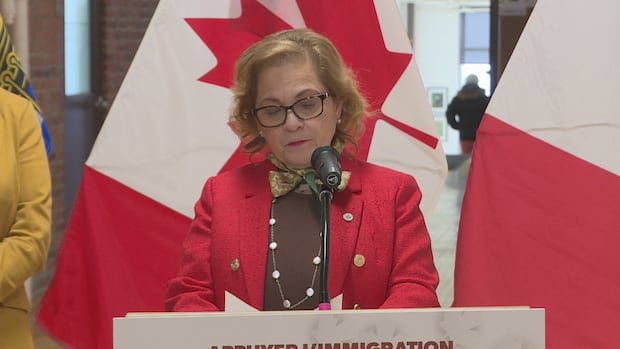
Ottawa wants more French-speaking immigrants — outside Quebec
After exceeding its immigration targets for French speakers in 2025, the federal government is opening up even more permanent resident spots for francophones in 2026.
Diab said that in addition to the new streams, existing streams for qualified workers with French language skills and experience are being maintained.
Those qualified workers include health-care workers such as: nurse practitioners, dentists, pharmacists, psychologists and chiropractors.
Skilled trades that will continue to be targeted include: carpenters, plumbers and machinists.
To help Canada drive innovation, workers in science, technology, engineering and math are also eligible for Express Entry into Canada.