
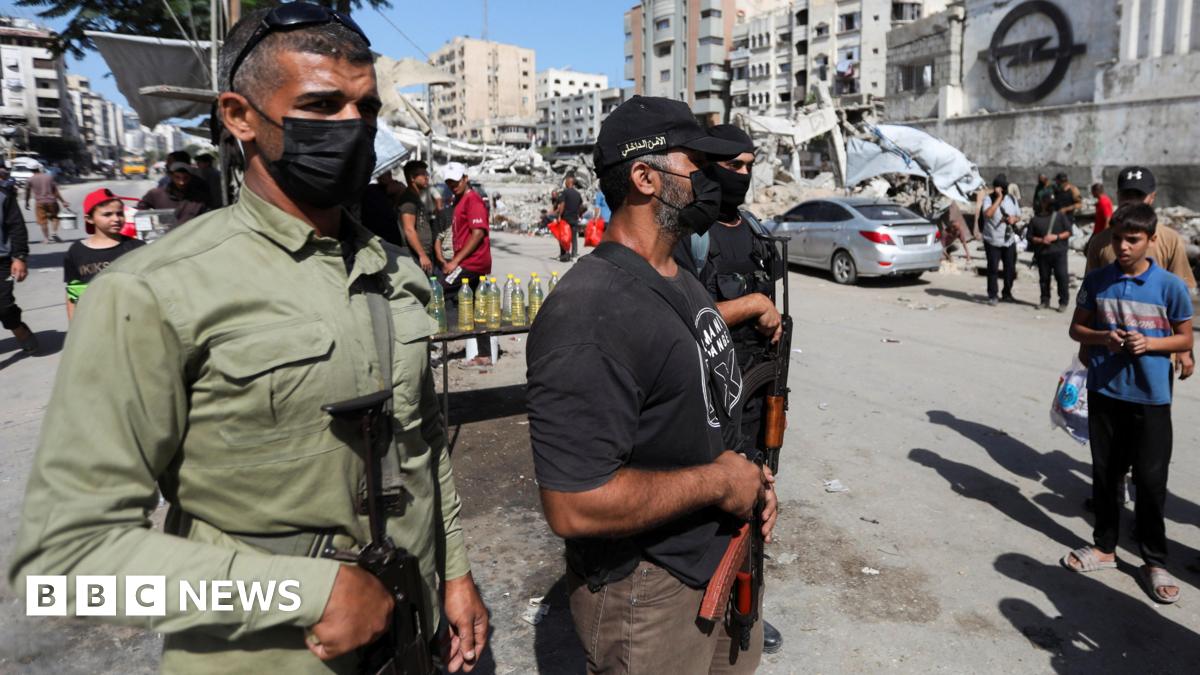
The stallholder, who spoke to our colleague in Gaza City, said he and his family of 12 had been displaced from Shujaiya to the east of the city, where he used to run a shop. Shujaiya today is a flat wasteland of rubble.
“Every day, the municipality comes,” said another man selling cigarettes nearby. “Let them count the stock and the sales, cigarette by cigarette, and tell me: should I pay them, or feed my children?”
Since the ceasefire, food and some other basic goods are flowing into Gaza more freely. The few key traders with a licence to bring them in from Israel say Hamas have reimposed strict control over taxing the imports.
One trader, who agreed to share details anonymously, told us force was used against those who refused to pay.
“The taxes imposed by Hamas depend on the type and quantity of goods, but prices start at 20,000 shekels and above,” he said. “If a trader refuses to pay, force is used and in some cases he is kidnapped or threatened. No one can avoid paying taxes on goods.”
He told us that traders used a code-word for Hamas when discussing tax payments, so that Israel wouldn’t learn that money was being siphoned off to the group.
“Hamas now has a database of all the traders who import goods into the Gaza Strip,” said the activist Mohammed Diab. “The trader pays in cash, not through bank transfers, so that the flow of funds cannot be traced. It is gradually restoring the system that was in place in the past, but away from the spotlight so it can’t be monitored.”
A Hamas spokesman, Hazem Qassem, said the Gaza Strip was in a state of emergency and that “exceptional measures” were required.
“Some traders maintain links with the [Israeli] occupation and attempt to generate excessive profits, so administrative bodies sometimes need to act firmly with traders who refuse to cooperate or meet required obligations,” he said. “This is purely a governmental matter and has no relation to Hamas.”