
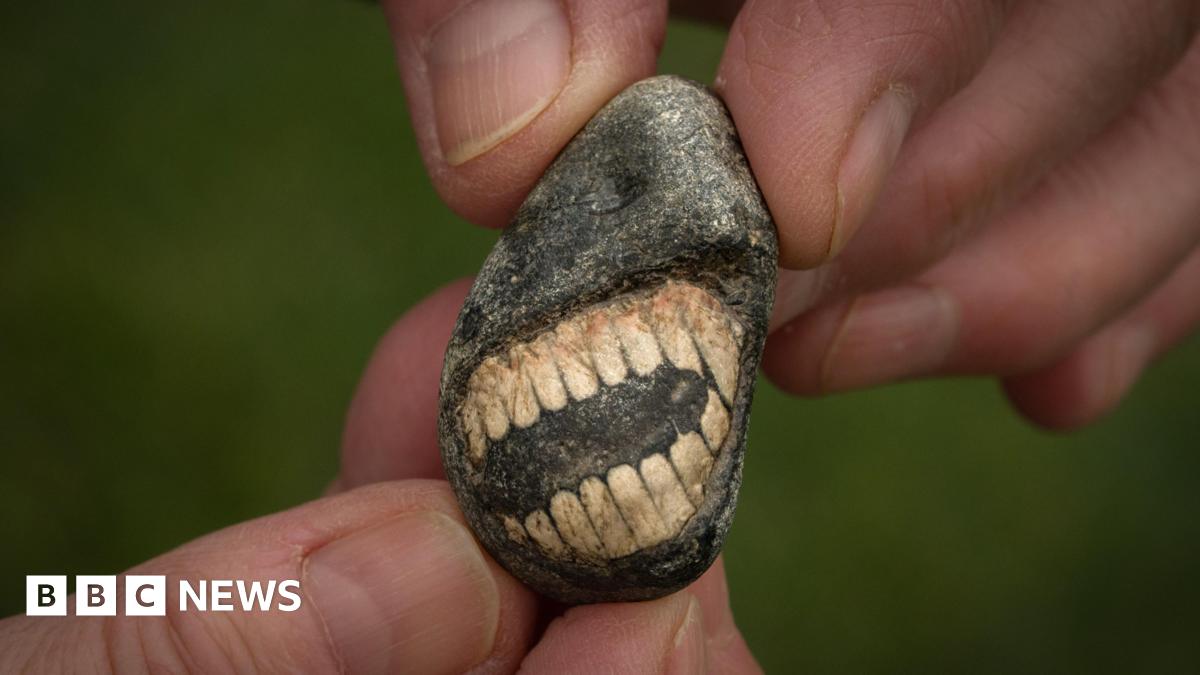
The BBC has had the fossil identified by the British Geological Survey (BGS) which confirmed it is a larger part of a crinoid.
Crinoids are marine animals that first appeared in the Cambrian period, more than 500 million years ago, making it one of the oldest complex animals on the planet, and versions of it still exist today.
It has a flexible stem, which is attached to the sea floor, with branching arms arranged around the main body of the animal at the top of the stem – although it is an animal, this arrangement has earnt them the nickname “sea lilies”.
“The stem consists of these little discs, called ossicles, and what Christine has found is a number of these ossicles connected together, in what is called a columnal,” explained Dr Jan Hennissen, senior paleontologist at the British Geological Survey (BGS).
The stem has been split lengthways and been curved round so that it resembles the very unusual “mouth-like” shape.
“It is probably from a rock formation called the Alston formation, which is a dark limestone, and that is about 350 million years old,” said Dr Hennissen.
Crinoids are part of the phylum Echinodermata which also boasts sea urchins and sea cucumbers.
It is very rare to find a complete crinoid, but rather the individual discs that make up the stem – these are the St Cuthbert’s beads – and often resemble polo mints.