
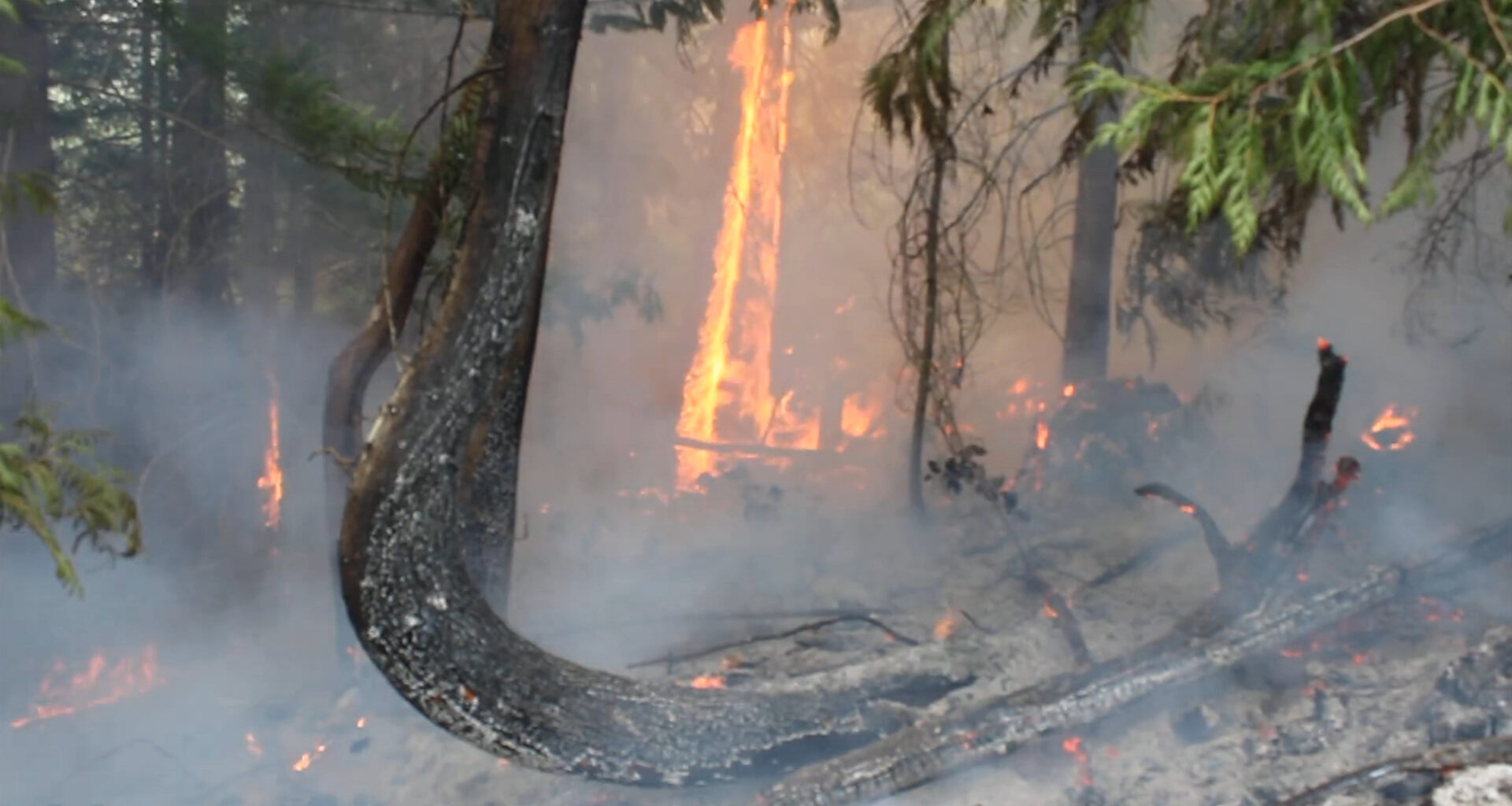
The Wesley Ridge fire burning along the north shore of Cameron Lake continued to grow Monday, with the BC Wildfire Service now classifying it as a “wildfire of note.”
As of Monday at 2:44 p.m., the fire remained at 511 hectares, up from 389 hectares reported the day before. A total of 164 firefighting personnel have now been deployed to help battle the blaze, including more than 80 structure protection specialists.
Despite the growth, fire officials say efforts to protect homes and slow the fire’s spread are showing success.
Watch the report below:
“Today, we experienced some fire growth throughout the fire, but we also had a pretty successful day operationally,” said BCWS deputy incident commander Dimitri Vaisius in an update posted to YouTube on Monday.
Crews were able to bolster structure protection efforts for homes near the northeast corner of the fire, and added structure protection resources on the southeast corner along Cameron Lake and to cabins on the west side of the lake.
“So really successful day from a structure protection standpoint,” said Vaisius.
SUNDAY STORY: Rain could help bring relief to Wesley Ridge wildfire
Aircraft equipped with night vision worked overnight, dropping water on active areas and cooling hotspots, BCWS said in an update. In total, eight helicopters and several air tankers and skimmers have been assigned to support the fight from the air as needed.
“The leading edge of the fire has not reached any of the community,” said BCWS information officer Madison Dahl. “There are spot fires within the community and they are being quickly and efficiently actioned by crews on the ground, structure protection, and those crews are there overnight and they are able to quickly supress any areas that may appear or flare up.”
On Monday morning, the Coastal Fire Centre also deemed the fire as a wildfire of note, a designation that doesn’t have any bearing on the resources or prioritization, but instead higlights that the fire is impacting multiple people in the area and allows for easier access to information, said Dahl.
Evacuees closely watching fire activity
As firefighting efforts continue, residents forced from their homes are keeping a close eye on the situation.
“Yeah, you never think it’s going to happen to you,” said evacuee Len Kaldenhoven, who returned to the area with a spotting scope to watch the wildfire from a distance.
Kaldenhoven, who’s staying with friends in Nanoose Bay, said Friday helicopters were already in his neighbourhood when he got the evacuation notice. Now, conditions appear calmer near his home.
“The smoke there is a lot less intense,” he said. “I actually got some sleep last night, so yeah, that’s the first night since Thursday.”
Trent Snyder, who remains on evacuation alert, said he’s packed and ready to leave if needed. “I don’t want to leave, but if it comes down to it, we’re going to have to. We’re just playing the waiting game for now,” he said. “It’s looking a lot better.”
Structural protection crews remained in place around the Little Qualicum River Village and park area, as well as lakeside properties. Vaisius said 24-hour operations will continue for the foreseeable future.
No change to evacuation orders, alerts
There are 387 properties near the fire that remain under an evacuation order from the Regional District of Nanaimo, as well as all of Little Qualicum Falls park, while 235 other properties are still on evacuation alert.
The RDN says a reception centre at the Qualicum Beach Civic Centre, 747 Jones St., is open 24/7 for evacuees.
Around 411 evacuees have already received support from emergency social services, and those affected by the evacuation orders are asked to register with ESS either at the reception centre or by visiting the ESS website.
During a media briefing Monday, the district was again asked if homes had been lost. Officials reiterated that if any homes were impacted, the district would be the organization to report it and as of now, they are not aware of any structures being destroyed.
The fire, discovered July 31, is burning in steep, forested terrain filled with heavy timber, especially along its southern flank near Cameron Lake.
The area remains challenging for ground crews to access and additional resources like fallers and air tankers have been brought in to support containment efforts.
Highway 4 remains open, but expect interruptions
As the fire continues to burn near Highway 4, the key route connecting Port Alberni to the east coast of Vancouver Island, the Ministry of Transportation has stationed traffic control personnel on both sides of the highway in case BCWS needs to interrupt traffic flow.
At this time, the highway remains open, but drivers should expect delays and are asked not to stop along the corridor.
“We are assessing that,” said Vaissius. “We’re closely working with Ministry of Transportation on that, but at this time, the highway has remained open, and we fully plan to keep it open as long as it’s safe.”
BC Wildfire has also issued a warning to recreational boaters on Cameron and Horne lakes, urging them to stay clear of firefighting aircraft collecting water.
Rain could aid efforts
While the weather remained dry Monday with a high of 25C and light winds expected, a slight chance of rain is in the forecast mid-week, which could help firefighting efforts.
“We’re going to continue to stay dry for the next few days. Overnight, the winds have been quite variable … they do remain light, though,” Dahl said in an update Sunday.
“We may see some rain arrive on Wednesday. We will require a significant amount of rainfall to make significant changes to the fire behaviour.”
The fire was discovered on July 31, and it’s believed to be human-caused, though such investigations “often take time and can be very complex,” the BCWS says.
Check the BCWS website for updates. The RDN posts evacuation order/alert notices here. Find the latest driving conditions on the DriveBC website.
With files from CHEK’s Ethan Morneau and Kendall Hanson.