
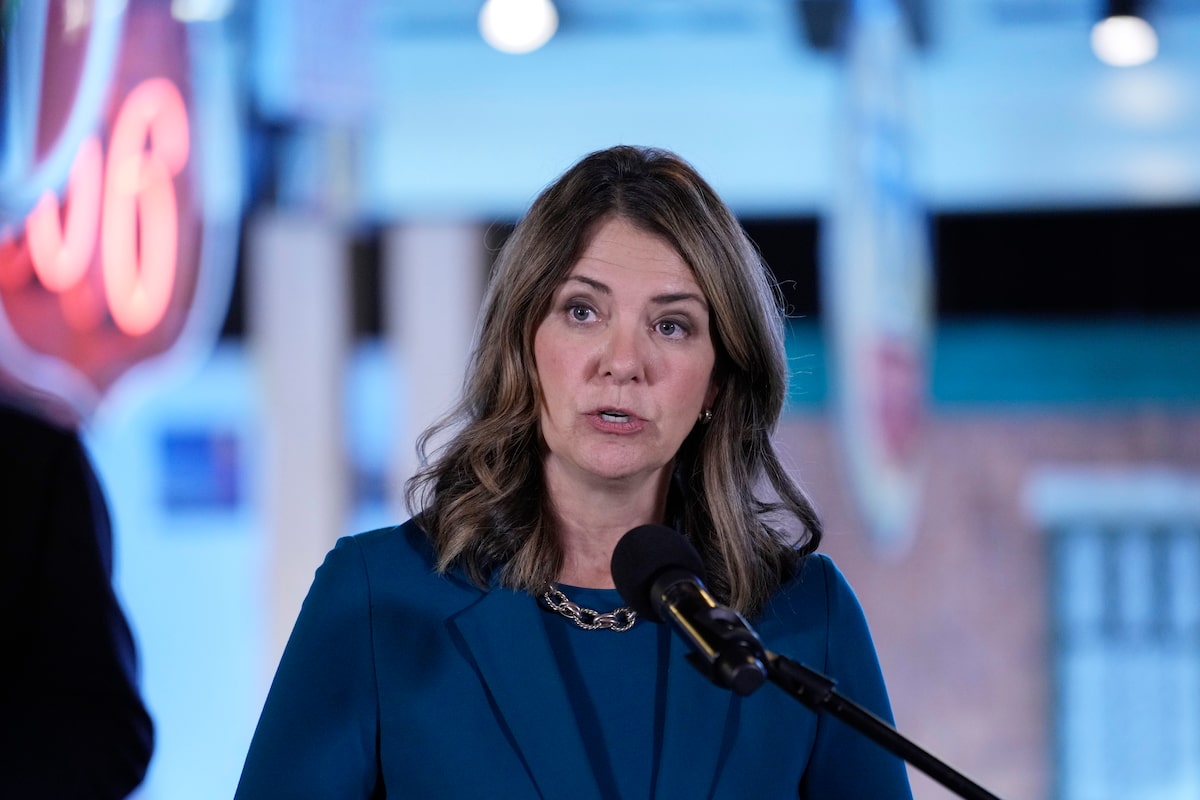
Alberta Premier Danielle Smith announced the province will hold a referendum on Oct. 19 focused on immigration and constitutional changes.Todd Korol/The Canadian Press
Premier Danielle Smith said she does not know how much newcomers cost Alberta’s health care and education systems, despite arguing that Ottawa’s immigration policies are jeopardizing her province’s finances.
Ms. Smith on Friday defended her plans for a fall referendum focused on immigration and constitutional changes. She announced the referendum in a televised address Thursday evening and fielded questions from reporters a day later.
Alberta is bracing for significant deficits in its coming budget, which will be unveiled Feb. 26, because of cratering oil and gas revenue. Ms. Smith also said the federal government’s immigration policies fuelled Alberta’s population boom, placing unsustainable pressure on provincial programs like health care and education.
She told reporters that Alberta has a “certain number of residents who are very high users” of social programs, but she stumbled when pressed for details on the financial burden newcomers place on the province’s health and education systems.
“It’s tough,” she said. “We’d have to do the figuring out.”
She added: “We don’t track residents and how much they use. All I can give you is averages about what things cost.”
Alberta calculated that it cost roughly $500-million to have the children of temporary residents in its kindergarten to Grade 12 system this year, she said. The province budgeted $9.9-billion for education in 2025-2026.
The referendum is scheduled for Oct. 19. The Premier said that if citizens canvassing for support for Alberta separation get enough signatures to force a referendum, the question would be put to residents on the same ballot.
The Official Opposition New Democrats said Ms. Smith’s plan to hold a referendum on limiting access to education and health care for some immigrants is an attempt to pit residents against each other. The NDP renewed its calls for a provincial election.
In remarks that featured a handful of expletives, Alberta NDP deputy leader Rakhi Pancholi on Friday said the proposals are designed to inflame and that she experienced first-hand evidence that racism is on the rise in Alberta.
“There is no doubt in my mind that underlying all of this is an attempt to be divisive, to pit people against each other, and it is emboldening some very dark and disturbing behaviour,” Ms. Pancholi told reporters.
“All she’s delivered on is the innuendo and the suggestion that people who are new here are somehow taking things away from people who lived here before, and that is designed to single out people and direct and encourage racism.”
Premier Danielle Smith says in a televised address that her government is putting nine questions to a provincewide referendum on Oct. 19, including proposals to restrict social services from some immigrants. Smith says she’s not afraid of direct democracy and trusts the judgment of Albertans. (Feb. 19, 2026)
The Canadian Press
Ms. Smith’s proposals would dramatically change who’s eligible to receive publicly funded social services in Alberta. One question asks if voters support mandating that only Canadian citizens, permanent residents and those with an “Alberta-approved immigration status” – which currently does not exist – should be eligible for provincially funded programs, including health and education.
It doesn’t say who wouldn’t be able to access those programs.
Gabriel Fabreau, a physician and professor who specializes in health systems, said policies that restrict access to health care for newcomers could be catastrophic to Alberta’s economy and social system.
Agriculture is a cornerstone of Alberta’s economy, and foreign labourers dominate jobs at industrial facilities such as slaughterhouses. The international labour pool also provides a crucial supply of health care workers, including skilled nurses.
If Alberta creates a system where newcomers must wait a year for social services or pay access fees, other jurisdictions will have an advantage over the province when trying to attract workers.
The health care system, which is already in a precarious state, would be especially vulnerable, Dr. Fabreau said.
“If we target these newcomers by revoking things, our health care system will collapse tomorrow,” he said. “We entirely depend on highly skilled foreigners and immigrants to want to move here.”
He noted that foreign workers tend to be young and healthy, meaning they do not put much pressure on services such as health care.
“There’s a natural-selection process for those that decide to move across the world.”