
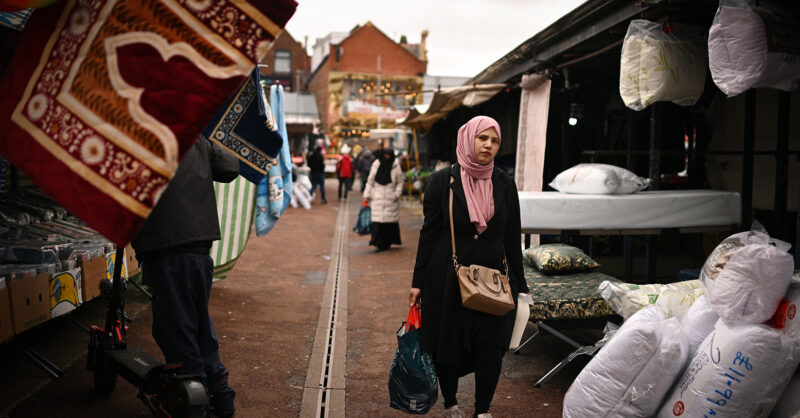
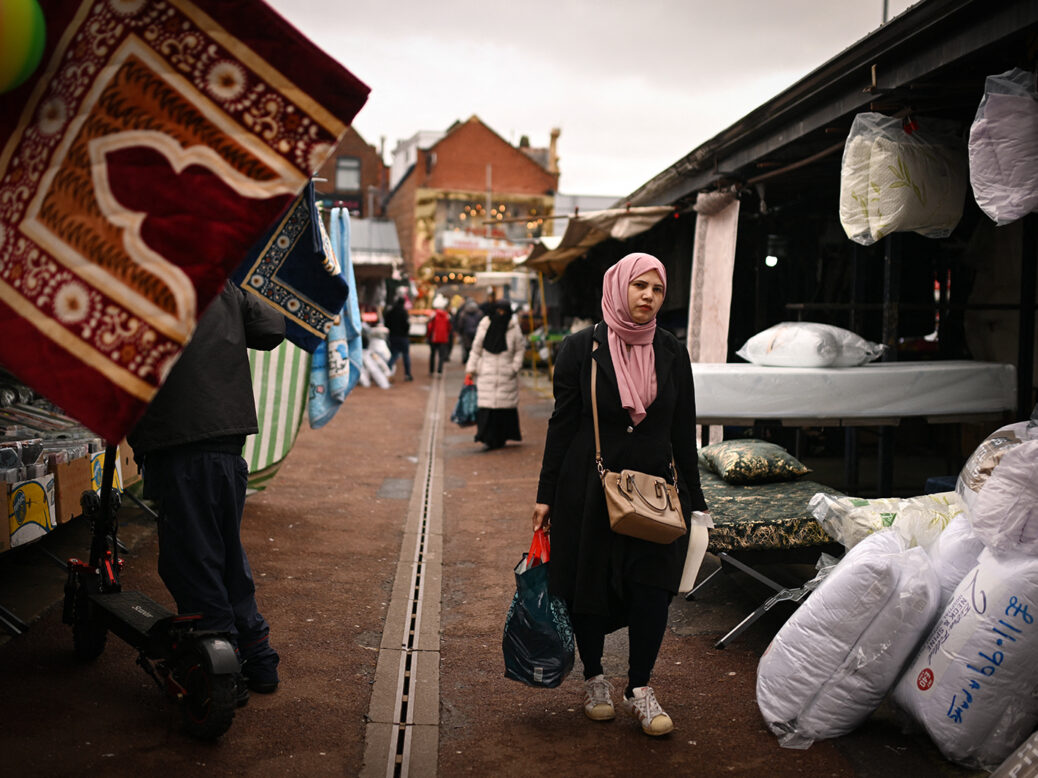
Shoppers at Longsight Outdoor Market in Greater Manchester, part of the Gorton and Denton constituency, ahead of the 26 February by-election. Photo by Oli SCARFF / AFP via Getty Images
“I feel like Labour used to be for the working class… that’s how they got their votes this time around. But when they actually came in they were not for the working class, they were more for the middle class.”
This bitter assessment is one the government has grown accustomed to hearing over the past 18 months – I heard much the same barely 100 days into Keir Starmer’s premiership. Yet it carries particular weight here, coming from a focus group of Muslim voters in Denton just a week before a knife-edge by-election.
Gorton and Denton has been dubbed a “Frankenstein’s monster constituency.” Created in 2024 by the boundary commission from parts of three separate Manchester constituencies, it is a patchwork: the four Manchester wards are, on average, 40 per cent Muslim and nearly 60 per cent non-white, while the three Tameside wards of Denton are 83 per cent white and 86 per cent British-born. Labour won the seat decisively in 2024, taking over 50 per cent of the vote with a 13,000-strong majority. But as the by-election on 26 February approaches, it has morphed into a three-way contest between Labour, Reform UK and the Green Party.
The seat’s demographics – two halves that differ sharply in age, class, income, and ethnic composition – make it notoriously difficult to predict, with pollsters largely conceding it is impossible to call. One thing, however, is clear: the substantial population of Muslim voters from Pakistani and Bangladeshi backgrounds is a key electoral force. As Ben Walker has noted, this group comprises roughly a quarter of the constituency’s population, though a smaller share of its electorate.

Subscribe to the New Statesman today for only £1 a week.
On a Wednesday evening, eight days before the by-election, seven voters joined a More In Common focus group on Zoom. They spanned a range of ages, professions, and life experiences: a joiner, a cardiologist and a woman with a small child playing in the background. All were Muslim, all had voted Labour in 2024, and all were unambiguous – albeit with varying intensity – that they would not be supporting Labour this time.
Focus groups should never be mistaken for polls. Yet the intensity of feeling among participants about the Prime Minister was striking. While most named the cost of living crisis and the NHS as their top concerns, the war in Gaza ranked a close second. Labour’s initial support for Israel following the 7 October attacks was dismissed as “pandering to the popular thinking” – an opportunistic bid for votes. Even the party’s gradual shift over the next two years, culminating in recognition of a Palestinian state in September 2025, earned no credit. “It took too long for him to recognise Palestine, so that was upsetting,” said one participant, particularly aggrieved that Starmer, a former human rights lawyer, had not acted more decisively in the face of Gaza’s death toll.
The government’s decision to proscribe Palestine Action under terrorist legislation in July 2025 – a ban the High Court of Justice ruled unlawful this month – was also flagged as “shocking,” seen as emblematic of Starmer’s lack of judgement. “If you couldn’t get that right when it’s blatantly obvious and glaring you in the face, it kind of speaks a lot for how you do everything else.”
It is no revelation that Labour’s handling of the Gaza conflict has inflicted deep, perhaps irreparable, damage on its relationship with Britain’s Muslim community – just ask the Labour candidates who lost to pro-Gaza independents in 2024. Yet the dynamics of the Gorton and Denton by-election are likely to sharpen focus. There is a genuine risk of Reform winning the seat, with a candidate who has argued that Englishness is an ethnicity reserved for those who can “trace their roots back over generations,” and that UK-born ethnic minorities cannot necessarily count themselves as “British”.
The government’s strategy – at least under Starmer’s recently departed chief of staff, Morgan McSweeney – has rested on the assumption that, however disillusioned former voters might be, they would “hold their noses” and back Labour rather than risk a Reform victory. Gorton and Denton is a test of that assumption: would disillusioned Muslim voters turn out for Labour to keep Reform at bay? The answer, for the most part, was no.
Partly, this reflects expectations: the debate over whether Labour or the Greens were best placed to block Reform seemed already settled for this cohort. “I think it’s a two-horse race, this by-election between Reform and Green,” one participant observed. There was cautious optimism for the Greens – Zack Polanski in particular was viewed positively. Participants highlighted the party’s stance on Gaza and its Muslim co-deputy leader, Mothin Ali, and more broadly saw it as “inclusive” toward ethnic minorities. Curiously, no one mentioned the environment, and the Green Party’s positions on trans rights or defence – areas other parties perceive as vulnerabilities for Polanski – appeared to concern no one.
But the reluctance to embrace tactical voting went beyond questions of which choice would actually be most strategic. Participants expressed genuine concern about Reform and the rise of overt racism they felt had become more visible in their communities in recent years: “I feel like people can openly be racist now. They’re not actually scared of anything. They’re just so open about it and they know there’s no consequences to it.” They pointed to a growing climate of division, citing Tommy Robinson’s “Unite The Kingdom” rally and the skewed portrayal of news stories on social media with an anti-Muslim bias.
This is exactly the sentiment Starmer sought to tap into during his conference speech in September, warning of the dangerous rhetoric propagated by Reform. Yet, troublingly for Labour, participants held the Prime Minister as equally culpable for fostering a culture of hostility.
“It just feels very different out there and I don’t like it. And I blame it on Keir,” said one woman, before conceding, “I feel like a lot of it is Reform as well.” A man accused Starmer of having “let Reform in through the back door basically,” adding: “I think that the tide turned during Brexit, that’s when people started getting a bit more racist… And Labour’s come in, they’ve not done anything about it. They’ve just let Reform come through and make up a lot of lies.”
There were, however, glimmers of hope for the government. The scrapping of the two-child benefit cap had resonated with voters, as had the introduction of new breakfast clubs. Labour strategists might also take comfort from the anxieties surrounding what a Reform government would mean for the NHS and the future of universal healthcare – a key attack line against Nigel Farage.
But overall, the mood was one of despondency ahead of Thursday’s by-election. As Luke Tryl, executive director of More In Common and organiser of the focus group, summarised: “This group of Muslim voters in Gorton and Denton were normally reliable Labour voters, but more than anything else the fact that Keir Starmer and his government did not seem to have their back against what they saw as a rising tide of racism meant they were now looking elsewhere.”
Gorton and Denton has become a battleground for narratives about who voters dislike most. The focus group revealed a level of disillusionment with the government that even the threat of a party campaigning on deportations could not offset. Labour’s attempts to win back Muslim voters and make its case to the community were, for now, failing to resonate.
In one moment of inadvertent comedy, a man noted the renewed efforts of Labour canvassers: “They’re sending people into mosques lately.” A woman quipped, quick as a flash: “They must be desperate if they’re doing that.”
[Further reading: Young people can’t get jobs. Does Labour care?]
Content from our partners