
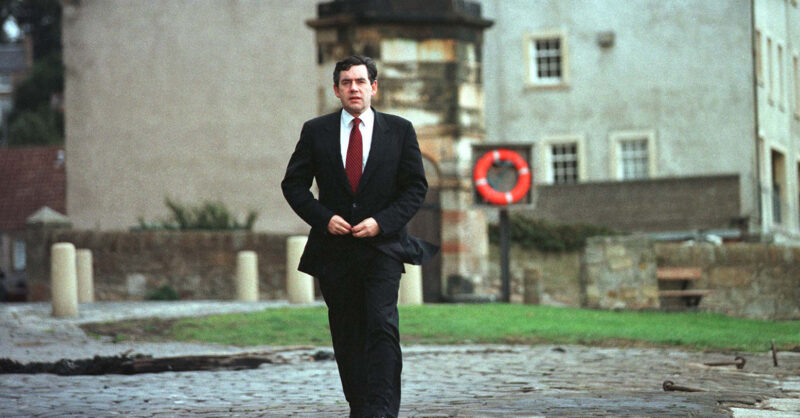
Gordon Brown at his home in Fife, Scotland, before entering government. Photo by Colin McPherson/Corbis via Getty Images
Gordon Brown wasn’t the only figure who demanded the police investigate the former prince Andrew, but he was certainly one of the most determined and high-profile. The former prime minister submitted to British police forces two memorandums showing in “graphic detail” how the former Duke of York’s paedophile associate Jeffrey Epstein used Stansted Airport in Essex to “fly in girls from Latvia, Lithuania and Russia”.
What drives a 75-year-old who last held public office in 2010 to keep fighting the good fight? He does so at zero financial gain, and indeed arguably at a personal price, while his contemporaries chase rather more lucrative engagements. The contrast couldn’t be greater with multimillionaire Tony Blair, whose eponymous institute is largely funded by the US tech bro Larry Ellison, and who gurned at the launch of ringmaster Donald Trump’s Board of Peace circus. Or with Peter Mandelson, Brown’s de facto deputy for two of his three years as PM, who has also faced the wrath of Brown after the Epstein files suggested he sent the financier official government economic information.
The answer, according to Stewart Wood, a former adviser to Brown and now Lord Wood of Anfield, is that this Scottish son of the manse is a conviction politician, driven since childhood to champion the underdog. “I think what motivates Brown is a belief that politics is fundamentally about serving those who are poor, without privilege or without a voice,” Wood says. “It is an instinct he inherited from his Church of Scotland father, though unlike his dad it took him into a political rather than religious calling.”
Brown, Wood says, is “harder working than anyone else in politics, blessed with incomparable stamina, prepared to be ruthless when necessary”. He also has an “insatiable appetite for ideas and new thinking”; he is confident in his beliefs, but willing to be challenged on them. Ultimately, he is “impatient for change”.

Subscribe to the New Statesman today for only £1 a week.
The Multibank, a charity Brown started in Kirkcaldy that operates six hubs across the country and works with more than 100 businesses, distributes more than 14 million essential items to around two million families. Here, Brown is doing the heavy lifting, attempting to create that change, instead of staying aloof.
Brown is also a United Nations special envoy for global education and a World Health Organisation ambassador for global health financing, as well as leader of progressive causes in Britain. He was instrumental in persuading Keir Starmer and Rachel Reeves to remove the cruel two-child benefit cap, lifting half a million children out of poverty. He lobbied hard privately and prodded publicly for it, and also itemised how taxes on huge gambling profits could be utilised to give children a better start in life.
A Labour left-winger politically closer to Jeremy Corbyn than to Brown, but who worked with both, observed an often-overlooked difference between the two. Corbyn, they recounted, would sympathise and comfort people he encountered with problems. Brown, said the figure, would sympathise, comfort, then immediately declare he had or would find a plan to improve their life.
Shortly before the Covid pandemic, volunteers in Fife told me how Brown, on entering a house in which two children were sleeping on the floor, went home to dismantle his own sons’ bunk beds to give to them. Brown, on discovering I’d learned what he did, looked embarrassed and mumbled it was nothing.
To Charlie Whelan, Brown’s spin doctor when Labour was in opposition and at the start of his chancellorship, told me the bed donation was “pure Gordon”. It was also a demonstration of his continuing dynamism in the area where his mother and father once effectively played the roles of community social workers.
Brown’s drive, says Whelan, originates from “his upbringing, his father and family and desire to do the right thing”. “Never, never, ever has money been a goal. It just doesn’t enter his head. Anybody who went to his house in the old days saw it was falling to bits… Sarah [Brown’s wife] made it better, but any extra money he did get would pay for another researcher or someone who could fight a cause and expose the Tories.
“Gordon’s unique among the political class. I have never met anybody like him.” Others go into politics, says Whelan, for “entirely different reasons” – reasons that have fuelled the distrust in the system only exacerbated by the links between British politics and institutions with Epstein. Brown has added this to his list of campaigns, “and [he] will never give up until he wins”.
Brown is an antidote to cynics who shout that all politicians are the same. They aren’t. But he does shame the entitled from Westminster or Windsor Castle.
Content from our partners