
Two Scottish sportswriters were left genuinely baffled by the referee’s explanation for why Celtic were denied a penalty at a pivotal moment against Hibernian.
With the game finely poised at 1–1 and Celtic already down to ten men, the flashpoint came inside the Hibs penalty area.
As a delivery was swung into the box, Liam Scales had his shirt clearly pulled just outside the six-yard box. It was not a slight tug or incidental contact, but a firm grab that visibly impeded him as the ball arrived.
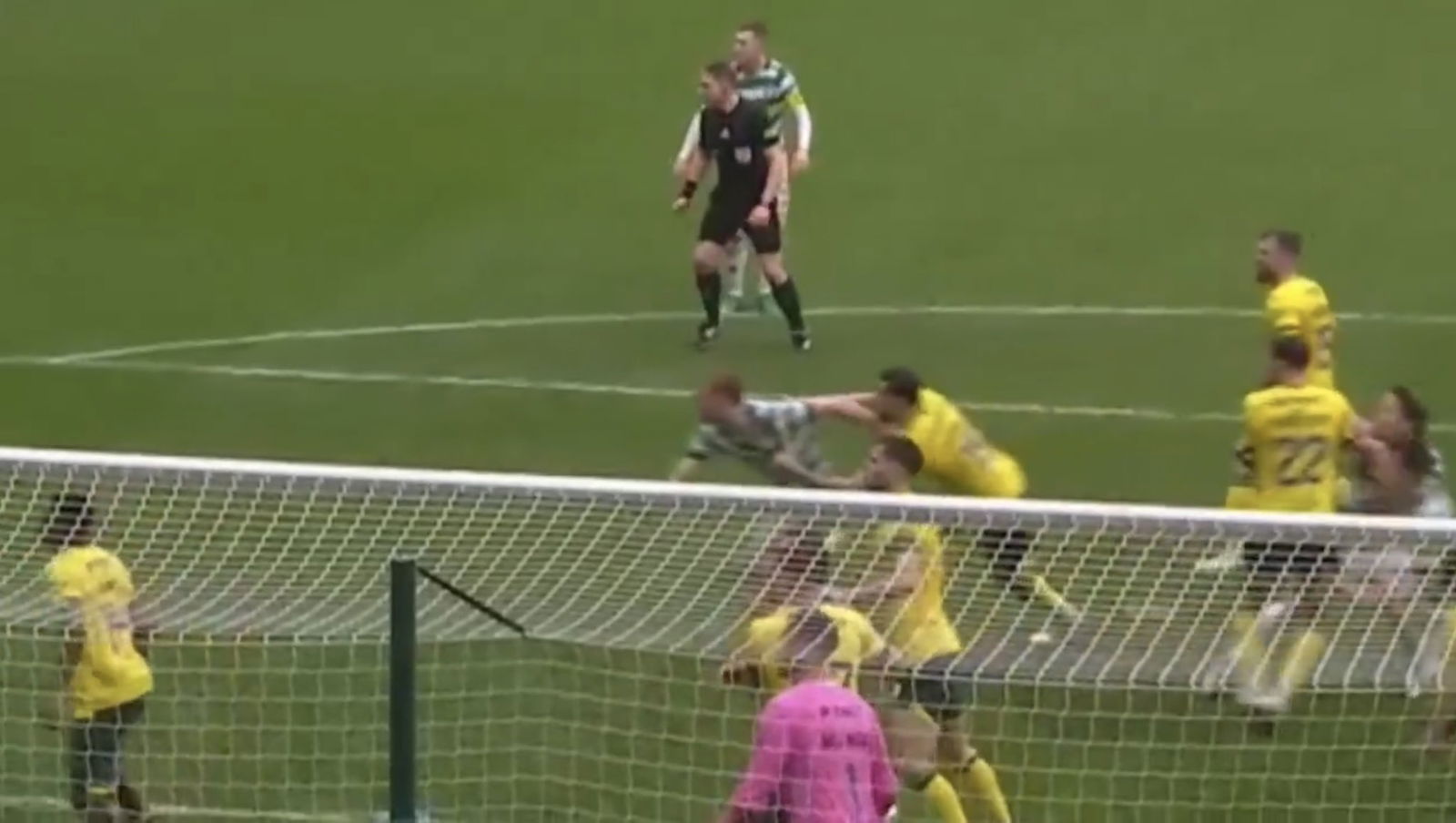
The referee initially awarded nothing. VAR checked the incident, and the explanation relayed inside the stadium was that the foul had occurred outside the penalty area. That alone raised eyebrows, given the location of the contact, but the confusion did not end there.
After the match, Martin O’Neill revealed the reasoning he was given by the referee was different again. O’Neill was told the decision was based on the fact that the shirt pull did not last long enough to warrant a penalty.
That reasoning was discussed in detail on The Press Box, hosted by Graham Spiers, where both Robert Grieve and Stephen McGowan expressed disbelief.
Grieve explained: “Martin O’Neill spoke again after the match and he said that the referee had explained to him that the pull didn’t quite last as long as it did to get a penalty.”
McGowan immediately challenged that interpretation, asking: “Can anyone point to that in the rule book for me? Where is that in the IFAB rules?”
Grieve continued: “That’s the point I was going to make. It’s a hugely controversial incident for me. It was actually in the same corner, before the ball was played in, that led to the red card. Celtic should have had a penalty. They didn’t, and they didn’t get it clearly.”
The reference to duration has no obvious grounding in the laws of the Game, which judge fouls on the act itself rather than how long it lasts. A clear holding offence inside the penalty area is, by definition, punishable by a spot kick, regardless of whether it lasts one second or three.
In a match already defined by fine margins, red cards and momentum swings, the lack of clarity and the conflicting explanations only added to Celtic’s sense of grievance.
The incident was not just about a missed penalty, but about an explanation that appeared to invent criteria that simply do not exist in the rule book.