
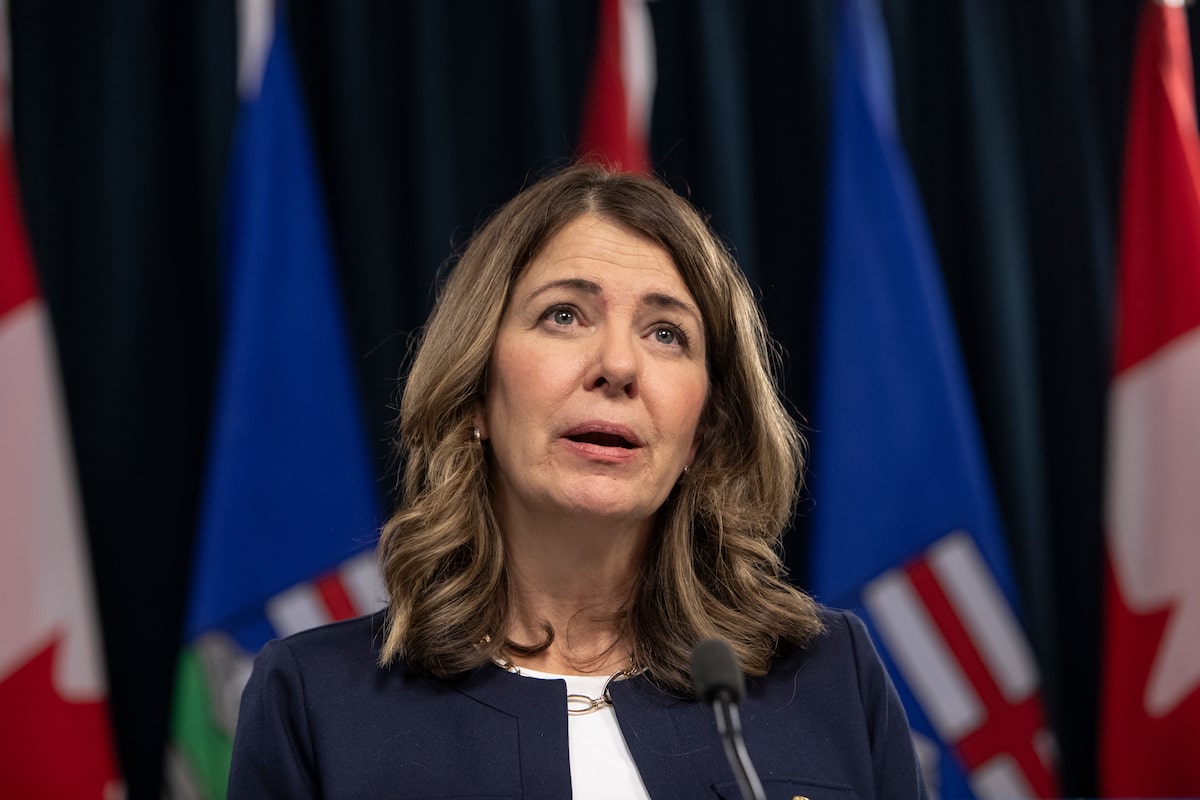
Alberta Premier Danielle Smith’s brand and her political survival are contingent on perpetually positioning herself as a prosecutor of grievances with Ottawa.AMBER BRACKEN/The Canadian Press
Lost in the controversy around the substance of the referendum questions that Alberta Premier Danielle Smith will put to voters next fall has been that the timing is nearly as striking.
Less than three months ago, via a memorandum of understanding, Prime Minister Mark Carney gave Ms. Smith many of the concessions on energy and environmental policy – among them a scrapping of the planned federal cap on oil-and-gas-sector emissions, a suspension of electricity regulations, a weakening of methane rules and a reconsideration of the oil tanker ban on B.C.’s northern coast – that she had framed as essential to national unity.
Now, even as she’s still publicly celebrating that victory, Ms. Smith is setting the stage for the next confrontation. Almost all the plebiscites that she announced last week, five of them around more restrictive treatment of immigrants and four around constitutional matters such as how judges are appointed and the future of the Senate, involve matters of federal jurisdiction.
That’s almost certainly a feature rather than a bug. Leading a provincial party with a strong nationalist contingent, and herself flirting with Alberta separatism (which may pop up as a 10th referendum question) just enough to hold those supporters at bay, both Ms. Smith’s brand and her political survival are contingent on perpetually positioning herself as a prosecutor of grievances with Ottawa.
But Ms. Smith may also have inadvertently served a warning to Mr. Carney about the folly of bending over backward to try to buy federal-provincial peace. And if Mr. Carney heeds it, it could yet affect what the landmark MOU on energy ultimately adds up to.
Gary Mason: Faced with fiscal woes, Danielle Smith takes aim at immigrants
As of now, the two levels of government are still hammering out details of that agreement, most of which are supposed to be settled by a self-imposed April 1 deadline. And despite its concessions already, Ottawa is under some pressure to compromise further.
That applies, most significantly, to the one big provincial concession that Mr. Carney got in return for all the federal climbdowns: a strengthening of Alberta’s carbon pricing system for heavy industrial emitters.
Although complex, the basic premise is that the policy’s stringency needs to be bolstered so that the tradable credits it awards companies for reducing their emissions have enough real value to incentivize investments in carbon capture or other forms of clean technology.
Ms. Smith has not publicly turned away from that commitment. But her government proceeded with a planned weakening of industrial pricing shortly after the MOU had been reached. Lobbyists for the province’s fossil-fuel sector and commentators aligned with it have increasingly pushed back on the degree of stringency the MOU suggested. And recent comments from both governments have suggested that there’s still considerable distance between their positions on what the system should look like.
That distance could also affect follow-through on other aspects of the MOU, including whether Ottawa permanently lifts its electricity regulations effectively requiring a phase-out of gas-fired power generation – a concession which is supposed to happen only if industrial pricing is strengthened to Mr. Carney’s satisfaction.
Andrew Willis: Referendum uncertainty risks undermining Alberta’s economy
Then there’s the broader premise underpinning the MOU: that Ottawa will support a new oil pipeline to the West Coast, contingent on (among other things) the construction of a massive series of carbon capture investments – known as Pathways – in the oil sands.
For now, both those projects remain mostly notional, and the private sector doesn’t seem terribly enthusiastic about either. But there’s more momentum around the pipeline, for which the province itself plans to initially serve as proponent, than the carbon capture, which almost everyone outside Ottawa seems to have soured on. (Tellingly, the umbrella group for oil-sands giants that was ostensibly trying to advance it just changed its name from the Pathways Alliance to the Oil Sands Alliance.)
So there will likely be some pressure on Mr. Carney, in the coming weeks and months, to relax the contingency rather than let Pathways’ dubious future stand in the way of getting more oil to overseas markets. And, perhaps, to put federal money behind that aspiration.
It would be one thing for him to go that route, or to give further ground on any of the negotiations’ policy specifics, because he believes it’s in the national and provincial interests at a time when economic sovereignty takes priority over combatting climate change.
Smith’s bid for more immigration powers boosts negotiating power with Ottawa, experts say
That was certainly part of the calculus around the MOU. Mr. Carney was clearly quite happy, for instance, to scrap the oil-and-gas emissions cap, which even some environmental groups conceded was clunky atop other regulations. He also seemed fine with at least relaxing the electricity rules, partly in the interest of powering new data centres.
But it was also clear during the negotiations that led to the MOU that Mr. Carney badly wanted a deal that would signal national unity, after the intergovernmental tensions of the Justin Trudeau era.
That was a noble goal (even if veterans of Mr. Trudeau’s government once thought they, too, had a grand bargain with Alberta) and it’s not as though Mr. Carney should now go out of his way to antagonize the province by showily backing away from things to which he’s already agreed.
But having already set expectations for what he believes is a reasonable balancing of economic and environmental objectives, he has all the more reason now to hold strong on achieving that mix.
Because as Ms. Smith just demonstrated, by cuing up the next set of grievances before the last round has been fully resolved, any intergovernmental harmony from further federal backtracking will be short-lived.