
The Mexican government’s killing of a notorious cartel leader is one of the biggest wins of Claudia Sheinbaum’s presidency. It is also one of her riskiest bets.
The operation against Nemesio “El Mencho” Oseguera, kingpin of the Jalisco New Generation Cartel (CJNG), should relieve some pressure from US President Donald Trump, who has threatened drone strikes inside Mexico if the country does not get to grips with fentanyl trafficking.
But the move has also created political and security hazards at home.
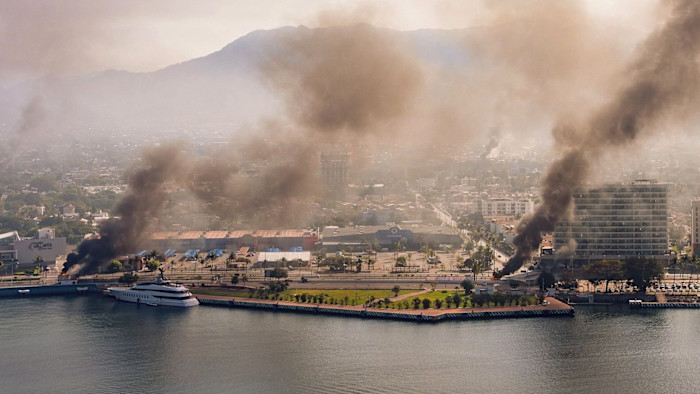
CJNG members went on a violent rampage after Oseguera’s death, setting fire to cars, shops and banks, and blockading 250 roads across 20 states. In Jalisco state, 25 National Guard members were killed.
The violence eased on Monday, but security experts say the threat is far from over, as events in the country’s north show a headless cartel can be an even more dangerous beast. For more than a year, rival Sinaloa cartel factions have sown havoc in a bloody civil war after the capture of one of its leaders.
Security minister Omar García Harfuch said on Monday they were “prepared” for “any kind of reaction or restructuring that there may be in the cartel, especially violent ones”.
On the campaign trail in 2024, Sheinbaum criticised rightwing opposition parties for championing a “war against narcos”. She defended the “hugs not bullets” security policy of her mentor and predecessor Andrés Manuel López Obrador, which avoided direct confrontation with gangs in favour of addressing the root causes of crime.
But since taking office that year, she has quietly overturned López Obrador’s strategy, with a dramatic increase in arrests, drug seizures and extraditions, and an expansion of the intelligence network.
“The results over her first year or so in office have been outstanding,” said Lila Abed, Mexico programme director at think-tank The Dialogue.
 Mexican newspapers on Monday report the killing of cartel boss Nemesio Oseguera © Jon Orbach/AP
Harfuch, whom the CJNG tried to assassinate in 2020 when he was Mexico City police chief, has overseen the extradition of 92 senior cartel members to the US, the arrest of 29,000 people for serious offences and the seizure of 3.5mn fentanyl pills, according to government figures.
Oseguera’s capture, which relied partly on US intelligence, has received “real recognition in Washington”, Abed added. “But only time will tell whether President Trump will continue to ask for more. If you ask me, I think he will.”
The killing will also put the spotlight on the president’s political will to fight organised crime groups, which analysts say are protected by officials at every level of government, including in Sheinbaum’s leftwing Morena movement.
“The president faces an enormous dilemma,” said María Teresa Martínez Trujillo, a professor at Tecnológico de Monterrey University and a co-founder of security research centre Noria MXCA.
“As a security strategist, she has a real chance to advance against crime groups, but as a politician she may want to avoid going after the political and economic structures that support the CJNG,” she added. “If so, she would be cutting the cartel’s muscle, not the bone.”
 Since Claudia Sheinbaum took office in 2024, Mexico has seen a dramatic increase in arrests, drug seizures and extraditions, and an expansion of its intelligence network © Rogel Blanquet/Getty Images
At home, Mexicans warn that the so-called “kingpin” strategy of taking out cartel heads has historically led to increased violence.
Some experts say the CJNG’s structure makes the risk of a chaotic splintering particularly high. Oseguera, who had a $15mn US bounty on his head, oversaw a far-reaching operation present in most of Mexico’s 32 states, while centred on Jalisco on the Pacific coast.
Under his leadership, the CJNG expanded rapidly from its founding in 2009, filling gaps left as older cartels shrank and raking in big profits from the nascent trade of potent synthetic opioids. As well as trafficking drugs to the US, the group is a big player in extortion, arms trafficking and fuel theft.
The cartel tightly controls some states and owns trafficking routes in others, while elsewhere it has made local alliances or gone to war against the dominant powers, according to security consultant Eduardo Guerrero.
“This has a clear implication: a full-frontal offensive could exacerbate local wars, set off new ones and end up increasing exactly what they want to reduce — homicides, disappearances, forced displacement and economic uncertainty,” Guerrero wrote in El Financiero newspaper this month.
Oseguera kept a low profile compared with flashier cartel bosses who made global headlines in earlier decades, but he was ultimately tracked down after Mexico’s military intelligence followed one of his girlfriends, according to defence minister General Ricardo Trevilla Trejo.
 National Guards clear the area around the General Prosecutor’s office in Mexico City on Sunday after the death of ‘El Mencho’ © Ginette Riquelme/AP
The coming months will test the strength of the investigative and intelligence networks that Harfuch has worked to develop, and may prove politically crucial for Sheinbaum. Security is Mexican voters’ top concern.
“If she manages to contain the fallout from the CJNG’s succession process and avoid an expansion of the conflict, it would strengthen the narrative that she has gotten control of the country,” said Armando Vargas, head of the security programme at think-tank México Evalúa.
“If not, she would face her first big challenge, shaping the public conversation around security.”
Sheinbaum has inherited a tough panorama. Local police forces across Mexico are severely underfunded and collusion with crime groups is rampant.
Illegal weapons continued to pour in from Mexico’s northern border, with about 80 per cent of the 23,000 weapons seized under Sheinbaum originating in the US, Trevilla said on Monday, including many of those used by Oseguera’s security detail on Sunday.
But many analysts say the biggest hurdle Sheinbaum faces is the corruption of political leaders by organised crime.
Sheinbaum has trumpeted several arrests, including the Morena mayor of Tequila, on kidnapping and organised crime charges, which he denies, as evidence that there is “zero impunity” in her government. But several senior Morena figures in Congress and government have been accused of links to organised crime and have faced no charges.
“We have seen arrests of some high-level people, but no actual prosecution,” said Cecilia Farfán-Méndez, a director at the Global Initiative against Transnational Organized Crime.
“Sheinbaum now finds herself at a crossroads. We may soon see if she is really willing to go down this path.”