
Jon Cooper has to defend his players.
Let’s start there. After a crushing overtime loss to the United States in the gold medal game, the Canadian men’s hockey team would have been in no mood to be reminded by their coach of how many chances they squandered before Jack Hughes finally made them pay.
Still, some words reign true more than others and others more hollow.
“I thought it was a flawless performance by a group of players that gave nothing but bled red and white for three periods-plus of hockey,” Cooper said at the silver medal press conference. He then added that, “Some days it’s just not meant to be. Unfortunately it wasn’t meant to be today but it wasn’t because this team stubbed their toe.
“They were exceptional.”
Canada was indeed exceptional at a lot of things on what was a Sunday afternoon in Milan. They had the lion’s share of puck possession and out-shot the Americans 42-28, being especially dominant after the first period where the Americans took the lead. They also won 27 of the 52 face-offs.
Dominating in this fashion and coming out on the losing end is exactly what makes it a not-so-flawless performance and very much getting in their own way of a gold medal.
Yes, Canada can drown its sorrows over having to play 3-on-3 hockey in overtime or some of non-calls by the referees, but this team had chance after chance to come away with the gold medal and practically begged the U.S. to punish their profligacy in front of net.
Was it the pressure? The weight of gold expectations? Or simply a bad day at the office at the worst possible moment? Here are the five biggest moments where the Canada men’s hockey team let a gold medal slip out of their grasp:
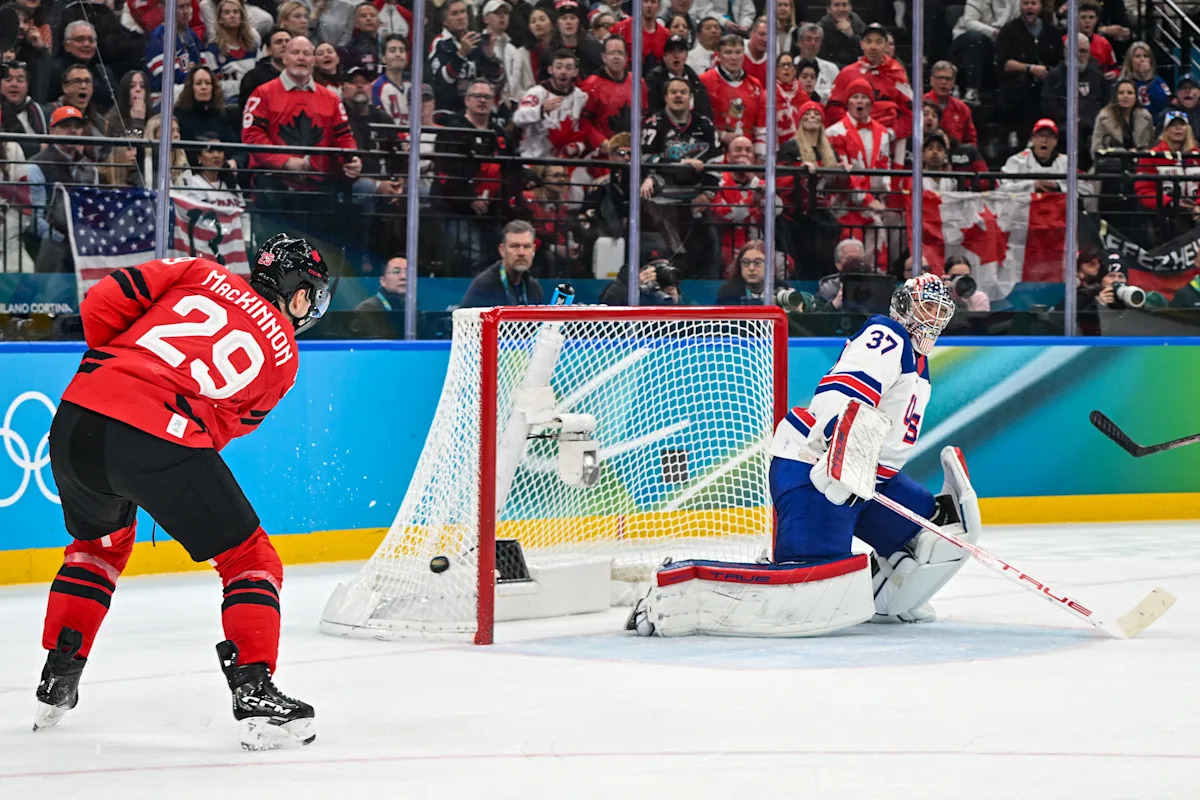
MacKinnon’s empty side miss for the ages
It’s a miss that will bring some sleepless nights to the MacKinnon household, among others in Canada.
With just over 10 minutes remaining in the third period and Canada having all the momentum, Macklin Celebrini picked out MacKinnon near the left post after the puck came loose of an American skate. It looked for all the money in the world that MacKinnon would give Canada the lead yet he only managed to find the side netting with American goalie Hellebuyck still hugging the opposite post.
One of the best players in the world, presented with an opportunity that any hockey professional would relish, and he somehow missed.
“Just couldn’t bury those chances,” MacKinnon said after the game. “We had so many good looks, really tilted that game. Yeah, tough one.”
We know MacKinnon loves that bottom left corner. It’s where he rifled the game-winner with 35.2 seconds remaining in the semifinals against Finland.
He didn’t need to be that precise here. Was Hellebuyck’s incredible performance in his mind and make him feel the need to be perfect?
It beggars belief that this chance went wasted.
Toews’ point-blank attempt denied by Hellebuyck
This one hurts but is just a tad more reasonable to cope with because it took something extraordinary from Hellebuyck for Canada to be denied here.
Less than 90 seconds into the third period, Mitch Marner drove the puck forward and teed up Devon Toews in front of the net. Hellebuyck was onto Toews’ first attempt to poke it in but then the puck was loose and the net appearing wide open.
Toews needed to react quickly and did, but somehow Hellebuyck’s reflexes were just as good as he stuck out his stick to rob Toews and Canada.
You can watch it time and time again and there’s very little Toews’ could have done differently. Just an all-time save by the Winnipeg Jets goalie.
McDavid’s and Celebrini’s fumbled breakaways
As if failing to convert on a 5-on-3 powerplay opportunity wasn’t enough, further pain was inflicted when Connor McDavid had a breakaway chance in the second period.
Through on goal with only Hellebuyck to beat, McDavid appeared to see if Hellebuyck would lean one way or another as he got increasingly closer. America’s Brock Faber got a stick in from behind along McDavid’s right hand to at least cause a bit of a distraction — probably not significant enough for a hooking call — and then Canada’s star man just never made a decision.
The puck was already at Hellebuyck’s pads without a shot attempted, a shockingly poor outcome for the best player in the world who had been magnificent all tournament in setting a new points record at a single Olympics.
Denying one breakaway wasn’t enough, Hellebuyck came through another time against Canada’s second-leading points-getter in Celebrini with around 15 minutes to play in the third period.
Unlike McDavid, Celebrini decided to shoot from well outside and Hellebuyck saved pretty comfortably. This one was equally hard to understand. Celebrini had separation from the USA’s last defender and seemed destined to close in on the US goal. And yet he elected to shoot from just beyond the end zone face-off spot.
After an incredible first four games, Celebrini was certainly wasteful in both the semifinals and final. But hey, the kid’s only 19, this was still an incredible overall performance at such a young age on his Olympic debut.
Crosby’s absence clearly felt on face-offs, powerplays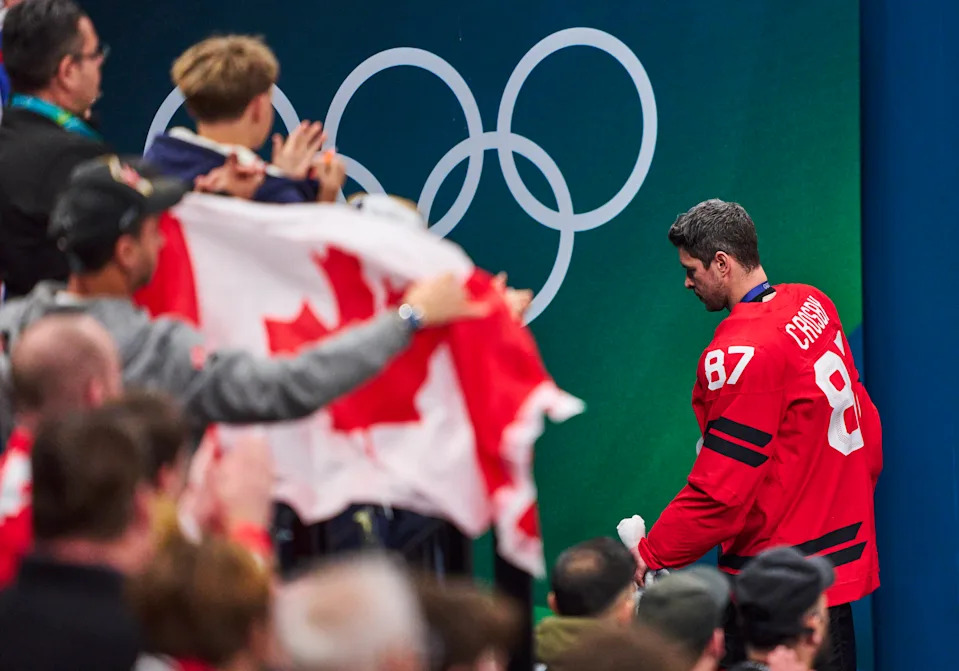
Sidney Crosby of Canada left the ice with Silver Medal disappointed after the Men`s Ice Hockey final match between USA and Canada on day sixteen at Milano Santagiulia Ice Hockey Arena on February 22, 2026 in Milan, Italy. (Photo by EyesWideOpen/Getty Images)
(EyesWideOpen via Getty Images)
Now, it’s easy to say this could have been a different outcome if Sidney Crosby was healthy to play.
There was still enough in the performance to give Canada a strong chance to win. If there was one area Canada felt his absence most deeply, though, it was in some crucial face-offs and powerplays where he was missed.
Nick Suzuki was the man stepping into Crosby’s role in his absence alongside Marner and Mark Stone, and he lost six of his seven face-offs. Crosby, of course, is the NHL’s all-time leader in face-off wins.
You throw in the effectiveness of Canada’s regular captain on powerplays and that’s where every extra-man opportunity squandered — especially the 5-on-3 — hurts even more.
Too aggressive in overtime?
There have been some who have criticized Canada being overzealous in the overtime period.
While there are certainly more questioning the validity of 3-on-3 hockey to decide a gold medal game, Canada looked extremely exposed on the eventual Jack Hughes winner.
Not for the first time in the period, McDavid looked to decide the game and take it all the way by himself but was stick-checked by Hellebuyck and that’s when it all fell apart.
McDavid was quickly behind the play as Werenski looked to play the puck ahead to Hughes. Everyone will talk about the goal for a very long time, and rightfully so, but as Cale Makar looked to steal a pass that looked short, Hughes made a huge poke just ahead of Makar and that’s when the U.S. was off to the races with what was, for all intents and purposes, a 3-on-1.
Werenski was able to chase and fend off MacKinnon, before teeing up Hughes for the gold medal winner as both Makar and McDavid lagged behind.
Could McDavid have ensured Canada were in a better place positionally when he attacked? Could Makar have been a bit more circumspect in going for the loose puck?
It doesn’t matter now. Ifs and buts won’t change the outcome.