
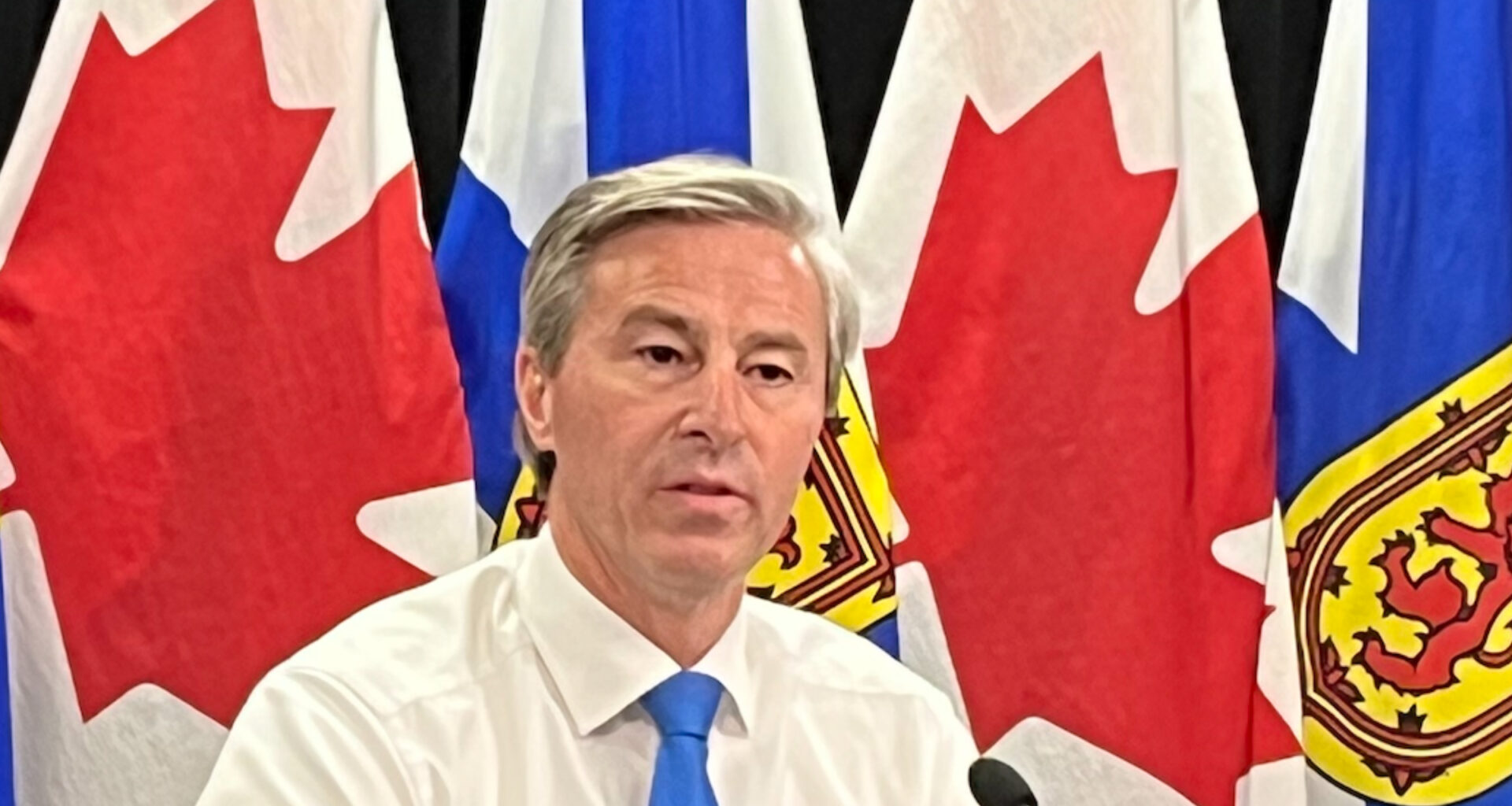
The provincial budget was released yesterday.
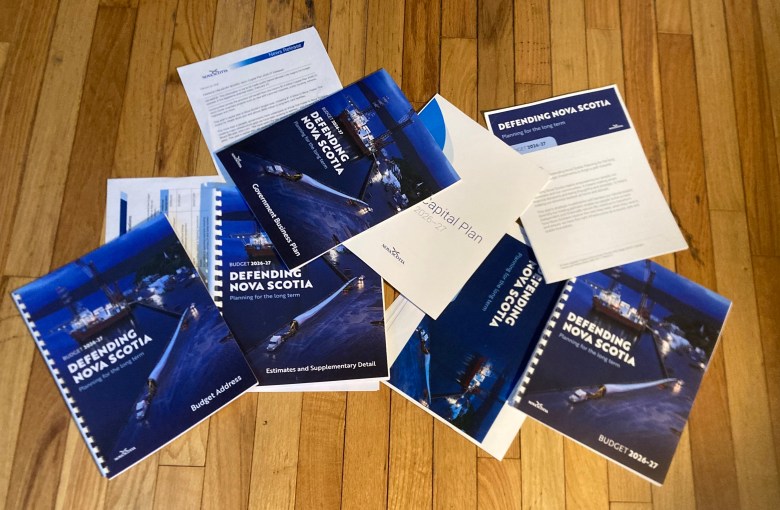 Provincial budget documents on the floor of my home office. Credit: Tim Bousquet
As we do every year, Jennifer Henderson and I arrived at One Government Place in the morning and were “locked up” behind closed doors and legally binding signed confidentiality agreements to review a four inch thick stack of embargoed budget documents, attend a not-for-attribution technical briefing with Finance Department staff, and hear Finance Minister John Lohr’s press conference about the budget.
Somewhere in there we actually had to write an article. Then, when Lohr spoke at the legislature in the late afternoon, we could publish an article about it all.
I’m glad Henderson joins me for these annual events. She has the experience and background knowledge, and most important, temperament, that I lack for budget reporting, and her mere presence keeps me more or less on track. She kindly nudges me in the right directions, floods me with information I would’ve never found by myself, and otherwise makes it possible for us to get the job done.
The result yesterday was our report, “Tim Houston’s austerity budget envisions huge deficits, staff cuts, and a billion dollars in additional cuts by 2030.”
It’s important that we get our reporting on the budget out quickly and coherently. While it’s impossible to report every nuance found in thousands of budget line items, I think we did a pretty good job at the top level of analysis.
The short of it is that while government spending is increasing by 7.7% there are cuts of over $300 million. The budget has a $1.249 billion deficit for this year, and the government has given up any hope of much restraining that deficit for the foreseeable future.
As a result, the aim is to reduce the provincial work force each and every year for the next four years by 5%, and to increasingly scale back spending each year, to the tune of nearly a billion dollars in the fourth budget year out, 2029/30.
Henderson, once again doing the hard work of reporting, somehow got still another article about the budget written this morning, “Opposition politicians frustrated by N.S. budget.”
When I step back and look at this, I see the budget as an ideological project.
That’s always true to some degree. Governments left, right, and centre each have different priorities, focus on different elements of governing, and have better and worse attitudes about employee compensation and debt burdens.
But the ideological project expressed by the Houston government with the current budget is of a different order entirely. It is a stark bid to remake the economic order and restructure society. It is, in a word, radical.
Let’s start this analysis with a conversation about the provincial debt. Debt is a necessary part of any budgeting process. Capital projects should be amortized over their useful years, smart governments can game fluctuating interest rates to best leverage financial markets, and the world is full of surprises and unexpected emergencies that require borrowing money to address (no one could have predicted COVID or the chaos of the Trump trade policies, for example).
The mere existence of debt is not a problem. It’s the size of the debt relative to the government’s ability to pay it down that matters. When debt financing costs get too large, it impedes the ability of government to do other useful things with the money.
And that’s what the Houston government has done, exactly: it purposefully has created a debt crisis in order to cut government.
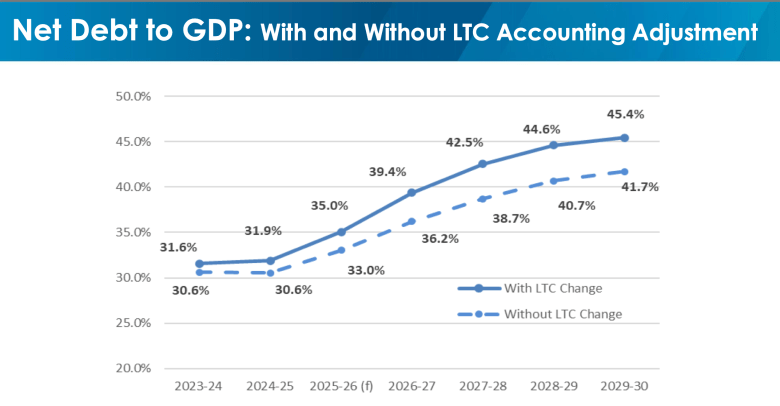 Credit: Province of Nova Scotia
The metric we use to measure the debt burden is the net debt-to-GDP ratio. I’m so old that I remember when the Nova Scotia government said it would keep that ratio under 30%. Just last year the Houston government said it would keep the ratio under 40%. With the current budget, that capped target is thrown out the window, as the ratio this year (39.4%) butts up against it, and next year increases to 42.5%, increasing still more to 45.4% in 2029/30.
The Houston government’s argument is: Debt is soaring, so we have to take drastic measures. On the spending side, we have to cut government. We have to cut the workforce by 5% a year. We have to slash grants to community groups and the like.
But — and here’s the kicker — we can perhaps limit those cuts and lessen the impacts if we increase revenues. And how will we increase revenues? Basically by mining ourselves into prosperity. The Houston government is fast-tracking approvals for gold mines, opening up the ability for oil companies to frack, and subsidizing the exploration of the offshore, while cutting regulatory oversight to speed the mining of trees.
We are presented this Sophie’s Choice — either turn the land and water of the province over to exploiters who will despoil the environment for generations (and even forever) or face crippling poverty as government services are cut — as the grim reality, simply the cold truth of the universe.
It’s not.
We need to understand this deeply: the debt crisis is entirely the creation of the Houston government. Tim Houston engineered this Sophie’s Choice for the ideological project of making the rich richer, the poor poorer, and working people more uncertain and thus less likely to object to deep political restructuring.
This year’s budget deficit would not exist at all were it not for three things: Houston’s irresponsible off-budget spending in surplus years, the massive tax cuts of recent years, and the removal of bridge tolls.
I’ve been thinking about the offshore lately, and specifically about how in 2005, then PC premier John Hamm used the entire royalty payment from the offshore — $830 million — to pay down the provincial debt.
I didn’t agree entirely with that. I think at least part of windfall revenues should be used for immediate needs. If I ever win the lottery, I’ll put the bulk of it in investments, but I’ll certainly also replace those old tires on the car and fix the broken sink in the basement. Likewise, I think Hamm could’ve used, I don’t know, half the royalties to pay down the debt and the other half to take some kids out of poverty.
Still: agree with him or not, Hamm’s decision to pay down the debt was and is entirely defensible. Disagreements about that decision are about political priorities, not ideology.
Compare that to Houston’s response when his government got some entirely unexpected surpluses — over $6 billion since he took office. (The windfalls truly defied all economic forecasting, reflecting the topsy turvy economy in the wake of COVID.) Unlike all other provinces, Nova Scotia allows the government to simply spend those surpluses outside of the normal budgeting process — that is, without debate in or approval of the legislature.
This off-book spending was so bad that the auditor general specifically called Houston out on it. But that didn’t change Houston’s spending habits.
It really didn’t matter where Houston spent the money — some of the expenditures were worthy, some not — because the point was specifically to not use any of it to pay down the debt. Using windfall revenues to pay down the debt would have avoided the crisis Sophie’s Choice moment.
Then, that money out the door, Houston brought in the tax cuts and the loss of revenue by removing bridge tolls, and here we are.
Budget discussions are necessarily discussions of values, and of morality.
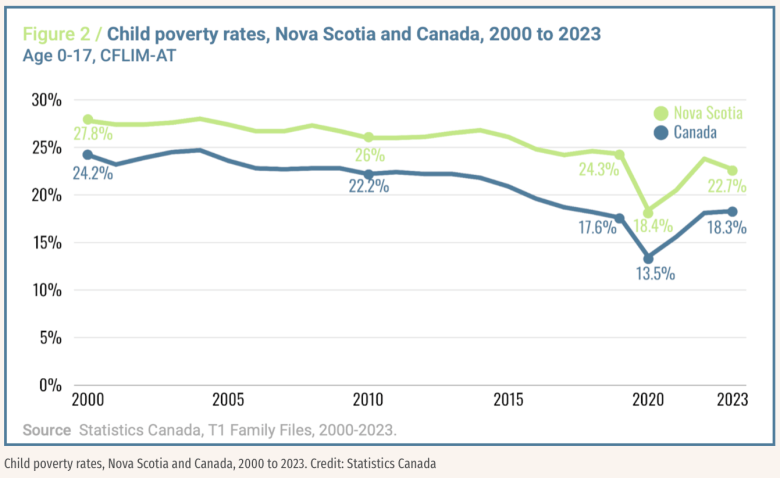
I was struck by this when I read Yvette d’Entremont’s recent article on child poverty in Nova Scotia. The article contains this graph:
As I commented on Bluesky:
Note drop in child poverty of about 25% in 2020. This was the result of COVID lockdown response policies, mostly at the federal level. A couple of thoughts…
1. In a moment of crisis, there was an enormous public expenditure that resulted in demonstrable good beyond the immediate need. It did not bankrupt us. Rather, it made the country better and improved lives. There’s no reason at all such policies can’t be implemented now.
2. Countries had better and worse COVID economic policies. There were certainly faults with Trudeau’s policies, and unequal implementation. I criticized some of those problems myself. But on balance, Canada did very well and Trudeau doesn’t get the credit he deserves for his COVID response.
As reader Pam pointed out, the COVID stimulus cheques were a proof of concept for Universal Basic Income (UBI). Numerous pilot UBI projects have demonstrated that if people have a basic level of income and the certainty and predictability that comes with it, they become both healthier people and more active citizens. People spend their money wisely, improve the health of their children, and better position themselves to contribute to their future personal financial health (by going to school, starting businesses, etc.) and ultimately pay more in taxes. Making sure people don’t fall into dire poverty benefits all of us.
But this necessarily requires a degree of progressive taxation that the wealthiest refuse to accept.
As reader John Muller commented, “I continue to believe that, amid COVID, we came tantalizingly close to basically fixing society, and entrenched power got so spooked by that prospect they had to astroturf a giant anti-science movement to try and eradicate the entire concepts of public health and social welfare.”
Or, as Jan Brown put it more succinctly, “the elites quickly realized they needed to act fast to force things back to ‘normal’ (and worse) before the public fully understood what was possible and began demanding better.”
I see Houston’s austerity budget through this lens: He wants to kill any notion that government can be a force for good in addressing the vast disparities of wealth and opportunity in our society by cutting that argument off at the knees: it’s either poverty forever or we give up all our interests to the corporate elite. No other vision is possible.
What he doesn’t say is that even if we choose the latter, we’ll have even less power over our own future, and be poorer still.
(To send or post this item, copy the website address at the top of this page.)
NOTICED
Who fire laws apply to, and who they don’t apply to
Apply to:
 The Sanctuary Arts Centre in downtown Dartmouth on Oct. 14, 2025. Credit: Tim Bousquet
Don’t apply to:
 The Kevel at King’s Wharf in February 2026. The base, still under construction, is for commercial leases. The tower above is already being occupied by residents. Credit: Jennifer Henderson
Two buildings in downtown Dartmouth, just five blocks away from each other, provide a stark example of how the fire inspection regime is applied differently depending on the wealth and political influence of the property owner.
On the one hand is the Sanctuary Arts Centre, which occupies the former First Baptist Church at the corner of Ochterloney Street and Victoria Road.
Sanctuary is operated by the nonprofit group Halifax Art and Performance Association, founded by Ivano Andriani and his family for the purpose of operating the performance space. Andriani is a successful business person and owns a handful of properties, but I wouldn’t describe him as filthy rich. He’s just a guy trying to do something cool with the old church.
But Sanctuary came under the radar of the Fire Marshal’s Office (FMO) when the arts group expanded its basement bar operation. The FMO is demanding that the entire building be retrofit with sprinklers, a venture so costly as to be unaffordable, and as a result Sanctuary faces possible insolvency and closure because of a very strict interpretation of the fire code.
Andriani has appealed the fire order to the Regulatory and Appeals Board, which held a hearing last month. A decision is expected in coming months.
On the other hand is The Kevel, one of the soulless residential towers going up in King’s Wharf. King’s Wharf is a project of Francis Fares, who I very much will describe as filthy rich, and politically connected besides.
 The bust of Gloria McCluskey is displayed in the sales office at the King’s Wharf development. Photo: Halifax Examiner
Recall that Fares was so beloved of former Dartmouth Mayor and HRM councillor Gloria McCluskey, and vice-versa, that Fares installed a bust of McCluskey in the King’s Wharf sales office. McCluskey retired years ago, but Fares wielded considerable political mojo both before and since. Unlike those mere workaday millionaires who own property along the Northwest Arm, Fares had no problem infilling the water lots at King’s Wharf, and he was magically able to flip the approved development pattern of the buildings with no argument from City Hall.
Now, as Jennifer Henderson reported yesterday, Fares is simply ignoring the legal requirement to obtain an occupancy permit before renting out the units in The Kevel, the newest building in King’s Wharf.
The development agreement with HRM that Fares signed requires that before any additional units in the development can be issued an occupancy permit, Fares must build a second access into King’s Wharf that can’t be blocked by trains on the adjoining railroad tracks. Practically speaking, that means building a bridge over the tracks.
But Fares doesn’t want to build a bridge, so screw the municipality and its development agreement. He’s renting out The Kevel without an occupancy permit. What are you going to do about it?
Well, given the lack of an occupancy permit, the municipality has the power to issue an “Order To Vacate” notice and fine Fares up to $10,000 a day for non-compliance, reports Henderson, but no one at City Hall or in the Fire Marshal’s Office or anywhere else seems to give a damn.
I guess the laws apply to some people, but not to other people.
Depends on who you are.
(Send this item: right click and copy this link)
Government
City
Tuesday
Budget Committee and Regional Council (Tuesday, 9:30am, hybrid) — agenda, agenda
Wednesday
Audit and Finance Standing Committee (Wednesday, 10am, hybrid) — agenda
Heritage Advisory Committee (Wednesday, 3pm, virtual) — agenda
Regional Centre Community Council (Wednesday, 6pm, hybrid) — agenda
Province
Legislature sits (Tuesday, 1pm, Province House) — watch here
On campus
Dalhousie
Tuesday
No events
Wednesday
Mini Medical School (Wednesday, 7pm, virtual) — Maria Migas and Shawna O’Hearn present “More Than Hot Flashes: The Many Faces of Menopause”
King’s
Tuesday
No events
Wednesday
Sex Ed 101: Understanding bodies, arousal and sexual health (Wednesday, 4pm, virtual) — webinar with Miriam Bonello MacQuarrie
Mount Saint Vincent
Tuesday
No events
Wednesday
Hannah Epstein: Plato’s Goon Cave (Wednesday to Sunday, 12pm, MSVU Art Gallery) — details
Saint Mary’s
Tuesday
Black-Owned Vendors Market (Tuesday, 12pm, details) — celebrating African Heritage Month
History, Truth-Telling, Reconciliation and Artistic Practice: A Conversation with Catherine Martin(Tuesday, 4pm, details)
Wednesday
SMU Research Spotlight Series (Wednesday, 12pm, details) — presentation by Somayeh Kafaie, Mathematics & Computer Science
Literary Events
Tuesday
No events
Wednesday
February MFA Author Talk (Wednesday, 7pm, Halifax Public Library) — Chris Moore will read from The Power of Guilt: Why We Feel It and Its Surprising Ability to Heal (read Yvette d’Entremont’s interview here)
Shelf Indulgence Book Club (Wednesday, 6:30pm, virtual) — Carol Moreira and Linda Hudson will discuss Elaine McCluskey’s The Gift Child
In the harbour
Halifax
15:00: Federal Hunter, bulker, sails from Pier 9 for sea
18:00: MSC Nahara, container ship, sails from Pier 42 for sea
10:00: CMA CGM Brazil, container ship, sails from Pier 41 for sea
Cape Breton
19:00: Triumph, heavy lifter, sails from Inhabitants Bay anchorage for sea
Footnotes
I shovelled around 7pm last night, but looks like I gotta go do it again.