
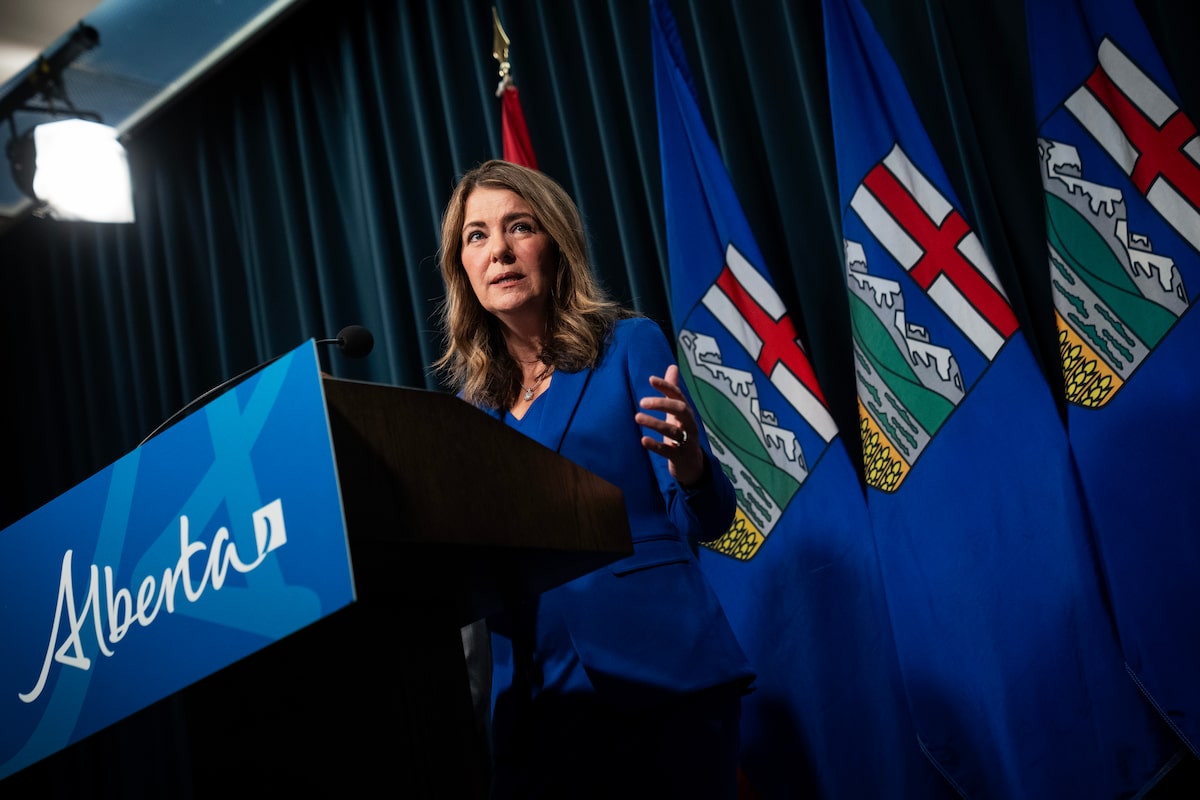
Alberta Premier Danielle Smith said the province will hold a referendum on Oct. 19, with a focus on immigration policies and constitutional questions.Todd Korol/The Canadian Press
The Alberta government is advancing its rollout of a provincial police service, with an eye toward training roughly 600 sheriffs so they can serve as full officers and to prepare for the possibility that it could replace the RCMP.
The United Conservative Party marked a return to the legislature Tuesday by introducing a bill that would transform the Alberta Sheriffs Branch into the Alberta Sheriffs Police Service. Further, it would give sheriffs a pathway to train for full police officer roles.
Premier Danielle Smith’s government is pursuing a handful of policies designed to beef up the province’s power while reducing its ties to Ottawa. Her government also intends to propose legislation that would license international recruiters as Alberta seeks more control over the flow of immigrants into the province, for example. During the legislative session, Alberta will also table provincial restrictions on medically assisted deaths, expanding on the federal government’s rules.
Smith’s bid for more immigration powers boosts negotiating power with Ottawa, experts say
Ms. Smith has pursued policies to create a homegrown police service that could replace the RCMP should the province opt not to renew its contract with the Mounties in 2032. Until then, Alberta argues that training sheriffs as officers is a way to bolster existing police services.
“This government will do whatever it takes to put boots on the ground to keep communities safe,” Mike Ellis, Minister of Public Safety and Emergency Services, told reporters before he tabled the bill facilitating the changes at the Sheriffs Branch.
“This is a major milestone in building the new service,” he said.
Roughly half of Alberta’s 1,200 sheriffs already perform police-like functions, such as highway patrol teams, surveillance teams and fugitive apprehension teams, Mr. Ellis said. He expects these employees would need about six weeks of training to qualify as full police officers.
“This is the fastest path to get at least 600 or so police officers on the streets of Alberta, trying to assist all police of jurisdiction in calls of service,” Mr. Ellis said.
He declined to provide information on how much the transition will cost, noting the provincial budget will be released Thursday.
Alberta Premier defends fall referendum plans
Mr. Ellis said Alberta is still evaluating its options regarding the RCMP, noting Ottawa has not made any commitments on future funding models.
“We are fully committed to augmenting and supporting all police services,” he said. “Once we transition many of these folks into becoming police officers … those police officers will be able to act without having their hands held by the local police of jurisdiction.”
The RCMP did not immediately respond to a request for comment.
Brian Sauvé, chief executive of the National Police Federation, which represents 20,000 Mounties across Canada, said the UCP’s pursuit of a provincial police service defies the wishes of residents and municipalities. He pointed to Ms. Smith’s Alberta Next panel, which toured the province listening to concerns. The government released summaries of three polls conducted as part of the process, with support for establishing a provincial police force with plans to take over from the RCMP peaking at 48 per cent.
The government is expected to unveil a significant deficit when it introduces its budget. Oil and gas prices are trading far below expectations, putting a sizable dent in revenue from the resources on which Alberta depends. Joseph Schow, the Government House Leader, said the province’s financial woes will not prevent it from providing key services such as health care.
“Budgets are always tough, especially when you have depressed oil prices. But doesn’t mean that we can’t walk and chew gum at the same time,” he told reporters Tuesday.
The government, he said, will introduce plans for medically assisted deaths designed to protect vulnerable citizens.
The proposed legislation would prohibit medical assistance in dying for mature minors, people with mental illness as their sole condition, individuals making advance requests and adults without health care decision-making capacity, Mr. Schow said.
The province will also “increase oversight and regulate health care workers involved in referring, assessing or performing medical assistance in dying.”
Federal rules restrict access to the procedure to people older than 18 who can make competent decisions and give informed consent. Ottawa forbids those suffering from only mental illness from being eligible, and has placed a moratorium on those cases until at least 2027.
Alberta to increase doctor spending by 22 per cent in upcoming budget
The House Leader doubles as Alberta’s Minister of Jobs, Economy, Trade and Immigration. He said his plans for the session include introducing legislation to “give greater control to the province over immigration and protect newcomers from bad actors in the immigration system.”
The proposed legislation would license international recruiters and increase oversight for employers who recruit and hire foreign workers.
“It has become clear the federal government has lost control over immigration,” Mr. Schow said, hitting on a theme Ms. Smith emphasized last week, when she tried to prepare residents for a tough budget while also appealing to Albertans who believe some new immigrants should not have access to the province’s social services, including health and education.
Ms. Smith said Alberta would hold a referendum on Oct. 19, with a focus on immigration policies and constitutional questions. She argued that Alberta’s population explosion, fuelled by the federal government’s immigration policies, was a drag on the province’s budget.
The questions do not stipulate which categories of immigrants would be targeted by restrictions, but Ms. Smith’s statements to reporters indicated non-permanent residents, such as foreign workers and students, would be at the top of the list.